Overview
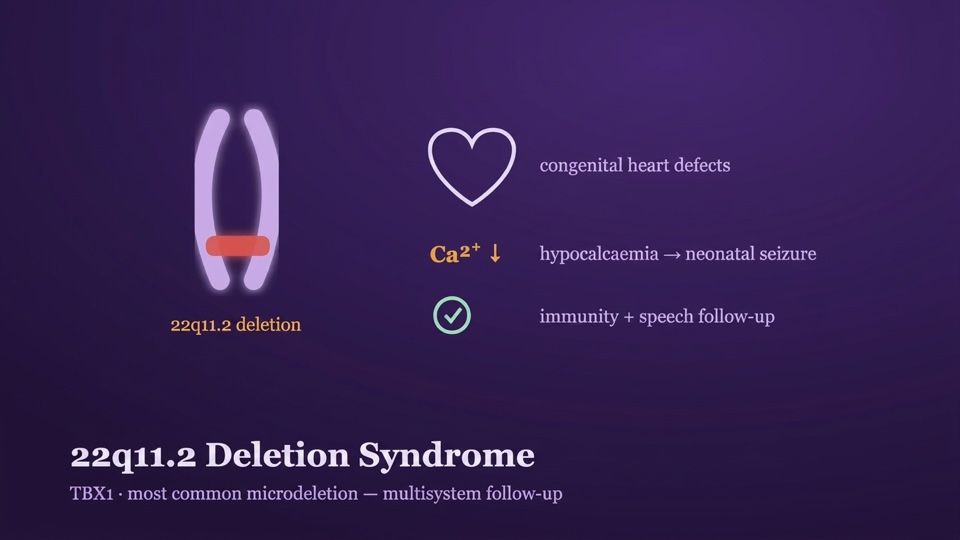
22q11.2 deletion syndrome (~1/4,000) is the most common microdeletion in humans and a "single diagnosis, many specialties" condition: the heart, calcium, immunity, palate-speech, learning and mental health all come together in the same patient file. A well-established follow-up schedule turns scattered problems into a manageable plan.
Genetic Cause
Deletion of ~40 genes, including TBX1, on chromosome 22. ~90% of cases are de novo; in close to 10% a parent is also a carrier (most are mildly affected and undiagnosed) → parental testing is essential; a carrier parent's risk of passing it to a subsequent child is 50%. Diagnosis is made by microarray/MLPA; it can also be picked up on NIPT screening.
Clinical Features — What Stands Out by Age
Newborn-infancy
- Conotruncal heart defects (Tetralogy of Fallot, truncus arteriosus, interrupted arch) — echo at diagnosis
- Hypocalcaemia: jitteriness, tetany or a correctable cause of seizures; parathyroid reserve is low and can drop again during periods of stress (surgery, illness, puberty, pregnancy)
- Feeding difficulty, nasal regurgitation (palatal dysfunction), small thymus
Preschool-school age
- Speech: delay plus hypernasal speech (velopharyngeal insufficiency) — assessment by the palate team; surgery to correct speech if needed
- Frequent infections (variable T-cell deficiency); learning profile: strong verbal skills, weak abstract/mathematical skills; ADHD and anxiety are common
Adolescence-adulthood
- Mental health: anxiety-mood problems are common; the risk of psychosis is markedly increased (rates of up to roughly one in four have been reported). This is not inevitable but a reason for early screening: annual mental health assessment from adolescence onwards and educating the family about early signs (withdrawal, disturbed sleep, suspicious thoughts)
- Recurrence of hypocalcaemia, thyroid problems, scoliosis; calcium and genetic planning in pregnancy for women
Follow-up Schedule (summary)
- At diagnosis: echo plus cardiology, calcium-PTH, thyroid, renal ultrasound, immune assessment (lymphocyte subsets; live vaccines only with immunology approval), hearing, palate-feeding assessment, parental testing
- Annually: calcium plus thyroid, growth, hearing (recurrent otitis), dental, spine; update of the developmental-school plan; mental health screening from adolescence onwards
- Calcium monitoring during surgery/illness; regular cardiology follow-up after cardiac repair
Treatment
- Surgical repair of heart defects (outcomes close to those of patients without the syndrome)
- Calcium plus active vitamin D for hypocalcaemia; the goal is absence of symptoms and a safe range
- Speech therapy starts early; timing of surgery for velopharyngeal insufficiency is a team decision
- In rare "complete" cases with severe T-cell deficiency, thymus tissue transplantation is performed at specialist centres
- Standard treatments are effective for ADHD-anxiety; early collaboration with psychiatry for psychotic symptoms markedly improves outcome
Prognosis — An Honest Framework
- The course in the early years is determined by the severity of heart disease; childhood is generally stable after repair
- Cognitive level is mostly in the borderline-mild impairment range; many individuals complete school with support, work and start families
- The main concern in adulthood is mental health and endocrine follow-up; psychosis caught early is managed well — an adult lost to follow-up is the highest-risk scenario
- Life expectancy is slightly reduced, but the follow-up regimen is what matters most
Research Horizon
- Large international 22q cohorts are investigating markers that predict psychosis risk in advance and protective interventions — adolescent follow-up is becoming more targeted each year as a result
Daily Life
- A one-page "22q card": heart status, latest calcium result, vaccination-immune notes, emergency warnings
- Teach the family the symptoms of hypocalcaemia (numbness, cramps, tingling) to watch for during illness/surgery
- School accommodations for speech intelligibility; visual-concrete support for mathematics
- Transition education with adolescence so the young person learns to manage their own health