The first human gene therapy trial in FOXG1 syndrome continues to enrol patients. The trial sponsor, the FOXG1 Research Foundation, announced that following the first site opened in July 2026, the second site has now been activated and the safety review committee has approved continued enrolment. In the public registry (ClinicalTrials.gov NCT07293546), two sites are listed today: Texas Children's Hospital (Baylor College of Medicine, Houston) and UCSF Benioff Children's Hospital Oakland (California).
What kind of treatment is FRF-001?
FRF-001 is a gene therapy delivered with an AAV-9 vector, administered via intracerebroventricular (ICV) injection, that is, as a single surgical procedure into a ventricle within the brain. The aim is to replace the FOXG1 function that is missing in FOXG1 syndrome.
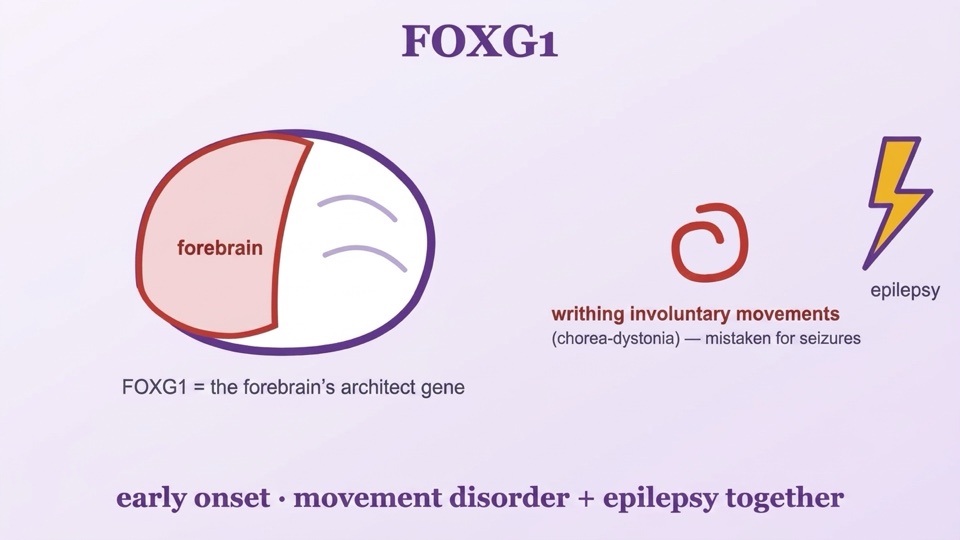
FOXG1 syndrome arises from loss of function of the gene; by contrast, an extra copy (duplication) of the FOXG1 region produces a different clinical picture. This dose sensitivity is directly reflected in the design of the trial: children with FOXG1 duplication and children whose deletion extends beyond the FOXG1 coding region are not enrolled in the trial.
Trial framework
- Design: open-label, first-in-human phase 1/2 trial (no comparison group).
- Number of patients: 12 participants. Age range 2-20 years, girls and boys.
- Timeline: the trial started on 20 July 2026; collection of primary endpoint data is planned to be completed in July 2029.
- What is being measured: the primary endpoints are (1) safety and tolerability up to week 104 — the frequency, severity and causality assessment of treatment-emergent adverse events; (2) motor milestone gains at weeks 52 and 104, measured with the Peabody Developmental Motor Scales, 3rd edition (PDMS-3).
- Status: the registry shows it as "enrolling by invitation". That is, there is no open application list; participants are assessed upon invitation by the study team.
Who can be assessed?
The main conditions stated in the registry are as follows:
- A pathogenic or likely pathogenic FOXG1 variant identified by testing performed at an accredited laboratory (whole exome/genome sequencing, gene panel, single gene testing or microarray), together with a clinical picture consistent with FOXG1 syndrome in the investigator's assessment.
- The family must be enrolled in the FRF Citizen natural history study at the time consent is signed. This is a written prerequisite of the trial.
- Being able to comply with the study schedule and all assessments.
Exclusion criteria include FOXG1 duplication and deletions extending beyond the coding region, another genetic diagnosis or coexisting illness that could confound the clinical picture, prior receipt of gene/cell therapy, a condition precluding MRI and lumbar puncture, inability to safely receive prophylactic corticosteroids, and inability to safely tolerate the sedation/general anaesthesia required for the procedures.
Can families from Türkiye take part?
Not today. Both sites listed in the registry are in the USA; no site has been opened in Türkiye or in Europe. In its 2025 activity report, the foundation lists among its 2026 goals engaging with regulatory bodies outside the USA to take the trial to an international level; which countries will be added and when has not been disclosed. The foundation also states clearly on its own page that the number of sites will not meet the number of interested families and that participation cannot be guaranteed. No fee is paid for participation in the trial; there is no such thing as "buying a place".
What families can do today
- Clarify the genetic report. The type of variant (point mutation/deletion/ duplication), the boundaries of the deletion and the laboratory's classification (pathogenic, likely pathogenic, VUS) are the information that will be asked first in any future trial.
- Join natural history registries. FRF Citizen registration is a prerequisite for this trial; patient registries also shape the design of future trials.
- Do not postpone today's care. Prompt standard treatment for infantile spasms, video documentation of movement disorders, management of feeding and sleep, and gaze-based communication work are the areas that change the clinical picture now.
For the diagnosis, emergency and follow-up topics of FOXG1 syndrome, see the FOXG1 Syndrome Guide; for the pathway from symptomatic care to candidacy for FRF-001, see the FOXG1 treatment pipeline; for a page explaining the stages of gene-targeted therapies and how long each stage takes, see Genetic Therapies — Basic Concepts.
Note for families
This announcement is a development at the research stage; it is not a clinical practice recommendation. The primary task of phase 1/2 trials is to measure safety; the results from a 12-patient trial with no comparison group are not, on their own, sufficient to prove efficacy. Treatment decisions should always be made together with the physician following your child. Our association will continue to follow trials in FOXG1 syndrome and share them with families.
Sources: ClinicalTrials.gov NCT07293546 — "An Open-Label First-in-Human Phase 1/2 Study to Evaluate the Safety, Tolerability, and Efficacy of FRF-001, an AAV-9 Gene Therapy Administered by Intracerebroventricular Injection in Participants With FOXG1 Syndrome" (accessed 24 October 2026) · FOXG1 Research Foundation, FRF-001 study page and 2025 activity report (foxg1genetherapy.org, 20 January 2026) · the activation of the second site and the safety review committee's approval for continued enrolment are based on the foundation's own announcement; the registry's site list shows two sites.