
Overview
KBG syndrome is an autosomal dominant neurodevelopmental condition caused by changes in the ANKRD11 gene. Its name comes from the initials of the surnames of the first three families described. It should come to mind when three findings occur together: macrodontia of the upper central incisors (unusually large front teeth), distinctive facial features, and developmental delay. Short stature, skeletal-spinal findings, recurrent otitis media, and epilepsy in a subset of patients may accompany the picture.
Diagnosis is often delayed because none of the individual findings stands out on its own. Macrodontia is not visible until the permanent teeth erupt — that is, before 6-7 years of age. For this reason, in a young child, diagnosis is considered on the basis of facial features and developmental profile.
Genetic Cause
- Single-copy loss or loss of function in the ANKRD11 (16q24.3) gene. Autosomal dominant; in some children the change arises anew (de novo), while in others it is inherited from a parent — for this reason, parental testing is requested.
- The majority of changes are frameshift variants; reported in 60.1% of the reported series.
c.1903_1907delis a recurrent variant. - Besides changes in the gene itself, 16q24.3 microdeletion can also cause the same picture. If sequencing comes back normal, this possibility should be investigated separately.
- Prenatal growth restriction, polyhydramnios, preterm birth, and increased nuchal thickness have been reported; when these findings occur together, ANKRD11 and 16q24.3 enter the differential diagnosis.
Signs That Suggest the Diagnosis
- Teeth: macrodontia of the upper central incisors — the most distinguishing finding.
- Face: triangular face, synophrys, long philtrum, anteverted nostrils, wide/prominent ears, low hairline.
- Growth: short stature, delayed bone age.
- Skeletal: spinal anomalies, shortening of the hand and finger bones.
- Development: learning difficulty or intellectual disability (mostly mild-moderate), speech delay; attention deficit-hyperactivity, autism spectrum features, and anxiety may accompany it.
- Ears: recurrent otitis media and associated conductive hearing loss. Sensorineural hearing loss has also been reported in some children.
- Less common: palatal anomalies, structural heart and kidney anomalies, undescended testis, feeding difficulty in infancy.
Epilepsy — a Profile Specific to ANKRD11
Not everyone carrying an ANKRD11 change has seizures; in those who do, the profile has been described as follows in a pooled series of 163 people:
- Age at onset median 4.0 years (interquartile range 1.5-8.0). That is, seizures begin later than in most neurodevelopmental syndromes; the absence of seizures in infancy does not rule out the diagnosis.
- Focal and generalised epilepsies occur at roughly equal frequency. Absence seizures occur in 22.8%.
- Brain MRI is abnormal in 45.9% of cases with available data.
- Course: 63.2% achieved seizure freedom, while 36.8% followed a drug-resistant course.
- In those carrying a missense change, onset was later, MRI was more often normal, and seizure control was better. This shows that the genetic report should be read not only for diagnosis but also for follow-up.
Emergencies and First Response
The following are topics that should be discussed with the family in advance, for which a written plan should be on hand, and which should be taken along when going to the emergency department.
- Prolonged seizures and status epilepticus. Since epilepsy follows a drug-resistant course in roughly one third of children, for every child with seizures, a home rescue medication (buccal/rectal), its dose, and the "how long before going to hospital" threshold should be written down. A seizure lasting more than five minutes is considered prolonged.
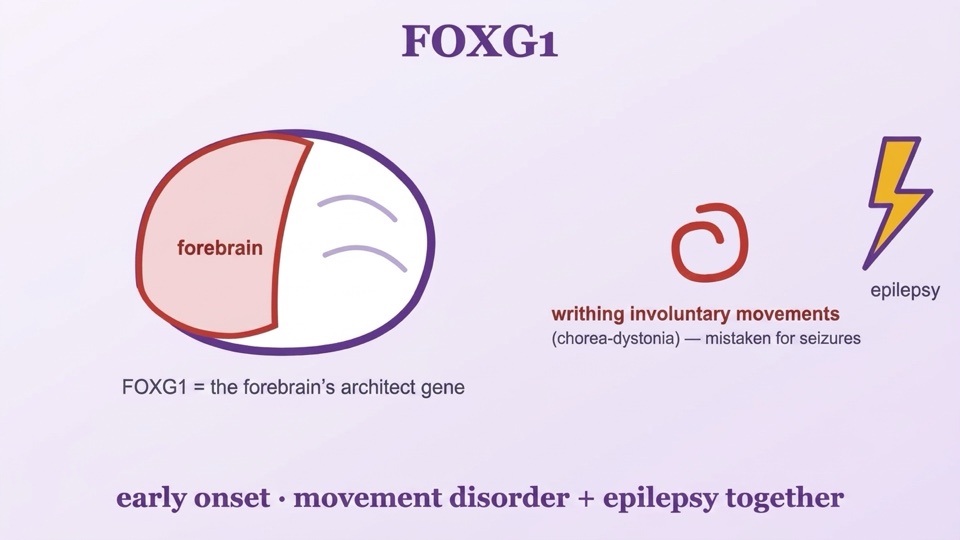
- Not every episode of stiffening is a seizure. Paroxysmal dystonia — attacks of flexor posturing and turning posture that may be one-sided, occurring in bouts — has been reported in KBG syndrome. Mistaking these attacks for seizures and giving repeated doses of benzodiazepines unnecessarily exposes the child to respiratory depression risk. Recording the attack on video speeds up the differential diagnosis; when in doubt, it should be treated as a seizure, but EEG confirmation should be requested for recurrent attacks.
- Hearing — a silent emergency. Recurrent otitis media and effusion are common in this syndrome. Untreated conductive hearing loss further delays speech that is already delayed. A "it will resolve on its own" approach is not appropriate here; ear, nose and throat assessment should not be postponed.
- Feeding and palate in infancy. An infant with suck-swallow difficulty and a palatal anomaly is at risk of aspiration. Feeds ending in coughing-cyanosis, failure to gain weight, and recurrent lung infection require assessment.
- Heart and kidney at the time of diagnosis. Since structural heart and kidney anomalies have been reported, echocardiography and renal ultrasound should be performed once at the time of diagnosis; this should not later be skipped on the assumption that "it has already been checked".
- Before surgery and anaesthesia. Because of spinal anomalies and palate-airway characteristics, before any planned procedure these should be recorded and up to date. These two points should be separately communicated to the anaesthesia team along with the diagnosis name.
Follow-up Schedule (summary)
- At diagnosis: echocardiography, renal ultrasound, hearing test, eye examination, spinal assessment, dentist, developmental assessment, parental genetic testing.
- Annually: growth (height-weight-percentile), hearing, spine (particularly for scoliosis during growth spurts), dental, review of the school-developmental plan.
- In those with seizures: EEG and drug level monitoring according to clinical course; seizure diary.
- As needed: behavioural and psychiatric assessment (attention deficit, anxiety, autism spectrum features), feeding follow-up.
Treatment
- There is currently no treatment that targets the gene itself. Follow-up and supportive treatments are the main tools that shape the course.
- Epilepsy: standard antiepileptic treatment according to seizure type. Given the frequency of absence seizures, correctly identifying the seizure type is important.
- Development: speech therapy, occupational therapy, physiotherapy, and an individualised education plan. Full benefit cannot be obtained from speech therapy unless the hearing problem is resolved; the two are carried out together.
- Dental: orthodontics for macrodontia and dental alignment problems; follow-up begins early.
- Short stature: an increase in height has been reported in a small group of patients given growth hormone, with no notable adverse effects observed. Data are limited to eight patients; the decision is made on a case-by-case basis with endocrinology assessment.
Prognosis — an Honest Framework
In KBG syndrome, cognitive involvement is mostly mild-moderate, and many children continue school with supported education. No progressive process shortening life expectancy has been described. Uncertainty is mainly concentrated in two areas: whether seizures will follow a drug-resistant course, and how far speech will develop. Both become clearer with follow-up; in both, early and ongoing support is the factor that makes the difference.
Daily Life
- Keep a card or phone note carrying the diagnosis name and current medication list; it is common to encounter a doctor in the emergency department who is not familiar with the syndrome.
- Record seizures or stiffening attacks on video whenever possible. Since there are attack types in this syndrome that can be mistaken for seizures, footage guides diagnosis faster than examination.
- Share the hearing status with the school; front-row seating and in-class adjustments are simple but effective steps.
- Do not neglect dental follow-up; macrodontia is manageable when monitored with a plan.
Printable Forms
The following two forms have been prepared to be filled in together with your doctor. Emergency Response Plan (3 pages): the child's information, regular medications and a rescue medication field, instructions for seizure/attack day; the second page is to be handed directly to the emergency department team — with a warning about paroxysmal dystonia being mistaken for seizures, the epilepsy profile, and an airway-spine note; the third page is an academic summary for physicians. Routine Follow-up Calendar (2 pages): a frequency-record chart with 13 headings, follow-up by age period, and what to ask at each check-up.
📄 Emergency Response Plan (PDF, 3 pages) — in Turkish 📅 Routine Follow-up Calendar (PDF, 2 pages) — in Turkish
References
- Su S, Ma J, Zhang Q, et al. Insights into ANKRD11-related epilepsy from 163 people. Epilepsia. 2026;67(9):4922-4938. doi:10.1002/epi.70351
- Wang SQ, Wu SN, Wei HY, et al. Clinical and genetic characteristics of and diagnostic insights on KBG syndrome in Chinese patients. Orphanet J Rare Dis. 2026. doi:10.1186/s13023-026-04305-6
- Dantam CR, Wilkes E, Summers HN, et al. Case report of paroxysmal dystonia in a child with KBG syndrome. Medicine (Baltimore). 2025;104(31):e43631. doi:10.1097/MD.0000000000043631
This text is for informational purposes; decisions about your child's diagnosis and treatment are made together with the treating doctor.