Overview
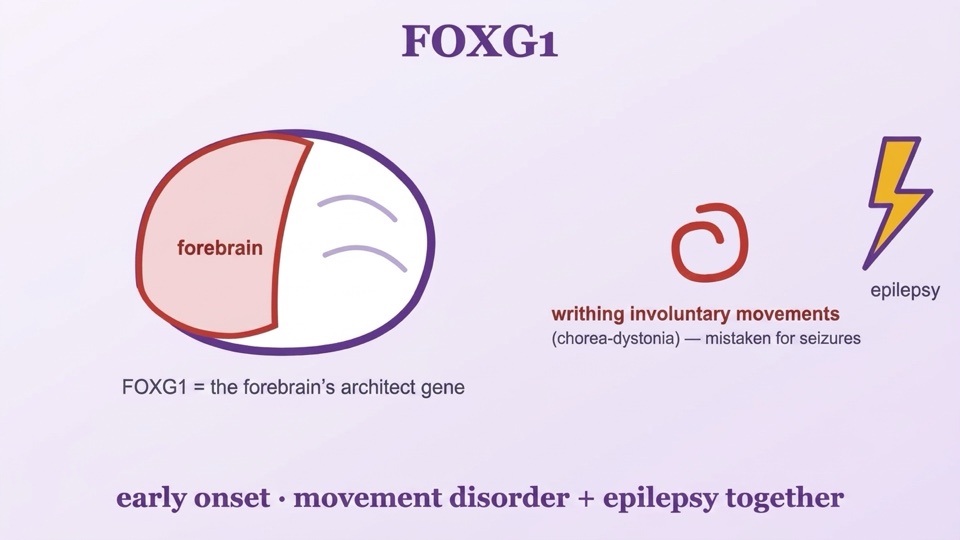
FOXG1 syndrome is a condition caused by deficiency of FOXG1, one of the architect genes of the forebrain (telencephalon), formerly called the "congenital variant of Rett syndrome" but now recognised under its own name. It differs from Rett in two key ways: findings begin from birth / in the first months (there is almost no normal period) and it affects both girls and boys. The core picture: postnatal progressive microcephaly, severe developmental involvement, prominent involuntary movements (chorea-dystonia) + hand stereotypies, hard-to-settle restlessness-crying in infancy, sleep and feeding problems, and epilepsy in most children. The most practical sentence in this guide: movement attacks and seizures are constantly confused with one another in this condition — video + EEG distinction is the compass of treatment.
Genetic Cause and Mechanism
- FOXG1 (14q12) is a transcription factor that governs forebrain development and the establishment of inhibitory circuits; variants are almost always de novo (sibling recurrence risk ~1%, with a share attributable to gonadal mosaicism). Both sequence variants and 14q12 deletions produce the same picture.
- Common MRI pattern: thinning of the corpus callosum, reduced frontal lobe volume / simplified gyration, delayed myelination — the imaging counterpart of its identity as the "forebrain gene".
- FOXG1 duplication (extra copy) is a separate condition — often presenting with infantile spasms, generally with a milder developmental course; it is important that the report does not confuse deletion/sequence variants with duplication. VUS results are reclassified every 1-2 years.
Clinical Picture
- First months: sucking-swallowing difficulty, reflux, hard-to-settle periods of crying, fragmented sleep, poor eye contact (may partially improve later), strabismus.
- Head circumference: often normal at birth but deviates from the curve in the first months (postnatal microcephaly).
- Movement: the hallmark of this syndrome — mixed chorea-dystonia involuntary movements (writhing, dance-like), hand-mouth stereotypies; purposeful hand use is very limited. Movements increase with excitement or discomfort.
- Epilepsy (~70-80%): may start early, including infantile spasms; mixed focal, tonic, and myoclonic types; drug-resistant in a portion of cases.
- Development: severely affected; sitting is delayed, independent walking is usually not achieved, verbal language generally does not develop — but regression is not typical; slow gains continue and communication (gaze, vocalisation, buttons) can be built.
Diagnosis
- Genetic: a neurodevelopmental/epilepsy panel or exome sequencing combined with deletion/duplication analysis (14q12 deletions should not be missed). Parental testing if positive.
- MRI once at diagnosis (callosal-frontal pattern); EEG without delay when spasms/attacks are suspected, and again with any clinical change.
- Differential diagnosis: Rett (MECP2 — different age of onset and normal period), CDKL5 (seizures earlier and more prominent), Angelman, CASK, GNAO1 (movement-disorder-predominant pictures) — in the panel era, molecular results clarify the distinction.
Treatment — An Honest Framework
- There is currently no disease-modifying treatment specific to FOXG1; good symptomatic care genuinely changes the course.
- Epilepsy: standard protocols for infantile spasms (hormonal treatment and/or vigabatrin) without delay; for other seizure types, drug choice depends on the type — there is no specific "drug to avoid" rule for this gene.
- Movement disorder: when it disrupts daily life, medication trials are carried out with a centre experienced in movement disorders; seizure medication changes can affect movements, and movement medications can affect alertness, so the single-variable rule (changing only one medication at a time) is invaluable here.
- Infantile restlessness: first a search for causes (reflux, constipation, teething, muscle spasm, sleep apnoea); then regulation strategies — the "fussy baby" label can conceal treatable causes.
- Feeding-sleep package: swallowing assessment, reflux management, gastrostomy if necessary; sleep hygiene ± melatonin on the physician's decision.
- Development package: physiotherapy (posture-sitting), occupational therapy, including gaze-based AAC early communication work; vision assessment (strabismus/CVI).
- Research horizon: a gene therapy aiming to replace FOXG1 function entered its first-in-human phase 1/2 study in July 2026 (FRF-001 — see the section below). It is at the research stage and is not a recommendation for clinical use. Enrolment in the natural history registry is a written prerequisite for this study.
Treatment Pipeline — The FRF-001 Gene Therapy Study
October 2026: the study is enrolling patients at two centres
The first human study targeting the gene in FOXG1 syndrome began on 20 July 2026. FRF-001 is an AAV-9 vector-based gene therapy run by the FOXG1 Research Foundation, administered once via intracerebroventricular (ICV) injection. The study has an open-label phase 1/2 design; there is no comparison group. 12 participants are planned, with an age range of 2–20 years. The primary endpoints are safety and tolerability up to week 104 and motor milestone attainment measured by PDMS-3 at weeks 52 and 104; data completion is planned for July 2029 (ClinicalTrials.gov NCT07293546).
The first centre, Texas Children's Hospital (Baylor College of Medicine, Houston), opened in July 2026, and the first patient was announced to have received treatment in September 2026. In October 2026, the foundation reported that a second centre had been activated and that the safety review committee had approved continued enrolment; the registry lists the second centre as UCSF Benioff Children's Hospital Oakland. The status on the registry is "enrolling by invitation" — there is no open application list.
Who is excluded — a critical distinction for this gene: FOXG1 syndrome arises from loss of function of the gene; an extra copy of the region causes a different condition. Because of this dosage sensitivity, children with FOXG1 duplication and those whose deletion extends beyond the coding region are not enrolled in the study. Other exclusion criteria include: another genetic diagnosis or comorbidity that could confound the picture, prior receipt of gene/cell therapy, a condition precluding MRI or lumbar puncture, inability to safely receive prophylactic corticosteroids, and inability to safely tolerate sedation/general anaesthesia.
Prerequisite: at the time consent is signed, the family must be enrolled in the FRF Citizen natural history study. The first information requested will be the type of variant in the genetic report (point mutation / deletion / duplication), the boundaries of the deletion, and the laboratory's classification.
Participation from Türkiye: not currently possible — both listed centres are in the USA. The foundation lists negotiating with regulatory bodies to extend the study outside the USA among its 2026 goals; no timeline has been announced. For details, see the FOXG1 gene therapy study announcement.
Framework: the primary task of phase 1/2 studies is to measure safety. A result from a 12-patient study with no comparison group cannot on its own prove efficacy. Today's care — prompt treatment of infantile spasms, video documentation of the movement disorder, the feeding-sleep package, gaze-based communication — should not be postponed.
Three Critical Points in the Emergency Department
- 1 · A movement attack ≠ a seizure: a flare-up of writhing chorea-dystonia (consciousness preserved, variable eye contact) should not be mistaken for a seizure and loaded with benzodiazepines/AEDs — record video, look for triggers such as pain, infection, or a medication change; if distinction is needed, it is made with EEG.
- 2 · New clusters of jerks may be infantile spasms: clusters of "salaam" movements → same-day EEG; they should not be dismissed as "gas/startle" and sent home.
- 3 · The standard status epilepticus approach applies (benzodiazepine → levetiracetam/valproate/fosphenytoin); there is no specific drug restriction. Consider aspiration in a child who vomits, given the background of feeding-reflux problems.
Follow-up — Summary
The backbone of follow-up: head circumference at every visit · spasm enquiry + low-threshold EEG in infancy · monitoring of the movement disorder with a video archive (for medication decisions) · feeding-growth and swallowing assessment · sleep enquiry and plan · eye examination (strabismus/CVI) · regular updating of the communication programme, including gaze-based AAC · scoliosis-hip examination · constipation programme · dental care · genetic counselling + VUS reclassification + registry participation. A detailed age-by-age table is provided in the Routine Follow-up Calendar document at the end of the article.
Prognosis — An Honest Framework for Families
- Involvement is usually severe: most children do not achieve independent walking or speech — but the condition is not progressive; gains are slow, and losses should not be unexpected (a new loss → a cause should be sought).
- The difficult period of restlessness in infancy softens with age in most children; when sleep and feeding are managed, the family's burden is markedly reduced.
- Communication is not limited to words: making choices with gaze and expressing requests with a button are achievable goals.
- Seizure burden and feeding are the main determinants of quality of life; both can be managed with a plan.
Daily Life
- Record movement attacks and suspected seizures on video with separate labels — with notes on "was consciousness preserved, could it be stopped, what triggered it".
- Have head circumference measured regularly and keep the growth chart.
- During difficult crying periods, work through a "list of causes": reflux? constipation? teething? lack of sleep? — a solvable cause is common.
- Try gaze-based communication early; home and school should use the same system.
- Join the FOXG1 family foundation and its registries — this is the path to being ready for the era of gene-based research.
Downloadable Documents: Emergency Action Plan + Routine Follow-up Calendar (PDF)
Two documents have been prepared for children with FOXG1 by Nörogender, under the guidance of Prof. Dr. Burak Tatlı. The Emergency Action Plan (3 pages): alongside the 5-minute rule, a box on "a movement attack is not a seizure — video + EEG distinction", the rule "clusters of jerks = spasms → same-day EEG", and the standard status epilepticus steps. The Routine Follow-up Calendar (2 pages): an age-by-age table and tracking chart covering head circumference, the movement disorder video archive, feeding-sleep, eyes, and gaze-based AAC.
📄 Emergency Action Plan (PDF, 3 pages) — in Turkish 📅 Routine Follow-up Calendar (PDF, 2 pages) — in Turkish
Complete the documents together with your physician; keep a copy at home and with caregivers, and update the rescue medication dose as weight changes.