
Overview
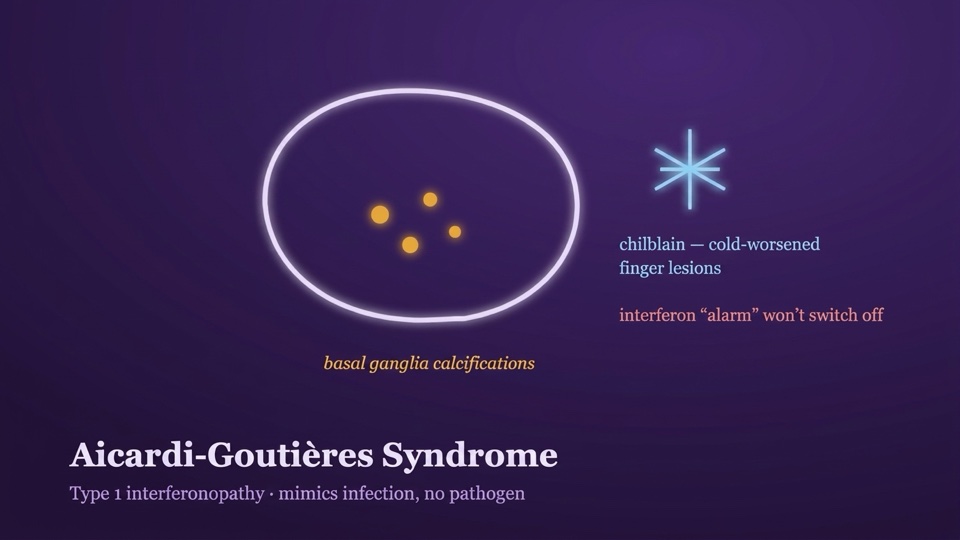
Aicardi-Goutières Syndrome (AGS) is a genetic interferonopathy that arises when the immune system's viral alarm (type 1 interferon) is mistakenly and continuously activated against the body's own nucleic acids. It mimics congenital infection; it should come to mind whenever "TORCH with no identified agent" is mentioned — because targeted treatment trials now exist.
Genetic Cause and Spectrum
It results from disruption of genes that clear or sense intracellular DNA/RNA remnants (TREX1, RNASEH2A/B/C, SAMHD1, ADAR1, IFIH1 and others); inheritance is mostly autosomal recessive (IFIH1 is often de novo dominant). The gene shapes the picture: TREX1 is associated with severe early onset, ADAR1 with marked basal ganglia involvement and sudden dystonic attacks, and IFIH1 with a more variable course.
Clinical Course
Onset (often in the first months)
- An encephalopathic period that may follow an infection-like episode: irritability, fever-free "septic" attacks (sterile fevers), feeding difficulty, increased startle response
- Acquired microcephaly, stalling/regression of acquired skills; hepatosplenomegaly and thrombocytopenia may be seen early on (the reason for confusion with TORCH)
Established period
- After an active period lasting months, the picture often plateaus (severe but non-progressive involvement): marked spasticity-dystonia, variable cognitive impairment
- Chilblain: purplish-painful lesions on the fingers, toes and ears that worsen with cold — the most specific external clue
- Glaucoma, thyroid problems and other autoimmune accompaniments should be monitored
Diagnosis
- Imaging: basal ganglia calcifications (clearest on CT), white matter changes, atrophy
- CSF: lymphocytosis without infection; an interferon signature in blood is supportive
- Definitive diagnosis: AGS gene panel. "TORCH-like presentation with negative microbiology" calls for genetic testing, not a second round of infection screening
Treatment
- JAK inhibitors (drugs that block interferon signalling; e.g. baricitinib) are used in many centres and are being evaluated in trials: improvements are seen in skin lesions, sterile fevers, irritability and interferon markers; there is a strong impression that starting early is decisive for neurological gains. They require an infection-vaccination plan and follow-up (blood count, lipids, BK virus)
- In some genotypes (TREX1 and related), reverse transcriptase inhibitors are being tested in clinical trials
- Supportive care package: management of spasticity-dystonia, seizure treatment, nutrition, cold protection for the skin; glaucoma-thyroid screening
Prognosis — An Honest Framework
- The most severe course occurs in the neonatal–early infancy onset group (particularly TREX1); there is a risk of loss in the first years
- In most children who get through the active period, the disease remains stable for decades: motor involvement is usually severe, but comprehension-interaction may be better than expected — communication supports (eye-tracking) should be tried
- In late/mild-onset cases (school age, ADAR1-IFIH1), some individuals walk and talk
- The natural course is being rewritten in the JAK era; early diagnosis is now not just a "label" but a window for treatment
Daily Life
- Winter plan: gloves-socks routine, heated precautions (take chilblain pain seriously)
- Agree a protocol with the physician on whether broad infection screening is needed every time there is a sterile fever attack
- While on JAK treatment, seek early contact for fever-infection; update the vaccination schedule with immunology
- AGS family networks are an important resource for medication experience and trial announcements