
Overview
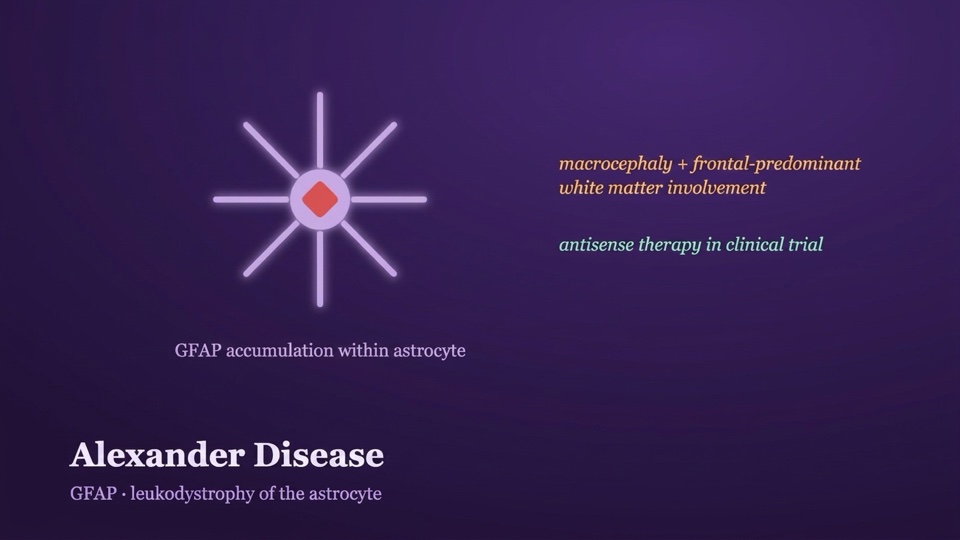
Alexander disease is a leukodystrophy caused by mutations in GFAP, the cytoskeletal protein of the brain's support cell, the astrocyte, in which myelin breakdown develops secondarily. It is rare but instructive — and now has its first cause-directed trial (an ASO that reduces GFAP).
Genetic Cause
GFAP mutations are almost always de novo and gain-of-function: the mutant protein accumulates within the astrocyte as Rosenthal fibres, rendering the cell "busy and toxic". As it is autosomal dominant, the risk of transmission from an affected individual to their child is 50% (important for families with the adult-onset form).
Clinical Forms
Type I (early onset; typical "infantile")
- In the first 2–4 years: macrocephaly, seizures, developmental plateau-regression
- Prominent vomiting attacks and feeding problems; irritability
- Spasticity and ataxia are added over time
Type II (juvenile-adult)
- Brainstem findings are prominent: swallowing-speech disorder, changes in the gag reflex, sleep apnoea; palatal myoclonus is typical in adults
- Gait disturbance-spasticity; cognition may be preserved for a long time; autonomic findings (blood pressure, bladder) may be added
Diagnosis
- MRI criteria are strong: predominant anterior white matter involvement, a thin periventricular rim, basal ganglia-thalamus signal changes, brainstem lesions and areas that may take up contrast; in the adult form, thinning of the medulla and upper cervical cord (a "tadpole" appearance) is characteristic
- Definitive diagnosis is made by GFAP sequence analysis; the era of biopsy has closed
- In the differential diagnosis of leukodystrophy with macrocephaly, there is a short, two-test list together with Canavan disease
Treatment and Follow-up
- Seizure treatment with standard medicines; for vomiting attacks, reflux treatment, an antiemetic plan and a fluid strategy for attack days (dehydration triggers seizures)
- Feeding-swallowing follow-up (videofluoroscopy in type II), gastrostomy when needed; sleep apnoea screening
- Spasticity management, physiotherapy, scoliosis follow-up; speech therapy (dysarthria)
- Head circumference-clinical follow-up for the development of hydrocephalus (rare)
Prognosis — An Honest Framework
- Type I is variable but progressive; the course is often measured in years — early seizure burden and feeding problems are determining factors
- Type II is slower; courses extending to the teens-twenties in juvenile onset and to decades in adult onset are seen; quality of life is determined by preservation of bulbar functions
- The same mutation can run a different severity course within a family; the prognosis discussion should be conducted together with MRI and clinical course
Treatment Pipeline — Detailed Look
- Zilganersen (GFAP ASO): an antisense treatment given intrathecally, with the logic of reducing the raw material of the mutant protein; a global pivotal trial programme is under way — it is a field-opening development as the first cause-directed human trial in astrocyte disease. The results will also guide other "gain-of-function" brain diseases
- Small molecules and cell-based approaches that reduce Rosenthal fibre accumulation are at the laboratory stage
Daily Life
- A written home plan for vomiting attacks: when to give oral fluids, when to seek admission for intravenous fluids
- In type II, choking-aspiration precautions (bite size, consistency) and awareness of night-time apnoea
- Trial centres are limited; conduct registration and eligibility follow-up with patient associations