Overview
Angelman syndrome is a neurogenetic condition recognised by marked developmental delay, absent or very limited speech, a happy demeanour and a characteristic gait disturbance (~1/12,000-20,000). With two ASO candidates having reached phase 3, it is one of the neurodevelopmental disorders closest to treatment.
Genetic Cause and Subtypes
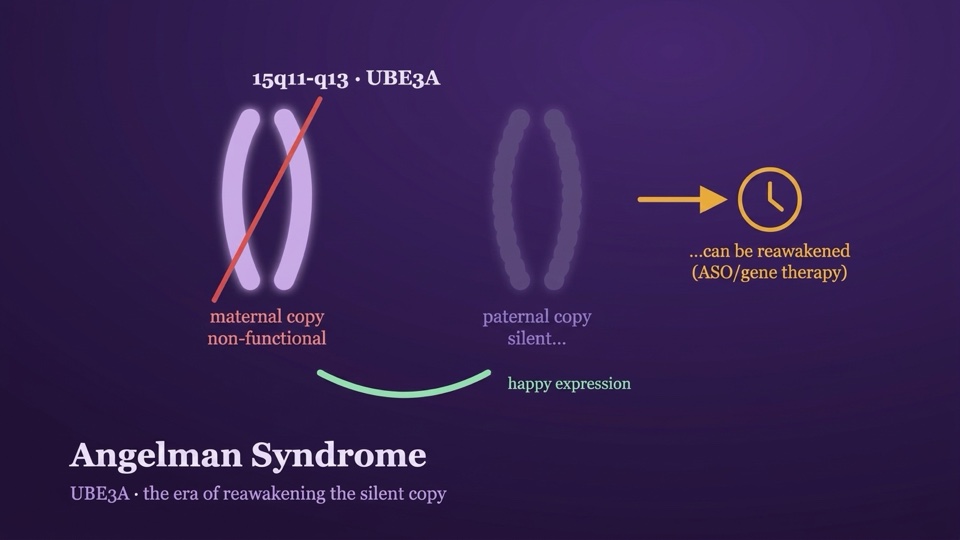
In neurons, only the maternally inherited UBE3A is active; the paternal copy is silenced by a natural antisense mechanism called UBE3A-ATS. When the maternal copy is lost, the neuron is left without UBE3A.
- Deletion (~70%): deletion of the maternal copy of the 15q11-q13 region — usually the most severe presentation; loss of OCA2 in the region may be accompanied by light skin and hair
- UBE3A point mutation (~10%)
- Paternal UPD and imprinting defect (~5-10%): often a milder course
The subtype affects severity, recurrence risk and eligibility for clinical trials — it must be clearly stated in the report. (Loss of the paternal copy of the same region causes Prader-Willi syndrome; the two conditions are a mirror image of imprinting.)
Clinical Course
Infancy
- Developmental delay noticed at 6-12 months; feeding difficulty, frequent smiling; loss of head circumference percentile (acquired microcephaly)
1-4 years
- Epilepsy (80-90%): often beginning at 1-3 years, with fever-triggered atypical absence, myoclonic and atonic seizures; "blank spells" may go unnoticed
- EEG signature: high-amplitude slow waves and a notched delta pattern — this strengthens clinical suspicion
- Ataxic, wide-based "puppet-like" gait with arms raised; hand-flapping, excessive movement
- Marked sleep disturbance: reduced sleep need, night-time awakenings
- Particular interest in water, music and shiny objects
School age and beyond
- Seizures mostly ease; hyperactivity decreases in adolescence; receptive language and social bonding continue to strengthen; scoliosis and weight are monitored
Diagnosis
- The first test is methylation analysis (detects deletion/UPD/imprinting defect); if normal, UBE3A sequence analysis follows
- Rett, Pitt-Hopkins, Mowat-Wilson and Christianson syndromes should be kept in mind for the differential diagnosis
- Recurrence risk is determined by subtype → genetic counselling is essential: the risk is low in deletion and paternal UPD (<1%, usually de novo); in UBE3A point mutation and imprinting centre (IC) deletion, it can reach up to 50% if the mother is a carrier — therefore the subtype must be clearly stated in the report, and testing of the mother (and family, if needed) should be planned
Treatment and Follow-up
Seizures
- Frequently preferred: valproate, levetiracetam, clobazam, lamotrigine (with caution), ethosuximide (for absence seizures); in drug-resistant cases, a ketogenic/low-glycaemic diet is effective
- Caution: carbamazepine/oxcarbazepine and vigabatrin can worsen absence-myoclonic seizures — generally unsuitable in Angelman syndrome
- Intermittent EEG and home videos are valuable for distinguishing blank spells from behaviour
Sleep and behaviour
- Melatonin plus strict sleep hygiene transforms the night for most families; safe bed arrangements (low bed, door safety) should be planned early
- A behavioural approach is the mainstay for short attention span and excessive movement; medication is used in selected cases
Communication and motor function
- Speech typically does not exceed a few words; comprehension is much better — alternative communication (signing, picture boards, eye-tracking/tablet AAC) should be started early, avoiding the trap of "waiting for speech and delaying"
- Physiotherapy (gait, balance), occupational therapy; ankle orthoses when needed
Prognosis — An Honest Framework for Families
- Life expectancy is close to normal; with good health follow-up, individuals with Angelman syndrome reach older ages.
- Seizures are the most difficult problem in childhood; convulsive seizures mostly ease in adolescence. However, recurrence in adulthood is a recognised course — in particular, non-convulsive status and myoclonic attacks may return; so follow-up should not be stopped by declaring "the seizures are over," and EEG should be requested during prolonged periods of drowsiness/regression.
- Independence: full independent living is not expected; however, walking (in most cases), toilet training (in some), simple tasks and device-assisted communication can be achieved. The happy, sociable temperament is families' greatest strength.
- Sleep tends to improve with age.
- The treatments in phase 3 target receptive-expressive communication and motor function — the coming years may change these prognosis statements.
Treatment Pipeline — A Detailed Look
Awakening the silent copy: ASOs (phase 3)
- GTX-102: targets UBE3A-ATS to awaken the paternally inherited copy; intrathecal, repeated dosing. Early phases reported signals of gains in communication-motor domains; the phase 3 Aspire trial (ages 4-17 with deletion) enrolment was completed in 2026, and a phase 2 Aurora trial is also under way for non-deletion types.
- ION582: a second candidate with the same strategy; it moved to a phase 3 programme following positive phase 2 HALOS findings.
- Rugonersen, however, was halted — not every molecule aimed at the same target shares the same fate; the results need to be awaited.
Gene addition
SKY-AS (announced in September 2026): a preclinical gene therapy candidate aiming to add a working UBE3A copy to neurons with a single administration.
Current-stage table: Genetic Treatments — Angelman treatment pipeline.
Daily Life and Support
- Water safety must be taken seriously (attraction to water plus seizure risk): pools/bathtubs should never be unsupervised
- AAC goals and a seizure action plan should be written into the school plan
- A seizure-sleep diary plus home videos make check-ups more productive
- Participation in patient registries/natural history studies with subtype information keeps the door open for the post-phase 3 period
Downloadable Documents: Emergency Action Plan + Routine Follow-up Calendar (PDF)
You can download the 3-page emergency action plan prepared by Nörogender under the guidance of Prof. Dr. Burak Tatlı for children with Angelman syndrome. The form includes fillable fields for your child's information and medications, step-by-step actions during a seizure, a 5-minute rule and rescue medication section, and two Angelman-specific critical warnings for emergency department staff: that hours-to-days of drowsiness may be non-convulsive status (EEG!) and avoidance of drugs that can worsen absence-myoclonic seizures (carbamazepine, oxcarbazepine, vigabatrin). The third page is a medical information note summarising medication choice and status steps for health professionals.
There is also a Routine Follow-up Calendar (2 pages): a checklist for the time of diagnosis including recurrence risk counselling by genetic subtype, a year-by-year follow-up table (epilepsy/NCSE enquiry, sleep, AAC, scoliosis, weight-metabolic), and a record chart to be filled in at check-ups.
📄 Emergency Action Plan (PDF, 3 pages) — in Turkish 📅 Routine Follow-up Calendar (PDF, 2 pages) — in Turkish
Fill in the form together with your doctor; keep one copy at home and one at school, and update the rescue medication dose as weight changes.