Overview
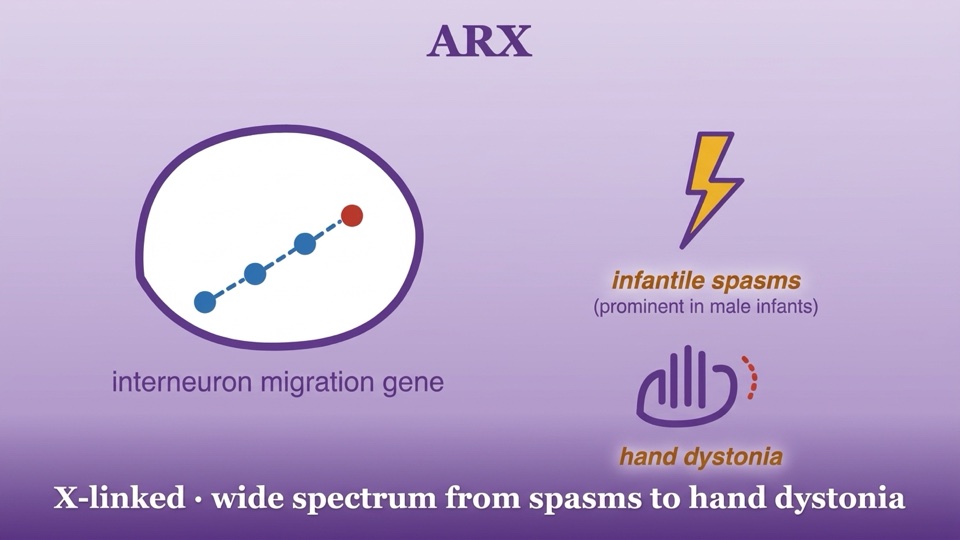
ARX-related disorders are an X-linked family of conditions caused by disruption of the ARX gene, which governs the prenatal migration and maturation of the brain's "brake cells" (GABAergic interneurons) — which is why the presentation is typically seen in male children. The spectrum is very wide: its most visible face is infantile spasms beginning in infancy (X-linked West syndrome); at the milder end are intellectual disability + dystonic posturing of the hands (Partington syndrome) and non-syndromic intellectual disability; and at the most severe end are newborn presentations in which brain structure fails to form properly and the external genitalia are also affected (XLAG). Two practical messages: clusters of repeated contractions in a male infant require same-day EEG, and the mother is usually a healthy carrier — family testing is vital for future pregnancies.
Genetic Cause and Mechanism
- ARX is a transcription factor that governs the migration of interneurons in the developing brain; this is why ARX-related conditions are referred to as an "interneuronopathy" — when the brake cells fail to reach their destination, the network becomes vulnerable to stimulation (the basis for spasms and epilepsy).
- The variant type roughly predicts the presentation: variants that completely abolish gene function (loss-of-function) cause the most severe presentations, with disrupted brain structure (XLAG: lissencephaly + genital differences); the most common polyalanine repeat expansions, however, cause presentations in which brain structure is normal but function is impaired — infantile spasms, Partington syndrome, non-syndromic intellectual disability.
- Inheritance is X-linked: carrier mothers are usually healthy (mild learning findings may be reported); the risk in each male pregnancy of a carrier mother is 50% — genetic counselling is an integral part of the diagnosis. VUS results are reclassified every 1-2 years.
Clinical Presentation — Faces of the Spectrum
1 · Infantile spasms / X-linked West presentation
- Clusters of jackknife-type contractions in the first months (often around waking); accompanied by a stall in development. Hypsarrhythmia is sought on EEG; treatment (hormonal therapy and/or vigabatrin) must be started without delay.
- After the spasm period, other seizure types (tonic, focal, myoclonic) may develop; in some cases a drug-resistant course accompanied by dystonia-spasticity occurs.
2 · Partington syndrome
- Mild-to-moderate intellectual disability + dystonic posturing/clumsiness of the hands (difficulty with writing, buttons, using a spoon) + dysarthric speech; seizures may or may not be present.
- Hand findings may be mistaken for "clumsiness" for years — this question is specifically asked within ARX families.
3 · Severe structural end (XLAG)
- In the newborn: drug-resistant seizures, marked hypotonia, temperature dysregulation and persistent diarrhoea-electrolyte problems, differences in the external genitalia; lissencephaly on MRI. The course is severe; care goals are discussed openly with the family.
Diagnosis
- Genetic: epilepsy/neurodevelopmental panels include ARX; however, polyalanine repeat expansions can be missed by some exome pipelines — if clinical suspicion is strong (male + spasms ± family history), targeted analysis is requested. If positive, maternal testing follows.
- EEG on the same day if spasms are suspected; MRI to distinguish the structural end (lissencephaly/corpus callosum).
- Differential diagnosis: other causes of West syndrome (TSC, CDKL5, STXBP1, metabolic), and other dystonia-intellectual disability presentations at the hand-dystonia end. "Unexplained intellectual disability in maternal uncles" in the family history is a classic clue to X-linked inheritance.
Treatment — An Honest Framework
- There is currently no ARX-specific disease-modifying treatment; early diagnosis + standard spasm treatment + good supportive care determine the outcome.
- Infantile spasms: hormonal therapy (ACTH/high-dose steroid) and/or vigabatrin without delay; response is confirmed with EEG. For subsequent seizures, drug choice is based on seizure type — there is no gene-specific avoidance list.
- Dystonia-hand function: occupational therapy (pen adaptation, daily skills) + a medication trial with a movement-disorder centre if needed; speech therapy for dysarthria.
- Developmental package: physiotherapy, special education, AAC if needed; behavioural support.
- XLAG care: temperature-fluid-electrolyte management, feeding, seizure control — with an experienced neonatal/paediatric neurology team.
- Research horizon: interneuron biology and gene-based approaches are at the preclinical stage; they are at the research stage and are not a recommendation for clinical use.
Three Critical Points in the Emergency Setting
- 1 · Clusters of repeated contractions in a male infant may be spasms: jackknife-type clusters on waking → same-day EEG; this should not be dismissed as "colic" and sent home. The treatment decision should be made with paediatric neurology without delay.
- 2 · The status approach is standard (benzodiazepine → levetiracetam/valproate/fosphenytoin) — there is no gene-specific restriction; ask about the family's rescue plan.
- 3 · A dystonic attack can be mistaken for a seizure: if consciousness is preserved during hand-arm twisting and it changes with stimulation, consider dystonia — take a video; in an XLAG infant presenting with fever/diarrhoea, actively manage the temperature-electrolyte balance.
Follow-up — Summary
The backbone of follow-up: asking about spasms at every visit + a low-threshold EEG in infancy · a seizure diary and type-labelled videos · hand function-dystonia assessment (with occupational therapy goals) and speech support · annual developmental-behavioural assessment + school plan · AAC if needed · a temperature-feeding-electrolyte plan at the XLAG end · dental care · genetic counselling (maternal testing; 50% risk for male siblings) + VUS reclassification. The detailed age-by-age table is in the Routine Follow-up Calendar document at the end of the article.
Prognosis — An Honest Framework for Families
- The course varies greatly according to variant type: at the Partington end, most independent living skills can be acquired; at the spasm end, outcome is closely related to how early the spasms are controlled; the XLAG end is severe.
- The condition is not progressive; gains are retained. Hand dystonia may change with age, but functionality improves markedly with occupational therapy.
- For family planning: there is a 50% risk in every male pregnancy for a carrier mother — prenatal/preimplantation options are discussed with counselling; female children are usually candidates to be healthy carriers.
Daily Life
- Record contraction clusters in infancy on video — this speeds up the EEG and treatment decision.
- Do not dismiss difficulty with hand skills as "laziness/clumsiness"; occupational therapy makes a concrete difference (thick-grip pens, adaptive tools).
- Draw up the family tree with your doctor: unexplained presentations in maternal uncles/cousins are valuable for diagnosis and counselling.
- A written school plan: flexible time for writing, alternative assessment, speech support.
- Join ARX/infantile spasm family communities.
Downloadable Documents: Emergency Action Plan + Routine Follow-up Calendar (PDF)
Two documents have been prepared for children with ARX by Nörogender, under the guidance of Prof. Dr. Burak Tatlı. The Emergency Action Plan (3 pages): alongside the 5-minute rule, the "clusters of repeated contractions = spasm → same-day EEG" rule, distinguishing dystonia from seizures, and a note on XLAG temperature-electrolyte management. The Routine Follow-up Calendar (2 pages): an age-by-age table and recording chart organised around spasm vigilance, hand function-occupational therapy, development-school, and family counselling.
📄 Emergency Action Plan (PDF, 3 pages) — in Turkish 📅 Routine Follow-up Calendar (PDF, 2 pages) — in Turkish
Complete the documents together with your doctor; keep a copy at home and at school, and update the rescue medication dose as weight changes.