Overview
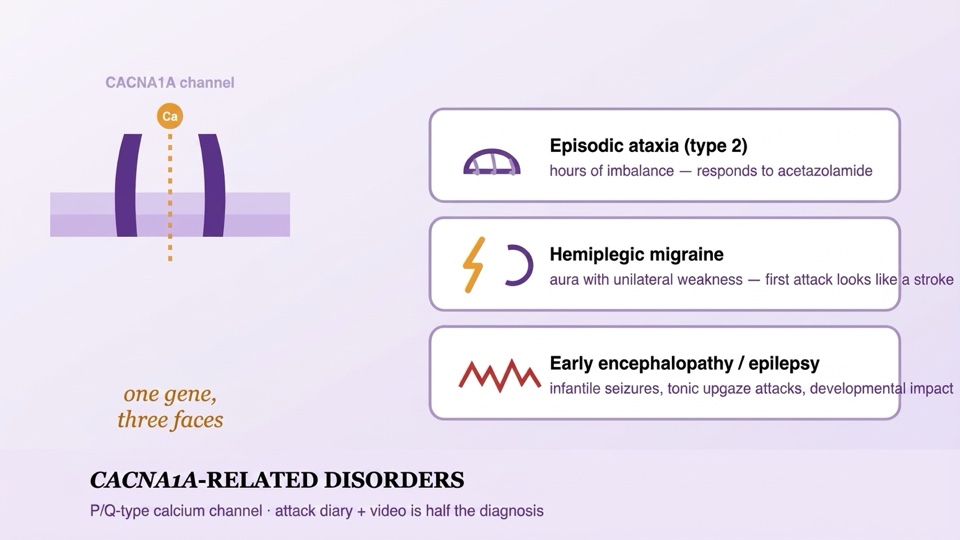
CACNA1A encodes one of the calcium channels the brain uses most heavily (the P/Q type, CaV2.1) — particularly in the cerebellum and at synaptic terminals. Disruption of a single gene presents in paediatric neurology with three faces that look very different from one another: episodic ataxia type 2 (attacks of loss of balance lasting hours — responsive to acetazolamide, i.e. treatable), hemiplegic migraine type 1 (aura with one-sided weakness — the first attack looks like a stroke), and developmental and epileptic encephalopathy beginning in infancy. Different individuals in the same family can show different faces; this is why CACNA1A is one of the genes for which the triad of "attack history + family tree + video" makes the diagnosis.
Genetic Cause and Mechanism
- The CaV2.1 channel lets calcium into the synaptic terminal, triggering neurotransmitter release; cerebellar Purkinje cells are almost dependent on this channel — this is why ataxia is central to the picture.
- Loss-of-function (LoF) variants classically predispose to episodic ataxia, while gain-of-function (GoF) variants predispose to hemiplegic migraine; severe early encephalopathy has been reported with both mechanisms — in practice, the phenotype is more informative than the mechanism label.
- Inheritance is autosomal dominant: transmission from an affected parent to a child is 50%; incomplete penetrance and within-family variability are prominent ("migraine in the father, ataxia in the child" is a typical picture). Severe infantile-onset cases are often de novo. Repeat expansion in the same gene causes SCA6 (late-onset progressive ataxia) in adulthood — in family counselling, asking about "unsteadiness in old age" in the grandparents' generation is meaningful.
- VUS results should be reclassified every 1-2 years.
Three Clinical Faces
1 · Episodic ataxia type 2 (EA2)
- Attacks: imbalance lasting hours (sometimes 1-2 days), dysarthria ("slurred, drunken-sounding speech"), nausea-vomiting, nystagmus; triggers include stress, fatigue, febrile illness, caffeine-alcohol and exertion. Between attacks the child is usually initially normal; over the years mild persistent ataxia and gaze-evoked nystagmus may develop.
- Treatability is the hallmark of this picture: acetazolamide markedly reduces attack frequency in most patients; in non-responders/intolerant cases, 4-aminopyridine is the reported second option (under physician supervision). Considering this diagnosis in a child with "attacks of imbalance + normal MRI" can end years of uncertainty with a single drug.
2 · Familial hemiplegic migraine type 1 (FHM1)
- Aura; in addition to visual-sensory symptoms, it includes one-sided weakness, speech disturbance, and sometimes confusion lasting hours to days; headache follows. Attacks can begin in childhood-adolescence.
- Critical safety information: in FHM1, even mild head trauma can trigger a severe attack — even encephalopathy and brain oedema; decisions about contact/near-contact sports involving head impact should be made with this in mind, and "prolonged drowsiness/confusion after a minor bump" should prompt an emergency visit.
- In some FHM1 families, mild progressive ataxia/nystagmus between attacks is also present (the two faces can overlap).
3 · Early-onset encephalopathy / epilepsy
- Seizures in infancy (generalised types including absence can appear at an early age), marked hypotonia, developmental impairment; paroxysmal tonic upgaze attacks and early-onset ataxia-nystagmus are among the clues to this gene. In some, cerebellar atrophy develops over time.
- At the severe end, status epilepticus and periods of encephalopathy during attacks have been reported — an emergency plan is especially important in this group.
Diagnosis
- Video + attack diary make up half of the diagnosis: distinguishing an ataxia attack, a hemiplegic aura and a seizure is usually done with recordings; the three attack types should be noted on separate pages.
- Genetics: epilepsy/ataxia/migraine panels or exome sequencing; if positive, parental testing (AD inheritance, incomplete penetrance) and screening the family tree with the three faces plus SCA6 in mind.
- MRI: often normal at onset; over time cerebellar (particularly vermian) atrophy may appear. EEG as clinically indicated in the phenotype with seizures; EA2 attacks are not epileptic (do not confuse this with EEG findings).
- The first hemiplegic attack is always evaluated as if it were a stroke (imaging + stroke exclusion); even when the diagnosis is known, the threshold is kept low for atypical/prolonged attacks.
Treatment — An Honest Framework
- EA2: acetazolamide is the first option (with monitoring of electrolytes and kidney stones); 4-aminopyridine in selected cases. Trigger management (sleep routine, caffeine) is part of treatment.
- FHM1: As attack-preventive options, verapamil, lamotrigine, acetazolamide and topiramate have been reported (according to centre preference); hydration and antiemetic support are used in acute attacks. Triptans and ergotamines are traditionally avoided in hemiplegic migraine (due to concern over vasoconstriction) — the decision to use them rests with the physician alone. Severe attacks with encephalopathy are monitored with hospital admission.
- Epilepsy phenotype: there is no absolute syndrome-specific drug ban; valproate-ethosuximide are prominent for the generalised/absence component, with standard choices used for focal seizures. Cases where acetazolamide reduces non-seizure paroxysmal attacks have been reported — this is assessed by the physician.
- Research horizon: gene/ASO approaches targeting CaV2.1 are at the preclinical stage; new attack-preventive molecules for EA2/FHM1 are under investigation. All of these are at the research stage; this is not a recommendation for clinical use.
Three Critical Points in the Emergency Department
- 1 · Sudden hemiparesis: First attack → stroke protocol. Even in known FHM1, the threshold for imaging is low for an atypical, prolonged or febrile attack; a severe attack may require admission for monitoring of encephalopathy-oedema.
- 2 · The "drunk-looking" child: An attack of imbalance-dysarthria lasting hours should not be assumed to be poisoning/intoxication — it may be an EA2 attack; a video and history of previous attacks should be requested from the family.
- 3 · Head trauma: In a child with FHM1, prolonged drowsiness/confusion after minor trauma should be taken seriously (possible triggering of an attack/oedema); the observation period should be kept generous.
Follow-up — Summary
The backbone of follow-up: monitoring the three attack types with separate diaries (ataxia / migraine / seizure) + videos · electrolyte-kidney monitoring and response assessment under acetazolamide · nystagmus-balance course on neurological examination (annually; development of persistent ataxia) · EEG as clinically indicated in the phenotype with seizures · head-trauma counselling (choice of sport, helmet) and a note in the school plan about "recovery after an attack" · family screening (AD 50%; asking older generations about migraine-balance; SCA6 in the older generation) · VUS reclassification. A detailed age-by-age table is in the Routine Follow-up Calendar document at the end of the article.
Prognosis — An Honest Framework for Families
- EA2 is mostly well managed with treatment; mild persistent balance findings may develop over the years, but school/work life is generally maintained.
- FHM1 follows a course of attacks; attacks are frightening but mostly resolve completely. In those who have had an attack with severe encephalopathy, preventive treatment and trauma precautions are kept stricter.
- The early encephalopathy phenotype is the most variable: the range of seizure control and development is wide; early developmental support improves outcome. The picture typically runs along the axis of attack burden and development rather than "progressive loss."
- Mild and severe faces can occur together in the same family — "the parent only had migraine" is not a guarantee of outcome for the child.
Daily Life
- Keep three separate attack diaries (ataxia/migraine/seizure) and record attacks on video — this is the compass for treatment decisions.
- Manage triggers: regular sleep, early intervention with fever, moderation with caffeinated drinks.
- In FHM1, discuss contact/near-contact sports involving the head with the physician; apply the helmet rule for cycling/skateboarding without exception.
- A written school plan: a safe space during an attack + contacting the family + rest after the attack.
- Family members' "migraine/unsteadiness" should not be dismissed — the diagnosis can shed light on them too.
Related Genes: CACNA1E and CACNA1C (Timothy)
Two further members of the same channel family are also important in paediatric neurology: CACNA1E causes a severe developmental and epileptic encephalopathy with early onset, often drug-resistant seizures, and marked hypotonia-contractures (its follow-up follows the severe DEE template). CACNA1C causes Timothy syndrome — a multisystem condition with cardiac involvement, particularly long QT, syndactyly of the fingers/toes, autism and seizures; in this diagnosis, cardiology follow-up and avoiding QT-prolonging drugs are central to management. Separate guides for these two genes can be prepared on request.
Downloadable Documents: Emergency Action Plan + Routine Follow-up Calendar (PDF)
Two documents have been prepared for children with CACNA1A by Nörogender, under the guidance of Prof. Dr. Burak Tatlı. The Emergency Action Plan (3 pages) is built around the three-faces logic: alongside the seizure section and the 5-minute rule, it includes warnings on the hemiplegic attack ("first attack looks like a stroke"; imaging for atypical presentations even with a known diagnosis), not mistaking the "drunk-looking" ataxia attack for poisoning, and mild head trauma potentially triggering a severe attack. The Routine Follow-up Calendar (2 pages) includes an age-by-age table and recording chart covering the three attack diaries, acetazolamide monitoring, trauma-sport counselling, and family/SCA6 screening.
📄 Emergency Action Plan (PDF, 3 pages) — in Turkish 📅 Routine Follow-up Calendar (PDF, 2 pages) — in Turkish
Complete the documents together with your physician; keep a copy at home and at school, and update drug doses as weight changes.