
Overview
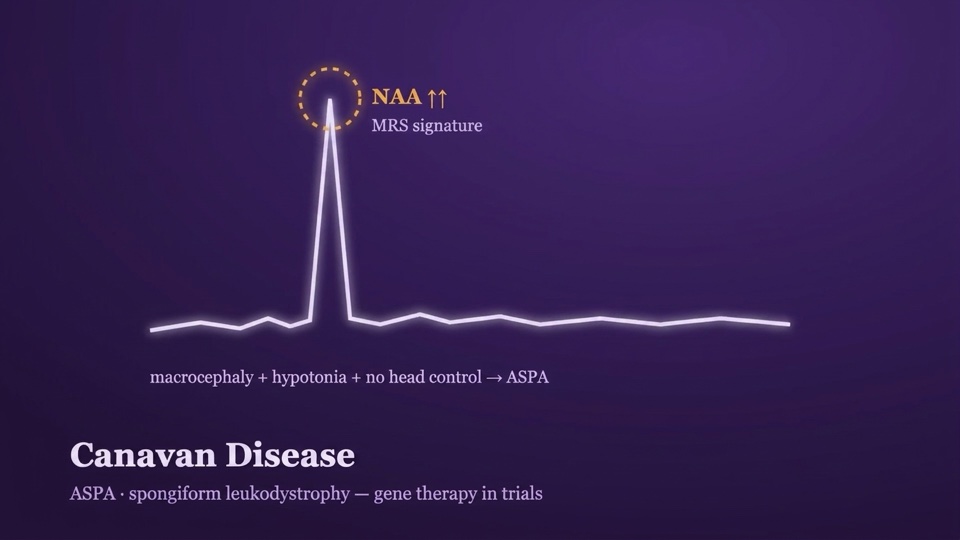
Canavan disease is a leukodystrophy in which deficiency of the ASPA enzyme leads to accumulation of NAA and spongy degeneration of the white matter. It is one of the classic causes of the "floppy baby with a rapidly growing head" picture and has historical importance: the first gene therapy trials delivered to the brain were carried out in this disease — today the same path is being followed with modern programmes.
Genetic Cause and Mechanism
ASPA mutations (autosomal recessive) eliminate aspartoacylase; NAA cannot be broken down in oligodendrocytes. NAA disrupts myelin both through osmotic load and by interfering with the transport of building blocks needed for myelin production. Carrier frequency is high in some communities, and it is included in the scope of pre-marital carrier screening.
Clinical Course
Classic (infantile) form
- 3-5 months: Head control is not achieved, marked hypotonia is present; however, head circumference grows by crossing percentiles (macrocephaly)
- Irritability, sleep problems, feeding difficulty-reflux; poor visual tracking, nystagmus
- As the disease progresses: stiffness (spasticity) replacing the floppiness, seizures (often in the first years), swallowing difficulty
- Motor milestones are not achieved; smiling-social response may be relatively preserved
Mild/juvenile form
- With residual enzyme activity: mild speech-motor delay, near-normal school course; sometimes recognised only through MRS/urine findings — "Canavan = always severe" does not hold
Diagnosis
- MRI + MR spectroscopy: Widespread white matter involvement and a markedly elevated NAA peak — while NAA falls in most brain diseases, it rises in Canavan disease; this is almost a signature finding
- Urinary NAA (organic acid analysis) is markedly increased; definitive diagnosis is made by ASPA gene analysis
- In the differential diagnosis, Alexander disease (another leukodystrophy with macrocephaly) and Tay-Sachs/mitochondrial presentations are considered
Treatment and Care Package
- There is currently no approved disease-modifying treatment; the goal of care is to support comfort and the developmental window
- Nutrition: Swallowing assessment, texture modification, gastrostomy when needed (a decisive step in weight and aspiration management)
- Seizure treatment with standard medications; for irritability-sleep, routine plus medication when needed; reflux-constipation are actively treated (a frequent cause of crying)
- Head-posture support: Seating systems and neck supports suited to the large head; contracture prevention with physiotherapy
- Arrangement of visual stimuli (high contrast, slow presentation)
Prognosis — An Honest Framework
- The course is severe in the classic form; life expectancy is variable — while some children are lost in early childhood, some reach their teens with a good care package. Determinants: swallowing safety, respiratory infections and seizure burden
- A normal life is possible in the mild form
- The recurrence risk for subsequent pregnancies is 25%; prenatal diagnosis and carrier screening should be offered to the family
Treatment Pipeline — A Detailed Look
- Gene therapy is at the clinical stage on two fronts: (1) a new-generation AAV programme given intravenously, (2) an AAV programme delivered directly into the brain, targeted to myelin-producing cells. Early reports have described decreases in NAA levels and signals of myelination — comparative confirmation of results against the natural course is awaited
- Trials typically look for a narrow age window: early diagnosis is a precondition for eligibility
- Older approaches such as lithium/glyceryl triacetate have not shown meaningful benefit; families should follow up-to-date information through association-registry networks
Daily Life
- Families can also measure and record head circumference monthly; seek early review if growth is rapid
- Set micro-goals in the daily routine (duration of eye contact, minutes of head support) — progress becomes visible
- Get physiotherapy-aspiration training for respiratory episodes
- Canavan family foundations are the main resource for trial announcements and care experience