
Overview
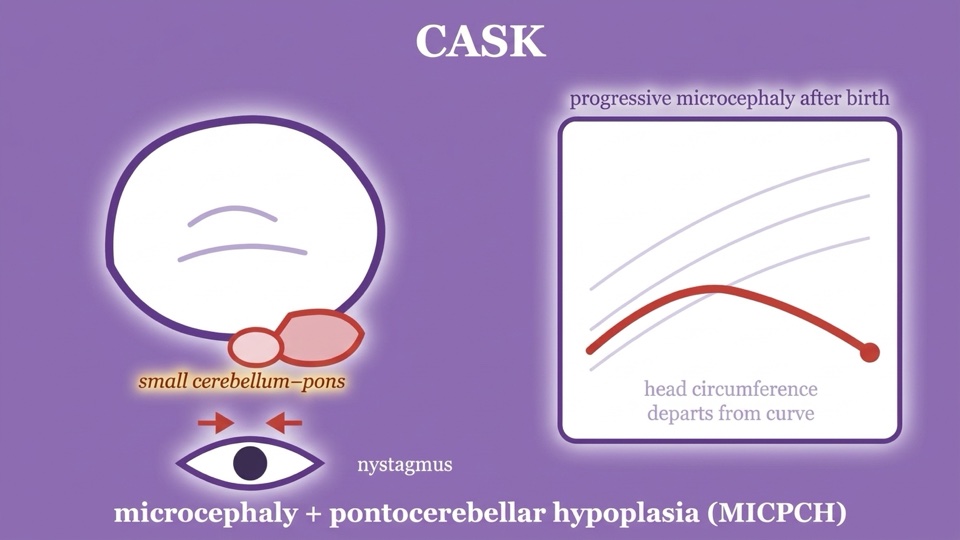
CASK-related disorder is a condition caused by deficiency of the CASK gene on the X chromosome, whose best-known presentation is MICPCH: progressive microcephaly after birth + smallness of the cerebellum-pons (pontocerebellar hypoplasia). It is most often seen in girls and de novo; marked developmental impairment, hypotonia, eye findings such as nystagmus-strabismus, and epilepsy in roughly half of cases accompany it. The two practical messages of this article: the head circumference curve is the indicator of course in this diagnosis, and new-onset serial contractions (infantile spasms) in infancy require an EEG on the same day.
Genetic Cause and Mechanism
- CASK encodes a scaffold protein that builds synapses and directs cerebellum-pons development; it is X-linked. Loss of the single copy in girls → MICPCH; in boys with severe loss-of-function variants, very severe early encephalopathy (Ohtahara/West-like) may occur, while boys with mild (missense) variants show intellectual disability with or without nystagmus.
- The great majority of cases are de novo; maternal carrier status and differences in X-inactivation can alter the picture → family testing and genetic counselling are essential. VUS are reclassified every 1-2 years.
- Microcephaly is typically mild or absent at birth, and departs from the curve in the first months — this "progressive microcephaly after birth" is the signature of this gene.
Clinical Picture
- Growth-head circumference: head circumference that drops below the percentile curve in the first 6-12 months; on MRI, the cerebellum and pons are disproportionately small, while the cortex is relatively preserved.
- Development: marked delay (sitting-walking may be late or may not be achieved); language is often very limited; progressive loss is not expected — gains continue, even if slowly.
- Eyes: nystagmus, strabismus, optic atrophy/reduced vision in a subset → regular ophthalmological follow-up.
- Hearing: sensorineural hearing loss is reported in a subgroup → screening and, if needed, hearing aids.
- Epilepsy (~in half): infantile spasms/West syndrome in infancy, among others; mixed focal/generalised types follow later. A drug-resistant course may be seen.
- Feeding-GOR: sucking-swallowing difficulty, reflux, and failure to gain weight are the main concerns of the early period; scoliosis-kyphosis is monitored with growth; sleep problems are common.
Diagnosis
- The combination of "progressive microcephaly + pontocerebellar hypoplasia" points to CASK — especially in a girl. Genetics: panel/exome (sequencing plus deletion/duplication analysis should be requested together; intragenic deletions may be missed otherwise).
- MRI: pons and cerebellar hypoplasia; EEG: hypsarrhythmia is sought if spasms are suspected (including a sleep recording).
- Differential diagnosis: other pontocerebellar hypoplasias (PCH types — often progressive, unlike CASK in general), Rett syndrome (head circumference drop similar, but MRI differs), mitochondrial conditions.
Treatment — An Honest Framework
- There is currently no CASK-specific disease-modifying treatment; good symptomatic care genuinely changes the course.
- Epilepsy: standard protocols for infantile spasms (hormonal therapy [ACTH/steroid] and/or vigabatrin) are applied without delay; drug choice in later seizures is based on seizure type — there is no gene-specific "drug to avoid" rule.
- Feeding: swallowing assessment, reflux management, gastrostomy if needed — protects weight and lung health.
- Vision-hearing: regular ophthalmology (nystagmus/optic nerve) + audiology; need for glasses/aids is addressed early, and visual communication strategies are added.
- Developmental package: physiotherapy (hypotonia-posture), occupational therapy, early language work including AAC for communication; orthopaedic follow-up (scoliosis, hip).
- Research horizon: approaches targeting CASK function/expression are at the preclinical stage; they are at the research stage and are not a recommendation for clinical use. Participation in natural history registries is advised.
Three Critical Points in the Emergency Department
- 1 · New-onset serial contractions may be infantile spasms: cradle-salute movement occurring in daily clusters → same-day EEG/hypsarrhythmia investigation; it must not be dismissed as "gas pain/startle" and sent home.
- 2 · The approach to status is standard (benzodiazepine → levetiracetam/valproate/phenytoin); there is no gene-specific drug restriction in this diagnosis — ask the family about their rescue plan.
- 3 · Feeding-aspiration: consider aspiration in respiratory distress; swallowing difficulty and reflux are a known background, and the feeding plan must be clear at discharge.
Follow-up — Summary
The backbone of follow-up: head circumference at every visit (plotted on the curve) · spasm inquiry + low-threshold EEG in infancy · eye (every 6-12 months) and hearing (at diagnosis + if suspected) assessment · feeding-growth and swallowing assessment · regular updating of the physiotherapy-occupational therapy-AAC programme · scoliosis-hip examination · sleep inquiry · dental care · genetic counselling (X-linked; family testing) + VUS reclassification. The detailed year-by-year table is in the Routine Follow-up Calendar document at the end of the article.
Prognosis — An Honest Framework for Families
- Developmental impairment is usually marked; verbal language remains very limited in most children — but communication is not limited to words: expressing preferences and making choices can be achieved with AAC.
- The condition is typically not progressive; gains are slow but real. Seizure burden and feeding are the main determinants of quality of life.
- The severe male phenotype is discussed separately: early respiratory-feeding support and drug-resistant epilepsy come to the fore.
- In family planning: most cases are de novo; if the mother is a carrier, the recurrence risk is clarified with the physician.
Daily Life
- Have head circumference measurements taken regularly, like the vaccination schedule, and keep the growth chart.
- Record on video the "startle-salute" clusters in infancy — this speeds up the EEG decision.
- If feeding times are lengthening or swallowing is accompanied by coughing, do not delay a swallowing assessment.
- Weak eye contact is not indifference — it may be nystagmus/a vision problem; do not neglect ophthalmology follow-up.
- Join CASK family communities and natural history registries.
Downloadable Documents: Emergency Action Plan + Routine Follow-up Calendar (PDF)
Two documents have been prepared for children with CASK by Nörogender, under the guidance of Prof. Dr. Burak Tatlı. The Emergency Action Plan (3 pages): alongside the 5-minute rule, the rule "serial contractions = spasms → same-day EEG", a note on feeding-aspiration, and standard status steps. The Routine Follow-up Calendar (2 pages): a year-by-year table and recording chart built around the head circumference curve, eye-hearing, feeding-swallowing, scoliosis, and the AAC-development programme.
📄 Emergency Action Plan (PDF, 3 pages) — in Turkish 📅 Routine Follow-up Calendar (PDF, 2 pages) — in Turkish
Complete the documents together with your physician; keep a copy at home and with caregivers.