
Overview
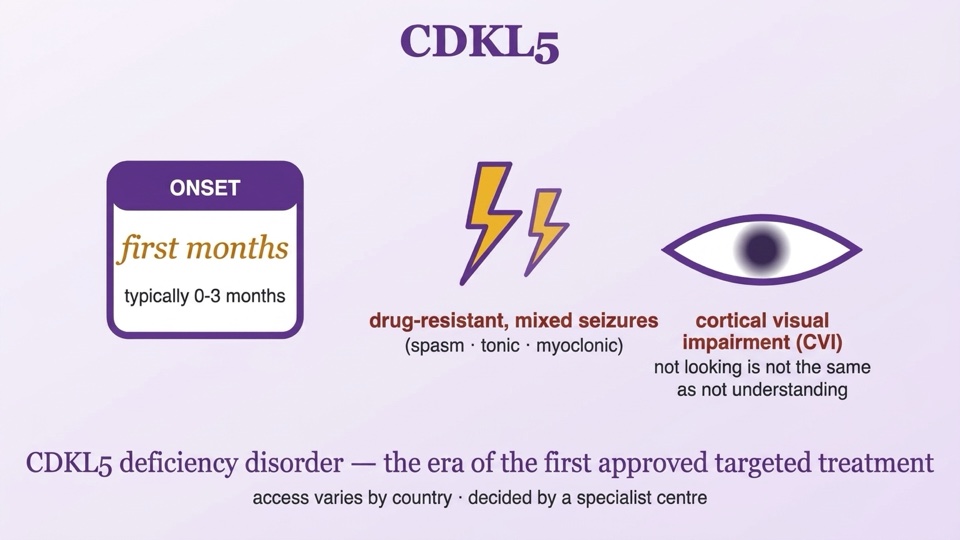
CDKL5 deficiency disorder (CDD) is one of the earliest-onset genetic epilepsies of childhood: seizures typically begin in the first months of life (often within the first 3 months), mostly follow a drug-resistant course, and are combined with severe developmental impairment, cortical visual impairment (CVI), hand stereotypies, and sleep and digestive problems. It used to be called "early seizure variant of Rett syndrome"; today it is recognised under its own name. There is a development that makes this diagnosis historically distinctive: CDD is among the rare genetic epilepsies to have obtained the first targeted drug (ganaxolone) approved in its own name — access varies by country and the decision belongs to the specialist centre, but the era of "nothing can be done" is over.
Genetic Cause and Mechanism
- CDKL5 is located on the X chromosome and encodes a kinase involved in synaptic maturation. Variants are almost always de novo.
- Girls are the majority (the picture is generally more severe in males, who have a single X); the X-inactivation pattern is one reason for variability among girls.
- Sibling recurrence risk is low (~1%, with a contribution from gonadal mosaicism); VUS results are reclassified every 1-2 years.
Clinical Picture
Epilepsy — the centre of the picture
- Very early onset: first weeks to months; the commonly described sequence is the "hypermotor-tonic-spasm" sequence (phases within a single seizure). Infantile spasms, tonic and myoclonic seizures are seen in a mixed pattern.
- The course is typically fluctuating: "honeymoon" periods (relatively calm intervals lasting weeks to months) may be followed by flare-ups — each flare-up does not mean "the drug has stopped working".
- A subset follows a drug-resistant course; a written rescue plan is essential for prolonged seizures and clusters.
Development and other domains
- Severe developmental impairment: sitting is delayed, independent walking is achieved in a subset; verbal language usually does not develop — gaze-based communication is the main area of investment.
- Cortical visual impairment (CVI) is very common: while the eye itself is intact, "the brain's seeing" fluctuates; not looking does not mean indifference or lack of understanding. Visual stimulation programmes help.
- Hand stereotypies and difficulty with purposeful hand use (resembles Rett syndrome; the difference is that seizures are early and prominent).
- Sleep disorders and gastrointestinal problems (reflux, air swallowing, constipation) are the invisible burdens on quality of life — they are not mentioned unless asked about.
Diagnosis
- Genetic: early infantile epilepsy panels include CDKL5; sequencing plus deletion/duplication analysis should be requested together. Parental testing (to confirm de novo status) is needed if the result is positive.
- EEG/video-EEG: without delay when spasms are suspected (hypsarrhythmia may not always accompany it — the clinical cluster description is sufficiently alerting); documenting seizure types on video guides treatment.
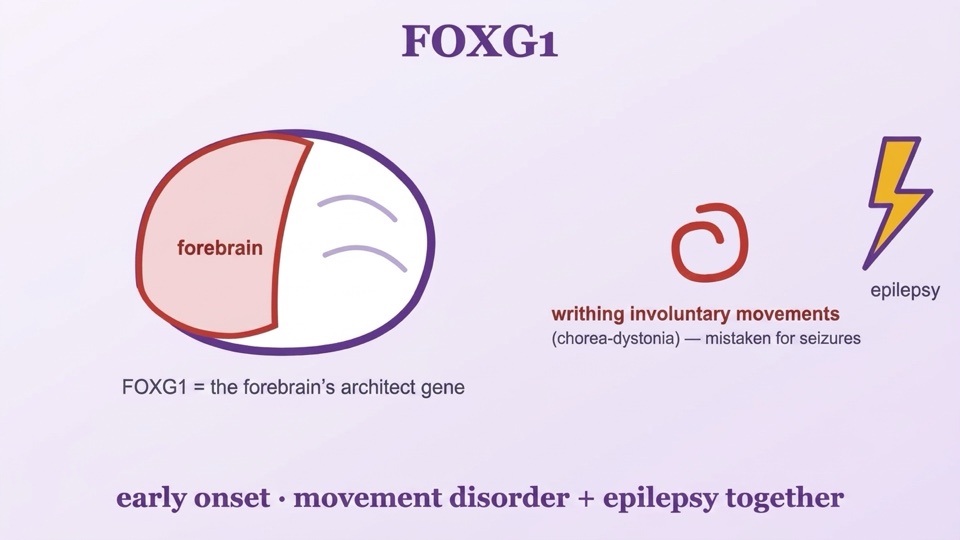
- Differential diagnosis: other causes of West syndrome, KCNQ2/SCN2A early encephalopathies, FOXG1 (movement disorder prominent), Rett syndrome (age of onset). The molecular result clarifies the distinction.
Treatment — An Honest Framework
- Targeted option — ganaxolone: a neuroactive steroid; it is the first CDD-specific treatment approved for CDD-related seizures from age 2 and above (US FDA 2022; also licensed in Europe). In trials it significantly reduced seizure frequency compared with placebo; the effect varies from person to person, and drowsiness is the main adverse effect. Access/reimbursement conditions in Türkiye vary — eligibility and supply are managed by decision of the specialist centre and physician.
- Standard epilepsy steps: hormonal therapy and/or vigabatrin during the spasm phase; afterwards, combinations according to seizure type (valproate, clobazam, topiramate, levetiracetam, etc.) — there is no gene-specific absolute prohibition list; when a myoclonic component predominates, carbamazepine/oxcarbazepine should be considered with caution. With multiple drugs, the "one variable at a time" rule and careful accounting of adverse effects are essential.
- Ketogenic diet and, in drug-resistant cases, VNS are options that can be considered.
- CVI programme: visual assessment plus visual stimulation (plain background, high contrast, single stimulus) — this is the gateway to communication.
- GI-sleep package: management of reflux-constipation; sleep hygiene ± melatonin by physician's decision.
- Research horizon: gene therapy and protein-replacement programmes are at the preclinical/early clinical stage; they are at the research stage, not a recommendation for clinical use. Participation in international CDD registries is recommended.
Three Critical Points in the Emergency Department
- 1 · Seizure management: standard steps apply for prolonged seizures/clusters (benzodiazepine → levetiracetam/valproate/fosphenytoin) — there is no gene-specific restriction; note the family's rescue plan, and that if the child is on ganaxolone, it should be continued without stopping (the decision to stop belongs only to the follow-up centre).
- 2 · New spasm clusters → same-day EEG; during flare-ups, look for triggers (infection, constipation, sleep deprivation, medication change) — not every flare-up requires a medication change.
- 3 · CVI + communication: not looking/not focusing does not mean not understanding or not being in pain; actively look for GI sources (reflux, air swallowing, constipation) in cases of distress; apply a low-stimulus environment plus keeping the family present.
Follow-up — Summary
The backbone of follow-up: seizure diary + type-labelled videos (spasm/tonic/myoclonic recorded separately) · updating the rescue plan at every weight change · vision-CVI assessment and visual stimulation programme · communication goals including gaze-based AAC · nutrition-reflux-constipation programme · sleep enquiry · scoliosis-hip examination · dental care · periodic review of targeted options (ganaxolone; diet/VNS in drug-resistant cases) with the specialist centre · genetic counselling + VUS reclassification + participation in the CDD registry. A detailed age-by-age table is in the Routine Follow-up Calendar document at the end of this article.
Prognosis — An Honest Framework for Families
- Epilepsy is mostly a long-term companion; the goal may not be "zero seizures" — fewer, shorter, safer seizures is a realistic and worthwhile goal.
- Development does not show progressive loss; gains are slow but real — communication and visual attention in particular can improve noticeably over the years with the right programme.
- The fluctuating course (honeymoon-flare-up) is the point that wears families down the most; knowing this in advance reduces panic during flare-ups.
- The era of targeted treatment has begun; participation in registries is the route to early access to new options.
Daily Life
- Record seizures on video with a type label ("spasm cluster", "tonic", "major seizure") — this is the compass for medication decisions.
- A CVI-friendly environment: plain background, a single toy, high contrast, unhurried waiting — allow time for "looking".
- Keep a constipation-reflux diary; many families first notice the overlap with distressed days there.
- Maintain the sleep routine; during flare-ups, review the trigger list (illness, sleep deprivation, teething).
- Join the CDKL5 family foundation and registries.
Downloadable Documents: Emergency Action Plan + Routine Follow-up Calendar (PDF)
Two documents have been prepared for children with CDKL5 by Nörogender, under the guidance of Prof. Dr. Burak Tatlı. The Emergency Action Plan (3 pages): alongside the 5-minute rule, the "new spasm clusters → same-day EEG" rule, the CVI-communication note ("not looking does not mean not understanding") and a note on continuing ganaxolone. The Routine Follow-up Calendar (2 pages): an age-by-age table plus a recording chart centred on the vision-CVI programme, nutrition-GI, sleep, scoliosis-hip and periodic review of targeted options.
📄 Emergency Action Plan (PDF, 3 pages) — in Turkish 📅 Routine Follow-up Calendar (PDF, 2 pages) — in Turkish
Complete the documents together with your physician; keep a copy at home and with caregivers, and update the rescue medication dose as weight changes.