
Overview
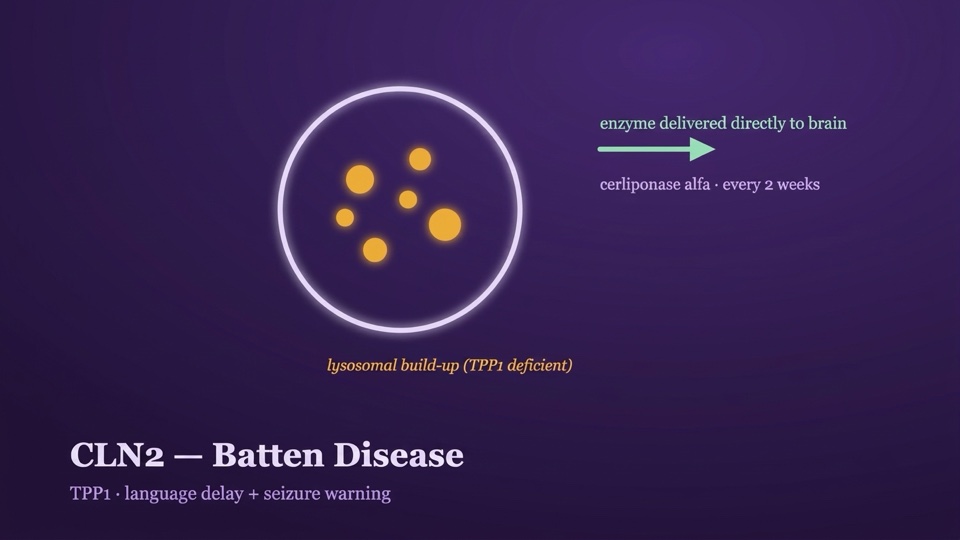
CLN2 disease (late infantile neuronal ceroid lipofuscinosis, from the Batten family), progresses with waste accumulation in nerve cells and progressive loss due to TPP1 enzyme deficiency. It is the first childhood brain disease for which an enzyme replacement therapy (cerliponase alfa) administered directly to the brain has been approved — and this directly translates diagnostic speed into "the amount of function preserved".
Genetic Cause
Mutations in the TPP1 (CLN2) gene (autosomal recessive) eliminate lysosomal tripeptidyl peptidase-1; wastes accumulate in neurons. Other members of the NCL family (CLN1, CLN3...) progress with different ages and findings — a gene panel screens all of them together.
Clinical Course
Insidious onset (2-3 years)
- Often the only finding is language delay — months are lost while it is watched as "talking late, it happens in boys"
- Subtle balance deficits, clumsiness may begin
Seizures (2-4 years)
- Of mixed type (myoclonic, atonic drop attacks, focal, generalised) and drug-resistant within a short time
- EEG signature: occipital spike response to low-frequency (1-2 Hz) photic stimulation — an EEG specialist seeing this finding should think of CLN2 out loud
Regression (3-5 years)
- Rapid loss of language and motor skills, marked ataxia, myoclonic jerks, swallowing difficulty
- Vision loss (retinal involvement) is added at 4-6 years of age and progresses
- MRI: cerebellar atrophy is noticeable in the early period
Diagnosis
- In the triad of "language delay + new-onset seizure + stalling of skills", TPP1 enzyme measurement (dried blood spot) + CLN2 gene analysis are requested together — both give results within days
- The spread of epilepsy gene panels has brought the diagnostic age forward; still, the fastest route is the enzyme test
- At the time of diagnosis, siblings should be tested immediately — a sibling caught before symptoms is the biggest winner of treatment
Treatment
Cerliponase alfa — direct enzyme to the brain
- Administered every two weeks into the brain ventricle (intracerebroventricular) via a small surgically placed reservoir
- Studies have shown it significantly slows motor-language deterioration compared with the natural course; functions are preserved for much longer in those started early (especially before symptoms)
- Follow-up: infection risk at the device site, hypersensitivity precautions on the day of administration
- Honest limit: the enzyme given into the ventricle does not reach the retina — it is not expected to stop vision loss; separate research is under way for the eye
Supportive treatment
- Seizure management (drugs that worsen myoclonus are avoided), nutrition (gastrostomy if needed), physiotherapy, vision rehabilitation, comfort for pain and spasm
Prognosis — An Honest Framework
- The untreated natural course is harsh: walking and speech are largely lost around 6 years of age; life is generally limited to late childhood
- With treatment, motor-language loss slows; in children started early, walking and communication are reported to be preserved for years — but the treatment does not stop the disease, what is gained is time; this framework should be explained clearly to the family
- Vision loss follows a separate course; early blindness should be anticipated in the education plan
- Sibling screening + newborn screening (now beginning in some countries) are the real tools that change prognosis
Research Horizon
- TPP1 gene therapy (aiming for a single administration to the brain) and intraocular enzyme/gene applications are at the research stage
- Gene therapy studies are also under way for other members of the NCL family (CLN3, CLN6...)
Daily Life
- Fix the two-weekly administration rhythm into the family calendar; plan travel around the dosing interval
- As vision decreases: consistency in home layout, high contrast, verbal cues
- Helmet/protective arrangements for falls and myoclonus
- Family associations (NCL/Batten networks) are a strong source of both practical and emotional support