
Overview
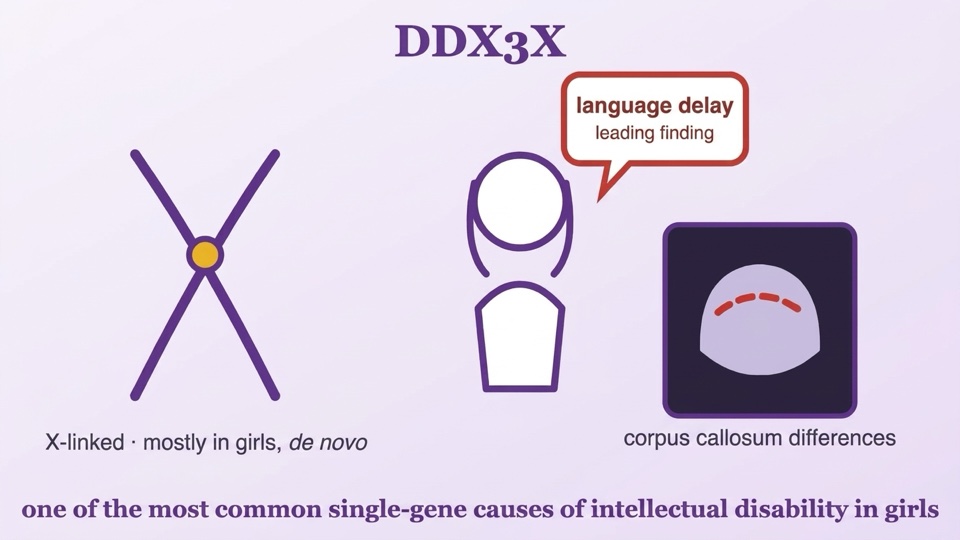
DDX3X-related neurodevelopmental disorder is a relatively newly recognised condition that, with the spread of gene panels, has come to be understood as one of the most common single-gene causes of intellectual disability in girls. The core features are variable degrees of developmental delay/intellectual disability, marked language delay, hypotonia in infancy, and frequently accompanying autism features and attention-anxiety problems; in a subgroup, brain MRI shows corpus callosum differences or polymicrogyria. The spectrum is very wide: it ranges from mildly affected girls attending mainstream classes to severe presentations with non-verbal status and seizures — so no family should be told there is "a single typical course".
Genetic Cause and Mechanism
- DDX3X encodes an "RNA helicase" that manages the folding and unwinding of RNA in the cell; it is critical for neuronal migration and synapse maturation during brain development. It is located on the X chromosome, and because it partially escapes X-inactivation, disruption of even a single copy causes the condition in girls.
- In girls it is almost always de novo (sibling recurrence risk is low, with a gonadal mosaicism contribution of ~1%). Male cases are rarer — usually with missense variants inherited from the mother and sometimes a more severe course; in the family history, asking about "affected males on the maternal side" is important.
- As a rough rule, some missense variants (especially those associated with polymicrogyria) may follow a more severe course than loss-of-function-type variants — reading the genetic report with this in mind gives families a more accurate prognosis. VUS classifications are reviewed every 1-2 years.
Clinical Presentation
- Development: floppy infant with hypotonia, late sitting-walking; language is the most affected domain — comprehension is usually better than expression, and this difference gives families hope and a strategy (AAC starts early).
- Behaviour: autism features, attention deficit-hyperactivity, anxiety; in some cases sensory sensitivities and self-stimulatory/self-injurious behaviours — these improve markedly with structured behavioural support.
- Neurological: in a subgroup, movement differences (unsteady gait, involuntary movements); epilepsy is a minority finding (~10-15%) and its type is variable.
- MRI: thinning/shortening of the corpus callosum, enlarged ventricles, and in a subgroup polymicrogyria; microcephaly may be seen.
- Other systems: early feeding difficulties, persistent constipation, vision problems (strabismus, refractive errors, cerebral visual impairment), scoliosis, joint laxity; early puberty may be reported in adolescence.
Diagnosis
- Genetic: neurodevelopmental panel/exome; in a girl with the triad of "marked language delay + hypotonia + autism features", DDX3X is already screened for on the panel. If the result is positive, parental testing is performed (de novo confirmation; in male cases, maternal carrier status).
- MRI once at diagnosis: the callosal/cortical pattern (polymicrogyria) is noted both for prognosis and for epilepsy risk. EEG only if a seizure is suspected.
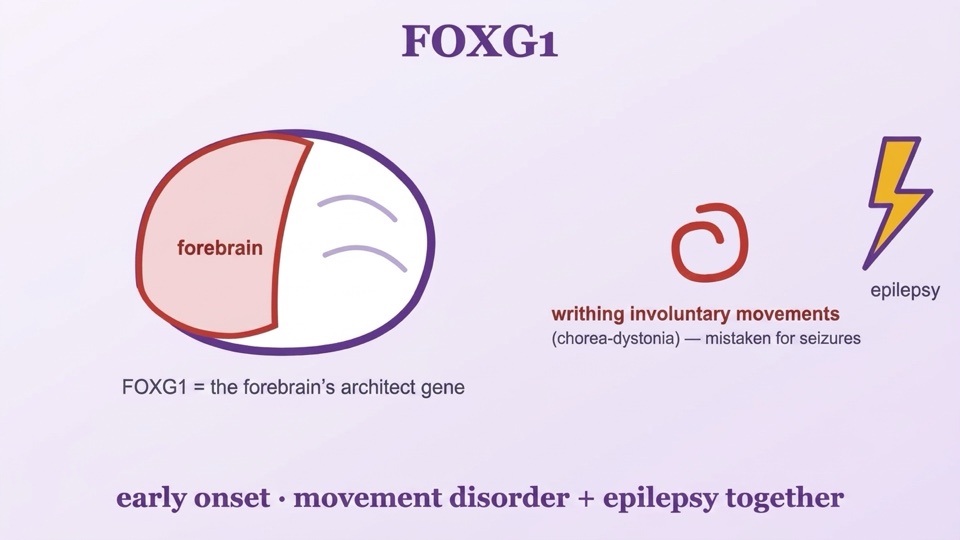
- Differential diagnosis: Rett and Rett-like conditions, FOXG1, Angelman syndrome, fragile X (in girls), CASK — in the panel era, differentiation becomes clear with the molecular result.
Treatment — An Honest Framework
- There is currently no disease-modifying treatment specific to DDX3X; the driver of gains is early and intensive developmental support: physiotherapy (for hypotonia), occupational therapy (sensory regulation + fine motor skills), speech therapy early and intensive — AAC if needed, and a behavioural/educational programme.
- If epilepsy develops, drug choice is based on seizure type; there is no gene-specific "drug to avoid" rule.
- Constipation should not be underestimated — it is a hidden cause of behavioural and sleep disturbance; it is managed with a regular bowel programme.
- Eye examination at diagnosis and at regular intervals; scoliosis is monitored closely during growth spurts; puberty timing is noted, with endocrine evaluation if early signs appear.
- Mental health: age-appropriate behavioural support, and medication support when necessary (by physician decision), for anxiety-attention problems markedly improves quality of life.
- Research horizon: DDX3X natural history studies and registries are active; mechanism-based approaches are at the preclinical stage; they are at the research stage, and this is not a clinical recommendation.
Three Critical Points in the Emergency Department
- 1 · Seizures are a minority finding in this diagnosis, but they occur: standard evaluation (EEG) at the first suspected seizure; if status develops, the steps are standard — there is no drug-specific restriction.
- 2 · Behavioural crisis: intense anxiety/sensory overload presentations may be mistaken for pain or illness; provide a calm, low-stimulus area, keep the family present, explain procedures in advance; not being able to speak does not mean not understanding.
- 3 · Consider constipation in cases of abdominal pain/restlessness — this is among the most common and most easily resolved reasons for emergency visits in this group.
Follow-up — Summary
The backbone of follow-up: annual structured developmental-language assessment (including AAC needs) · behaviour/autism-attention-anxiety screening and updating of the school plan · eye examination (at diagnosis + every 1-2 years) · growth-nutrition and constipation programme · scoliosis examination (every 6 months during growth spurts) · puberty monitoring · low-threshold EEG for suspected seizures · sleep history · dental care · genetic counselling + VUS reclassification + registry participation. The detailed age-by-age table is in the Routine Follow-up Calendar document at the end of the article.
Prognosis — An Honest Framework for Families
- The spectrum is very wide: from mild learning difficulties to marked intellectual disability. MRI findings (especially polymicrogyria) and the early course give the best clues about the severity of the condition.
- The condition is not progressive; language continues to develop even if delayed — good comprehension increases the benefit of AAC and intensive language work.
- The main long-term agenda is learning-behaviour-anxiety and independence skills; regular screening and school collaboration markedly improve outcomes.
- Life expectancy is close to normal.
Daily Life
- Use the framework "communicates this way for now" instead of "doesn't speak": sign, picture card, device — whichever works, let home and school use the same system.
- Keep a constipation calendar (a stool diary); most families first notice its overlap with restless days there.
- Get to know the sensory profile: which sounds-lights-textures overwhelm, which arrangements calm — share a written "sensory identity card" with the school.
- Record suspected staring/jerking episodes on video; this speeds up the decision for the first EEG.
- Join the DDX3X family foundation and registries — information and study announcements flow from there.
Downloadable Documents: Emergency Action Plan + Routine Follow-up Calendar (PDF)
Two documents have been prepared for children with DDX3X by Nörogender, under the guidance of Prof. Dr. Burak Tatlı. The Emergency Action Plan (3 pages): alongside the 5-minute rule, the behavioural crisis–sensory overload approach, a note on constipation, and the standard status steps. The Routine Follow-up Calendar (2 pages): an age-by-age table and tracking chart centred on annual development-language/AAC assessment, behaviour-anxiety screening, eye-scoliosis-puberty monitoring, and the constipation programme.
📄 Emergency Action Plan (PDF, 3 pages) — in Turkish 📅 Routine Follow-up Calendar (PDF, 2 pages) — in Turkish
Complete the documents together with your physician; keep a copy at home and at school.