
Overview
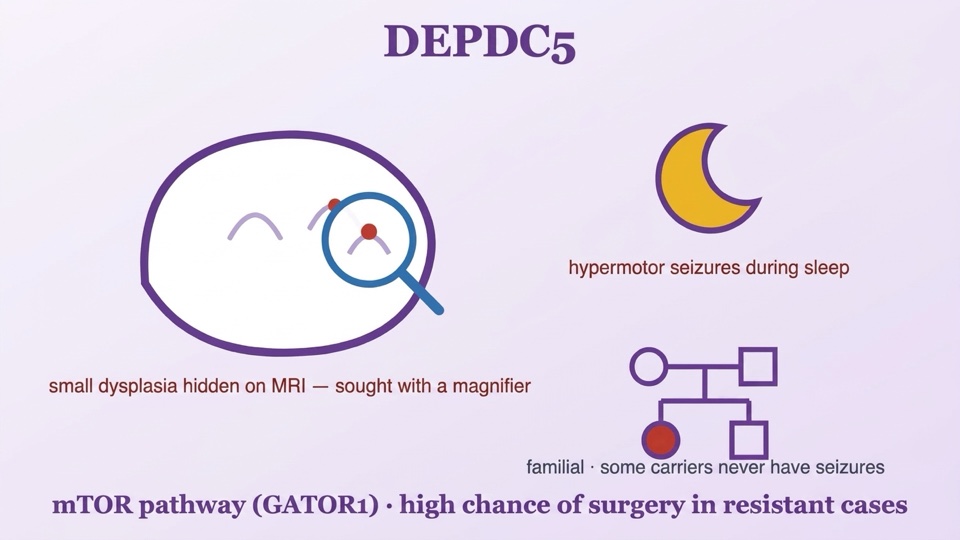
DEPDC5-related epilepsy is one of the most "familial" faces of genetic epilepsy: within the same family, some members have focal seizures arising from the temporal lobe, others from the frontal lobe, and others from a different focus (familial focal epilepsy with variable foci); in a subset, attacks occur almost exclusively during sleep, with sudden, violent movements (sleep-related hypermotor epilepsy). Because DEPDC5 is the brake on the mTOR pathway (the GATOR1 complex) that restrains cell growth, this gene is also a leading genetic cause of small, sulcus-bottom focal cortical dysplasias that are easily missed on MRI. Three practical messages: night-time attacks thought to be "nightmares/parasomnia" may in fact be epilepsy; even when the MRI is reported as "normal", it should be re-examined closely for dysplasia — because if found, the chance of cure with surgery is high; and this gene shows incomplete penetrance — some family members who carry the variant never have a seizure.
Genetic Cause and Mechanism
- DEPDC5, together with NPRL2 and NPRL3, forms the GATOR1 complex, which is the brake on the mTOR pathway. When this brake is weakened, small regions of the cortex receive an excessive "growth signal" — this explains both the tendency to seizures and the risk of focal cortical dysplasia (type II). In dysplastic tissue, a second, somatic (tissue-limited) hit has often been demonstrated — the "two-hit" model.
- Inheritance is autosomal dominant with incomplete penetrance (~60%): not every individual carrying the variant has seizures. The family history may therefore appear to "skip" generations — the history should be taken generation by generation.
- The same mechanism applies to NPRL2/NPRL3 variants; the principles in this guide can also be applied to those families. VUS results are reclassified every 1–2 years.
Clinical Picture
- Onset is often in childhood or adolescence (though the range extends widely from infancy to adulthood); seizures are focal: staring plus automatisms, forced head-eye turning, unilateral contraction, or a focal seizure that spreads to a generalised one.
- Sleep signature: in a subgroup, attacks occur almost only during sleep — sudden sitting up, pedalling or thrashing-type violent movements, lasting a few seconds to two minutes, several times a night. For years these may be mistaken for nightmares, disturbed sleep, or a psychological episode; video and video-EEG make the distinction.
- Development is mostly normal; learning-attention difficulties and autism spectrum features are reported in a subset — screening should be carried out, but this should not be presented to families as an inevitable outcome.
- Course is variable: one group achieves full control with medication; up to a third follow a drug-resistant course — in this drug-resistant group, the search for dysplasia and surgical evaluation become central.
Diagnosis
- Genetic testing: focal epilepsy plus a family history warrants a gene panel/exome; if positive, parents and siblings should be asked about symptoms and tested if necessary (with incomplete penetrance explained).
- MRI search for dysplasia: 3 Tesla, thin-slice, epilepsy protocol; if the first MRI is "normal", re-reading or repeat imaging should follow the diagnosis — small sulcus-bottom dysplasias are easily missed. PET or advanced processing at an experienced centre if needed.
- Video-EEG: establishes the nature of the night-time attacks and localises the focus; it is a basic step in surgical candidacy.
- Differential diagnosis: parasomnias (night terrors, sleepwalking — longer, purposeless, not recalled), psychogenic attacks, other familial focal epilepsies (CHRNA4/B2 autosomal dominant nocturnal frontal lobe epilepsy).
Treatment — An Honest Framework
- The standard approach to focal epilepsy applies: sodium channel blockers, including carbamazepine/oxcarbazepine, are suitable and often preferred options in this diagnosis (the avoidance rules that apply in generalised syndromes do not apply here); lamotrigine, lacosamide and levetiracetam are further options.
- Surgical evaluation should not be delayed in drug-resistant cases: when dysplasia is found, resective surgery has been reported to achieve high rates of seizure freedom in this gene — the common assumption that "genetic epilepsy means no surgery" is incorrect for DEPDC5.
- Sleep routine is part of treatment: sleep deprivation triggers attacks; shift patterns and late bedtimes are a particular topic to discuss in adolescence.
- Discussing SUDEP: an increased risk has been reported in drug-resistant cases with night-time seizures; night-time monitoring/sensors and the importance of seizure control should be discussed openly with the family.
- mTOR inhibitors (everolimus/sirolimus): the mechanism is rational and case series and early studies are ongoing; at present this is at the research stage / considered case by case at the decision of a specialist centre; it is not a recommendation for routine clinical practice.
Three Critical Points for the Emergency Department
- 1 · Night-time hypermotor attack ≠ nightmare/psychogenic episode: in a child presenting with sudden, violent, brief attacks from sleep, consider epilepsy; request video, and refer to neurology — a "psychological" label is the most common cause of delay in this diagnosis.
- 2 · The standard approach to status epilepticus applies without restriction: this is a focal syndrome — the institutional protocol of benzodiazepine → levetiracetam/valproate/including fosphenytoin is applied; ask the family about their rescue plan.
- 3 · Do not rely on a "normal MRI" report: in this gene, dysplasia may be small and hidden; if there is a history of a drug-resistant course, add a recommendation for epilepsy-protocol MRI plus evaluation at a surgical centre to the discharge note.
Follow-up — Summary
The backbone of follow-up: a seizure diary plus videos of night-time attacks · asking about sleep routine at every visit · an honest assessment of medication response — evaluation at a surgical centre after non-response to two appropriate drugs (video-EEG plus epilepsy-protocol 3T MRI; re-reading a "normal" MRI with dysplasia in mind) · learning-attention screening (at school age) · discussing SUDEP risk in drug-resistant cases plus a night-time plan · family screening (autosomal dominant, incomplete penetrance — generation-by-generation history) plus genetic counselling · driving-occupation counselling (adolescent-adult) · VUS reclassification. A detailed age-by-age table is in the Routine Follow-up Calendar document at the end of the article.
Prognosis — An Honest Framework for Families
- Most individuals achieve good control with medication and lead an ordinary life; development is typically normal.
- In a drug-resistant course, the most important message is this: this is one of the genetic epilepsies that benefits most from surgery — the search for dysplasia should be pursued patiently.
- The picture can vary greatly within the same family; some individuals carry the variant and never have a seizure — family screening is not meant to label anyone as "ill" but to provide information and early diagnosis.
- In drug-resistant cases with night-time seizures, discussion of SUDEP should not be neglected; the risk falls as control is achieved.
Daily Life
- Record night-time attacks on video (keep the phone by the bedside; capture the start of the attack if possible) — this guides both diagnosis and treatment.
- Protect sleep hours; lapses during exam weeks or holidays are the most common trigger.
- Draw up the family tree with your doctor: fragments such as "grandmother had fainting spells when young" are valuable.
- In a drug-resistant course, do not delay a second opinion and evaluation at a surgical centre.
- Discuss driving-occupation planning with your doctor according to your seizure control status.
Downloadable Documents: Emergency Action Plan + Routine Follow-up Calendar (PDF)
Two documents have been prepared for individuals with DEPDC5 by Nörogender, under the guidance of Prof. Dr. Burak Tatlı. The Emergency Action Plan (3 pages): alongside the 5-minute rule, a note that "a night-time hypermotor attack is not a nightmare", the standard status epilepticus steps applied without restriction, and a note on "do not rely on a normal MRI — search for dysplasia". The Routine Follow-up Calendar (2 pages): an age-by-age table and record chart organised around sleep routine, the threshold for surgical evaluation (non-response to two drugs), discussion of SUDEP, and family screening.
📄 Emergency Action Plan (PDF, 3 pages) — in Turkish 📅 Routine Follow-up Calendar (PDF, 2 pages) — in Turkish
Complete the documents together with your doctor; keep a copy at home and at school.