
Overview
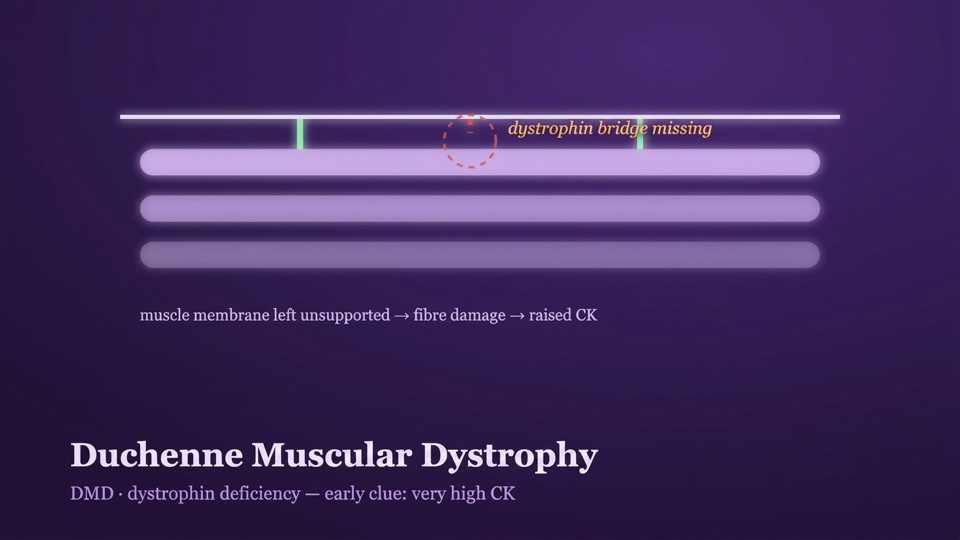
Duchenne Muscular Dystrophy (DMD) is the most common inherited muscle disease of childhood (~1/3,500-5,000 male births). Dystrophin, which protects muscle against mechanical stress, cannot be produced; the muscle fibre is damaged with every contraction. With standardised multidisciplinary care and new treatments, the natural course has changed considerably.
Genetic Cause
The X-linked DMD gene (the largest in the genome): deletions (~65%), duplications (~10%) and point mutations. If the reading frame is preserved, the milder Becker phenotype is seen. About 1/3 of cases are de novo; in the rest the mother is a carrier → maternal testing is essential, and cardiac follow-up (intermittent echo/MRI in adulthood) is recommended for carrier women.
Clinical Course
- Ages 2-5: Inability to run, frequent falls, needing to hold on when climbing stairs, rising from the floor with the Gowers manoeuvre, calf pseudohypertrophy; speech and learning difficulties may accompany this (brain dystrophin isoforms)
- Ages 6-12: Weakness progresses; walking is typically lost around 10-13 years of age (can be delayed with steroids)
- Adolescence onward: Scoliosis, declining respiratory capacity and cardiomyopathy come to the fore — this is the main focus of modern follow-up
Diagnosis
- The gateway: very high CK (thousands to tens of thousands). Request CK also in unexplained AST/ALT elevation — the classic "liver investigation spiral" is a well-known cause of delayed diagnosis
- Genetic sequence: first MLPA (deletion/duplication) → if negative, sequence analysis; muscle biopsy is now rarely required
- The type and location of the mutation determine treatment eligibility (which exon is suitable for exon skipping?) — keep the report
Treatment and Follow-up
Steroids — the main treatment
- Prednisone/deflazacort is started during the motor plateau period (~4-6 years); it improves walking duration, respiratory and cardiac function, and reduces the risk of scoliosis
- Adverse effect management is a package: weight-height monitoring, vitamin D + calcium, vertebral fracture screening (bisphosphonate when needed), behavioural effects, cataract checks
- Adrenal suppression: A stress dose of steroid is required during severe illness/surgery — this must be written on the emergency card; steroids must never be stopped abruptly
- Vamorolone is a structurally modified option intended to retain the corticosteroid effect while reducing the burden on growth and bone. It is approved in the USA and Europe from at least 2 years of age; the permitted daily upper limit differs between the two regions, so the dose is set by your doctor according to the current product information in your country. It is not correct to say it is not a steroid: it suppresses the adrenal axis as well, and the stress-dose rule applies in exactly the same way
- Givinostat works independently of mutation type and targets inflammation and fibrosis in muscle. In the USA it is approved from at least 6 years of age; European authorisation was granted on 6 June 2025 and was limited to children who are ambulant and taking corticosteroids at the same time. It requires monitoring of blood counts, triglycerides and ECG (QT)
Heart and respiration
- Cardiology: echo/cardiac MRI follow-up; starting an ACE inhibitor/ARB at around 10 years of age (or earlier if there are MRI findings) is the standard approach
- Respiration: regular FVC; when it declines, cough-assist devices and night-time non-invasive ventilation — these are evidence-based steps that extend life expectancy
Surgery-anaesthesia warning
Succinylcholine is contraindicated in DMD; inhaled anaesthetics carry a risk of a rhabdomyolysis-like reaction — the team must be informed before every procedure (a written card).
Physiotherapy-orthopaedics
- Daily stretching (the Achilles tendon!), night splints, standing programmes; after loss of walking, scoliosis monitoring and surgery when needed; an appropriate wheelchair-seating system
Prognosis — An Honest Framework
- With standard care (steroids + cardiac protection + respiratory support) today, life expectancy now extends into the 30s and beyond; DMD adults who go to university and work are no longer the exception
- The main factor determining long-term survival is cardiomyopathy management; "protecting the heart early" is today's strongest asset
- Loss of walking is not an "end" but a stage at which care goals change: independent mobility (power wheelchair), education and social participation continue
- The course in the Becker form is much slower; cardiac follow-up is essential there too
Treatment Pipeline — The Position in October 2026
This field changes quickly, and the direction of change is not always forward: over the past two years the scope of some medicines has been narrowed and some confirmatory trials did not meet their targets. The picture below is valid as of 31 October 2026. A medicine being approved in another country does not mean there is marketing authorisation, actual supply or reimbursement in Türkiye; each of these has to be verified separately.
Exon skipping medicines
- Eteplirsen (exon 51), golodirsen and viltolarsen (exon 53), casimersen (exon 45) — in suitable deletions they cause a shortened dystrophin to be produced, given weekly by the intravenous route. All four were licensed in the USA through accelerated approval, that is, on the basis of the increase in dystrophin on muscle biopsy
- The confirmatory trials did not produce the expected result. In the ESSENCE trial, casimersen and golodirsen in 225 children did not reach the primary functional endpoint at week 96. In the RACER53 trial, viltolarsen in 77 ambulant children was not found superior to placebo in time to rise from the floor at 48 weeks
- The applications to convert accelerated approval into traditional approval were accepted for review on 30 June 2026; the target decision date is 28 February 2027. Acceptance of an application does not mean the conversion has been approved
- An important distinction: "my child has an exon 51 deletion" and "my child is eligible for exon 51 skipping" are not the same thing. Eligibility is determined by whether the reading frame is restored when the target exon is skipped; the genetic report needs to be interpreted together with a specialist
Ataluren — European authorisation not renewed
The conditional European authorisation for ataluren, developed for nonsense (premature stop codon) variants, was not renewed on 28 March 2025 on the grounds that clinical efficacy could not be confirmed. Presenting the former European indication as a current, active authorisation is incorrect. This process shows that conditional approval carries an ongoing obligation to generate evidence.
Microdystrophin gene therapy (delandistrogene moxeparvovec / Elevidys)
- It is a single intravenous AAV treatment carrying a shortened dystrophin gene. The protein produced is not full-length normal dystrophin
- The EMBARK phase 3 trial did not meet its primary endpoint: in 125 ambulant children aged 4-7, the difference in NSAA at week 52 was 0.65 points, p=0.2441
- The scope was narrowed on 14 November 2025. The FDA removed the indication for non-ambulant patients and added a boxed warning for acute liver failure, which can be fatal. The current US indication is: a confirmed DMD mutation, at least 4 years of age and ambulant. The broad 2024 scope is no longer valid
- Behind this change are two fatal cases of acute liver failure in non-ambulant children who received the treatment
- No authorisation was granted in Europe: the EMA issued a negative opinion, with a refusal date of 24 September 2025
- Genetics are also decisive for eligibility: deletions involving exon 8 or 9 are a contraindication, and some other regions require additional risk assessment. Antibody level measurement is mandatory, and from 4 August 2026 this test must be performed by an authorised method
- The decision cannot be made on genetic eligibility alone: age, walking status, liver and cardiac status and the centre's capacity for intensive monitoring are assessed together. Weekly liver and platelet checks are required in the first months, and weekly troponin monitoring in the first month
Approaches at the research stage
- Next-generation exon skipping: antibody-conjugated molecules aiming to increase entry of the medicine into muscle. Delpacibart zotadirsen (exon 44) reported an average dystrophin increase of around 25% in an early trial; the target decision date for zelecirment rostudirsen (exon 51) is 21 January 2027. For both, functional benefit has not yet been confirmed
- Genome editing: the first experience in humans was published on 26 October 2026. Targeted editing was demonstrated on muscle biopsy in four children; however, a fatal serious adverse event due to an immune reaction developed in one participant at the high dose. A result that shows plainly the difference between molecular feasibility and safe clinical use
- Gene activation — the utrophin route: The medicines above aim to repair the dystrophin gene or to put a shortened copy in its place. This approach does not touch the dystrophin gene at all; it raises utrophin, its relative, instead. Utrophin is abundant in muscle before birth and withdraws to the neuromuscular junction in mature muscle; raised again, it can take on part of dystrophin's job. The practical consequence is that the effect does not depend on which dystrophin mutation the child carries — unlike exon skipping, it requires no mutation-specific selection. In a study published in Nature Biotechnology on 28 October 2026, the denCas12m tool, which increases how much a gene is read without cutting the DNA, was fitted into a single AAV; given systemically in a humanised DMD mouse model, a four- to sevenfold increase in utrophin was reported at eight weeks, and the improvement in grip strength and endurance lasted six months. This was done in mice; there are no human data. It is worth remembering that the fatal event in the item above was also delivered by a single AAV: the danger there came from the AAV dose and the immune response, not from the cutting. A method is not made safe by the fact that it does not cut DNA
- Cellular therapies: in the published trial of deramiocel (a cardiosphere-derived cell product), a difference in favour of treatment was reported on an upper-limb scale in 106 participants (p=0.029); however, the regulator stated that in the calculation made according to the original analysis plan the difference was not significant (p=0.24). The decision date was extended to 22 November 2026
- Commercial exosome and stem cell preparations do not belong under this heading. The cell source, the manufacturing standard and the dose define the identity of a product; a result seen with one investigational product cannot be transferred to preparations from another source. There is no class of regenerative treatment in DMD that has entered routine use and whose members are interchangeable
How to read this: an increase in dystrophin on biopsy shows that the biological target has been reached; on its own it does not determine the size of any meaningful benefit for the child in walking, arm use, heart or breathing. A medicine producing a higher dystrophin percentage does not prove its clinical superiority over another. In a progressive disease staying stable can also be a valuable outcome; but without a comparison group it cannot be established that the stabilisation was caused by the treatment.
Current picture: Genetic Treatments — Duchenne treatment pipeline.
Follow-up: What Became Clearer in 2025-2026
Alongside the treatment headings, points have also become clearer in follow-up itself over the past two years. These are talked about less than new medicines, but this is the part that affects daily life the most.
- Respiratory thresholds. When forced vital capacity (FVC) falls to 60% of predicted, lung volume recruitment comes onto the agenda; at 50%, referral to a specialist respiratory team is recommended; and below 30%, priority referral. A normal daytime oxygen reading does not exclude night-time hypoventilation; morning headache, daytime sleepiness and broken sleep should be asked about separately
- Cardiac imaging. The 2026 consensus recommends that echocardiography continue as the basic follow-up method, and that cardiac MRI be used more for important treatment decisions from about 10 years of age, once the child can cooperate. Palpitations, fainting or a new cardiac finding do not call for waiting until the scheduled appointment
- Bone health. A vertebral fracture can be painless; follow-up is therefore not based on asking about pain alone. Regular DXA and lateral spine imaging are planned. Correcting calcium and vitamin D deficiency is a basic measure, but these do not replace the treatment to be given if a fracture has already occurred
- Puberty and hormone monitoring. The 2026 guideline recommends that conversations about puberty begin at around 10 years and physical examination by 12 years at the latest. Children on daily corticosteroids should be referred to endocrinology by the age of 12; in those on an intermittent regimen or not taking steroids, assessment is needed if puberty has not begun by 14
- Learning, attention and mental health. DMD is not only a muscle disease; dystrophin also has roles in the brain. In a multicentre study published in 2026, the rate of at least one diagnosis among 238 boys aged 5-17 was 21% (attention deficit 8.4%; anxiety disorders 7.9%; autism spectrum 6.7%). Regular screening of these areas from diagnosis onward is not a matter to be left for later
- Transition to adult care. The international consensus published in 2025 sets out that transition is not a single referral; it is a process covering planning, handover, adult follow-up and the young person's own goals in life. Education, transport, housing and independent decision-making are part of the care plan
- Carrier mothers' own health. Women carrying a DMD variant should not be assessed only in terms of reproductive risk. The international consensus recommends a cardiology assessment within six months of carrier status being confirmed, and, after a normal baseline, a check approximately every 3-5 years. A negative blood test in the mother does not reduce the recurrence risk to zero, because of germline mosaicism
A resource for Türkiye
The Ministry of Health's Duchenne Muscular Dystrophy Clinical Guideline was published in September 2025. This 174-page national resource is the reference document for how care is to be organised within the country. Since an approval decision abroad does not mean marketing authorisation, actual supply or reimbursement in Türkiye, the current status at the Turkish Medicines and Medical Devices Agency (TİTCK) and the Social Security Institution (SGK) has to be verified separately for each medicine.
Questions you can ask at your appointment
- How closely does my child resemble the group in which this medicine was studied and licensed (age, walking status, mutation)?
- What is the expected outcome: improvement, a slowing of deterioration, or the preservation of a particular ability?
- Was the expected benefit shown only by a laboratory measurement, or by an outcome that is felt in daily life?
- What is the most serious harm, what monitoring is needed to detect it early, and where can we have that done?
- If we do not start this treatment, what is the alternative plan?
Daily Life
- Written information for school: arrangements for stairs/physical education, a fall plan, an emergency card
- Weight management (steroids + reduced movement) should be addressed early; dietitian support
- Psychosocial support: for the family after diagnosis, for the young person themselves during adolescence
- Participation in patient registries with mutation information — trial eligibility is screened from there
Downloadable: Duchenne Emergency Action Plan (PDF)
You can download the 3-page emergency action plan prepared for children with Duchenne by Nörogender, under the guidance of Prof. Dr. Burak Tatlı. At the centre of the form are DMD's four emergency pillars: steroid stress dosing (chronic cortisone must never be stopped abruptly; continue intravenously in a vomiting child), the heart (ECG + troponin for chest pain/palpitations; a note that "CK is already high"), anaesthesia (succinylcholine strictly forbidden, avoidance of gas anaesthetics), and a warning about fat embolism after fracture. The identification section has spaces reserved for steroid and cardiac medicines. The third page is a medical information note with dosing boxes, for healthcare professionals.
There is also a Routine Follow-up Calendar (2 pages): a year-by-year table and record chart built around four pillars — steroid adverse effect monitoring, annual cardiac assessment (echo/cardiac MRI + ECG), respiration (FVC-cough-night-time), and bone-scoliosis.
📄 Emergency Action Plan (PDF, 3 pages) — in Turkish 📅 Routine Follow-up Calendar (PDF, 2 pages) — in Turkish
Complete the form together with your doctor; keep one copy at home and one at school, and show it to the team before every surgery/anaesthesia.