
Overview
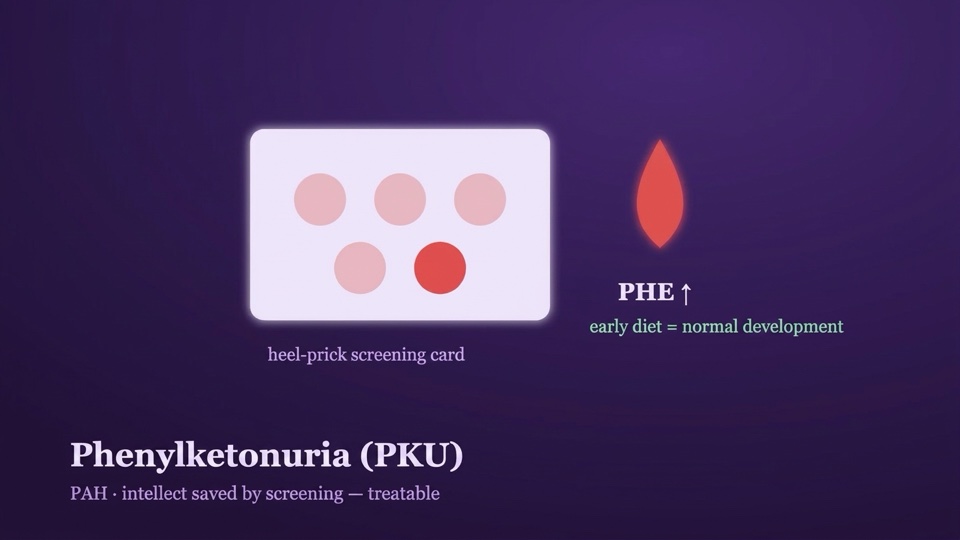
Phenylketonuria (PKU) is a metabolic disease in which phenylalanine (Phe) cannot be broken down and damages the brain, but which is caught by screening and can be completely prevented with diet. In Türkiye the frequency is above the world average, and heel-prick blood screening has been applied successfully for decades. The essence of modern PKU care can be summed up in one sentence: keep the blood Phe level within the target range for life.
Genetic cause and classification
Mutations in the PAH gene (autosomal recessive) reduce the enzyme. Depending on the remaining enzyme activity, the picture ranges from mild hyperphenylalaninaemia to classic PKU; the genotype helps predict diet tolerance and response to sapropterin. In a small group the problem lies in BH4 (cofactor) metabolism — BH4 disorders must be excluded at every new diagnosis, because their treatment is entirely different (neurotransmitter precursors are required).
Screening and diagnosis
- High Phe on heel-prick blood → confirmation (quantitative amino acid analysis), BH4 assessment, PAH analysis
- Target for a positive screen: starting treatment within the first 7-10 days — every week of delay can translate into a cognitive cost
Treatment
Diet — the main treatment
- Natural protein is restricted; the resulting protein deficit is made up with a Phe-free amino acid mixture; special low-protein products close the energy gap
- Target blood Phe: the commonly accepted range in childhood is 120-360 µmol/L; follow-up frequency is weekly in infancy and becomes less frequent with age. Targets can show small differences between centres — follow your own centre's chart
- "Diet for life": in individuals who relax the diet in adolescence or adulthood, problems with attention/processing speed, mood fluctuations and white-matter changes on MRI can be seen; when levels are brought back under control, a significant part of these findings improves
Drug options
- Sapropterin (BH4): in suitable (generally mild-to-moderate) cases, it supports the enzyme and increases Phe tolerance; it is determined with a response test
- Pegvaliase: enzyme replacement for adults who cannot reach target with diet; because of the risk of allergic reaction, it is carried out with a stepwise dosing schedule and a ready adrenaline plan — in the right patient it dramatically relaxes the diet
Maternal PKU — the most critical counselling point
Uncontrolled Phe harms the baby during pregnancy (heart defect, microcephaly, developmental delay) — even if the baby does not have PKU. The rule is clear: Phe must be brought into the target range (<360, ideally 120-360) before pregnancy is planned and monitored closely throughout pregnancy. Giving this information to every young person with PKU during adolescence protects the next generation.
Prognosis — an honest framework
- With early and continuous treatment, intelligence is within the normal range; school and working life are typical. Subtle differences (attention, speed, tendency to anxiety) can be seen and are related to level control
- Late-diagnosed/untreated classic PKU leaves permanent cognitive impairment — today in Türkiye the main task is catching migrant or home-birth infants who escape screening
- Life expectancy is normal; the follow-up burden (diet cost and logistics) should be eased for families with support programmes
Treatment pipeline and research horizon
- Gene therapy trials (delivering PAH to the liver) are at an early stage; in first-generation programmes the balance between efficacy and safety is still being sought
- mRNA-based enzyme replacement and biological approaches that break down Phe in the gut (enzyme-containing probiotics) are at the research stage
- The goal is clear: "PKU without diet" — but for today the proven assurance is still the combination of diet plus medication
Daily life
- A written Phe plan and a "hidden protein" list (including aspartame!) for school/nursery
- Track level results on a chart; two out-of-target measurements = a dietitian appointment
- Adolescent period: gradually transfer responsibility to the young person (calculating their own meals)
- PKU family associations are the most up-to-date source on product access and regulatory rights