
Overview
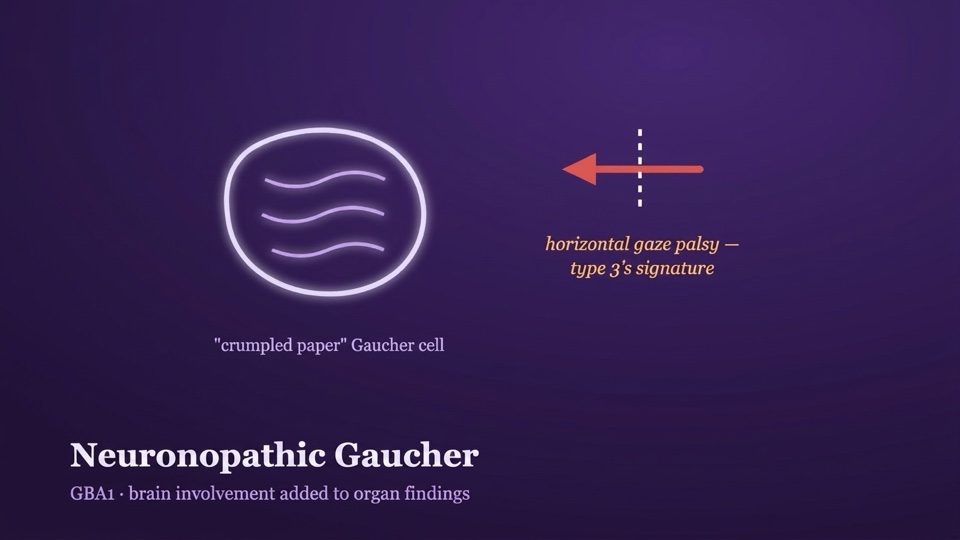
The neuronopathic forms of Gaucher disease (type 2 and type 3) are presentations in which brain involvement is added to the organ findings. Enzyme therapy corrects the spleen, liver and blood but cannot enter the brain; therefore this guide has two focuses: recognising brain involvement early (eye movement!) and following the treatment horizon developing for the brain.
Genetic Cause
GBA1 mutations (autosomal recessive) lower glucocerebrosidase; accumulation turns macrophages into "Gaucher cells". The genotype gives a rough guide (e.g. L444P homozygosity is associated with neuronopathic risk) but is not destiny. (Note: GBA1 carrier status increases Parkinson's disease risk in adulthood — this has a place in family counselling.)
Clinical Features
Type 2 (acute infantile)
- In the first months: feeding-swallowing difficulty, stridor, backward neck arching (retrocollis), gaze palsy; marked hepatosplenomegaly
- Rapid neurological deterioration; rarely, newborn forms with skin findings are seen
Type 3 (subacute; childhood)
- Organ-blood findings (enlarged spleen, thrombocytopenia, anaemia, bone pain) + horizontal gaze palsy: the eye cannot jump to a target, the child looks by turning the head or by a blinking trick — this may be the only neurological finding for years
- Over time: learning difficulty, myoclonic seizures (progressive myoclonic epilepsy in a subgroup), ataxia; in some cases heart valve involvement
Diagnosis
- Enzyme assay on dried blood spot + GBA1 analysis; the biomarker (lyso-Gb1) is useful for both diagnosis and follow-up
- Gaucher disease should be considered in every child with "splenomegaly + thrombocytopenia"; in every child diagnosed with Gaucher disease, an eye movement examination should be performed (the cheapest test to distinguish type 3 from type 1)
Treatment
- Enzyme replacement therapy (ERT): Effectively corrects organ size, blood counts and bone findings; it is the main treatment that prolongs life in type 3. Its limit: it cannot cross the blood-brain barrier — neurological findings may progress slowly even under ERT
- In type 2, the emphasis is placed on honest goals: comfort, feeding, breathing and supporting the family; ERT can lighten the organ burden but does not change the brain course — the decision is made together with the family, with goals discussed openly
- Drug choice for managing seizures/myoclonus is made carefully (agents that worsen myoclonus are avoided)
- At the research stage: High-dose ambroxol (a chaperone that crosses into the brain) has shown encouraging early results in small series in type 3 — only under the decision and follow-up of a specialist centre
Prognosis — An Honest Framework
- Type 2: The course is severe; life is generally limited to the first 2-3 years. An early, open and compassionate conversation about goals is the family's greatest need
- Type 3: In the ERT era, the majority of children reach adulthood; there are individuals who study and work. The neurological component (gaze, learning, myoclonus) may progress slowly; follow-up continues as a partnership between neurology and metabolism specialists
- Sibling screening and, in some communities, pre-marital carrier screening are part of preventive medicine
Treatment Pipeline and Research Horizon
- Treatments that reach the brain are the focus of the field: enzyme designs that cross the barrier, brain-targeted gene therapy programmes and chaperones (including ambroxol) are being investigated at various stages
- Markers such as lyso-Gb1 are becoming standardised as tools to show the effect of studies early
Daily Life
- Fix ERT infusion days into the school/work schedule; ask about the home infusion option
- Avoid sports with abdominal trauma risk while the spleen is enlarged; monitor for bleeding-bruising
- In type 3, reading-learning support and eye movement adaptations (line guides, large print)
- Gaucher associations are strong networks for drug access and study announcements