Overview
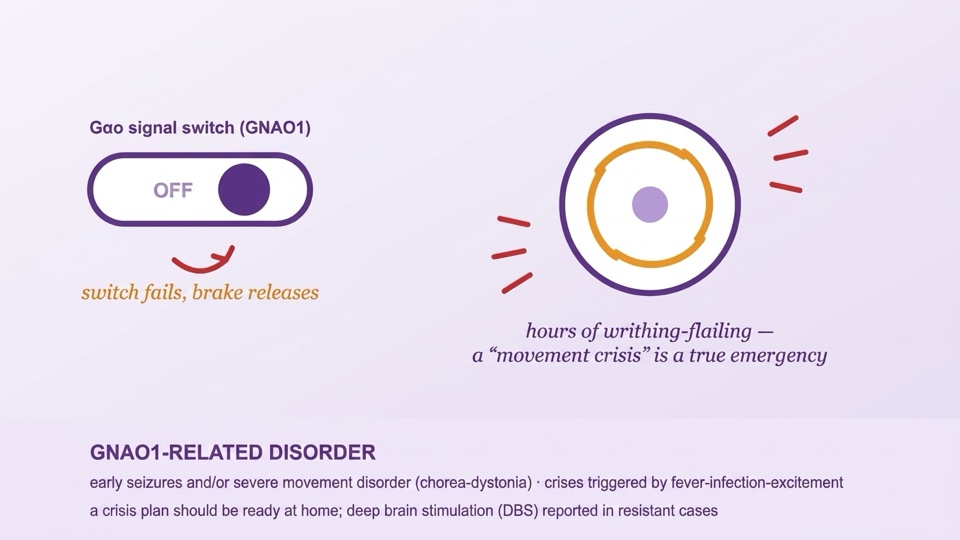
GNAO1-related disorder arises from disruption of one of the most fundamental signalling switches in brain cells (the Gαo protein) and has two faces: infant-onset epileptic encephalopathy and/or a progressive, at times life-threatening movement disorder (chorea-athetosis, dystonia, flailing). What makes this diagnosis distinctive in paediatric neurology is the storms known as "movement crises": episodes of writhing and flailing triggered by fever, infection, pain or excitement, lasting hours to days and exhausting the child — they may require intensive care, but can be managed with a crisis plan written in advance. This plan is the backbone of this article and its accompanying emergency document.
Genetic Cause and Mechanism
- Gαo is the internal switch of G-protein-coupled receptors in neurons (including the dopamine-GABA systems that brake movement); when it is disrupted, the brake-accelerator balance of the basal ganglia is thrown off — both the tendency to seizures and excessive movements are two outcomes of the same switch.
- Variants are almost always de novo (sibling recurrence risk is low, around ~1% accounting for gonadal mosaicism). The type of variant can shape the clinical picture: one group of variants is associated with an epilepsy-predominant course, while another (e.g. certain hot-spot changes) is associated with a movement-predominant course — the literature correlate of the variant should be asked about in the report. VUS results are reclassified every 1-2 years.
Clinical Picture
Background
- Early, marked hypotonia, developmental delay (usually moderate-severe), absent/limited speech; feeding-swallowing difficulty is common. Eye contact and social interest are preserved in most children — "non-verbal but connected".
The epilepsy face
- In one group of children, seizures begin in the first weeks-months and may be drug-resistant (including Ohtahara/West-like presentations); in another group, seizures never occur or remain in the background.
The movement disorder face — and the crisis
- From infancy onwards, chorea-athetosis, dystonia and ballistic (throwing-type) movements; these may become more pronounced with age.
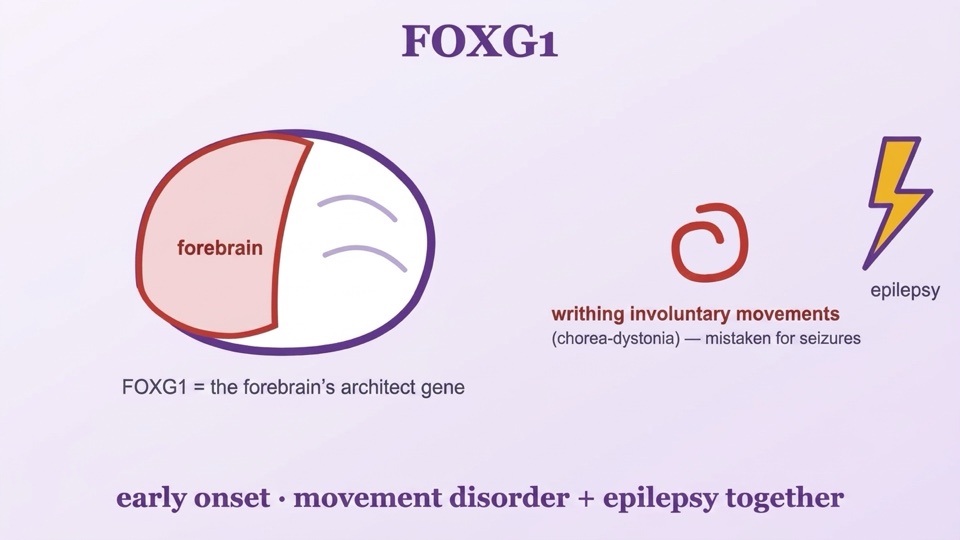
- Movement crisis (dyskinetic storm): a severe period of writhing and flailing triggered by factors such as fever, infection, pain, constipation, excitement or sleep deprivation, lasting hours to days. The risks are real: exhaustion, inability to feed, high fever, muscle breakdown (rhabdomyolysis), and resulting kidney strain. For this reason, every family should have a written crisis plan on hand, and when a crisis is prolonged the child should be managed at an experienced centre.
Diagnosis
- Genetic: epilepsy/movement disorder panels or exome sequencing; the literature profile of the variant (epilepsy- or movement-predominant) is clarified with a specialist centre.
- Video is everything: seizures, chorea-dystonia and crisis periods are distinguished by video; when in doubt, video-EEG is used — because loading antiepileptics does not resolve a crisis, nor does loading movement medication resolve a seizure.
- MRI is often normal or shows non-specific findings; CK and renal function are monitored during a crisis.
Treatment — An Honest Framework
- Seizures: there is no absolute syndrome-specific drug prohibition; standard antiepileptics are used, and ketogenic diet/VNS may be considered in drug-resistant periods.
- Daily movement disorder: tetrabenazine, benzodiazepines, clonidine, gabapentin, trihexyphenidyl and baclofen are reported options; response is individual and each is tried one by one with patience (under physician supervision).
- During a crisis (framework): first, hunt for the trigger (source of fever, pain, constipation, urinary tract), control pain-fever, provide a calm, dim environment; the medication step follows the physician-written crisis plan (often starting with a benzodiazepine ± clonidine); for an unresponsive/prolonged crisis, hospital care — if necessary, sedation in intensive care (e.g. midazolam/dexmedetomidine infusions), cooling, fluids and CK-renal monitoring.
- Deep brain stimulation (DBS): in children with drug-resistant, recurrent severe crises, GPi-DBS has been reported to markedly reduce crisis burden; GNAO1 is among the diagnoses most discussed regarding DBS in childhood. The decision is made at an experienced movement disorder-DBS centre — in a drug-resistant course, this evaluation should not be delayed.
- Research horizon: gene/molecular approaches targeting Gαo signalling are at the preclinical stage; all are at the research stage; this is not a recommendation for clinical use. Participating in patient registries keeps the door open.
Three Critical Points in the Emergency Department
- 1 · A movement crisis is a genuine emergency: it should not be dismissed as "not a seizure" and sent home — the child is assessed for exhaustion, hyperthermia and rhabdomyolysis (CK + renal monitoring, asking about dark urine); the trigger is sought; the crisis plan is applied.
- 2 · The right drug for the right label: the crisis ↔ seizure distinction is made by video; escalating antiepileptics does not resolve a crisis.
- 3 · In a child with DBS, the device is checked (battery/programme); a prolonged crisis is managed by notifying the DBS centre.
Follow-up — Summary
The backbone of follow-up: updating the crisis action plan at every visit (medications and doses according to weight; home stock) · a video archive of episodes (seizure/chorea/crisis labelled separately) · feeding-weight monitoring (dyskinesia burns energy — gastrostomy should be discussed in a child not gaining weight) · orthopaedic follow-up (examination for hip dislocation and scoliosis in dystonia, with radiographs in children who walk little) · baseline and post-crisis CK · active management of sleep and constipation (both are crisis triggers) · communication/AAC assessment · DBS centre evaluation in a drug-resistant course · genetic counselling + VUS reclassification. A detailed age-by-age table is given in the Routine Follow-up Calendar document at the end of this article.
Prognosis — An Honest Framework for Families
- The spectrum is wide; in the movement-predominant group, childhood is the period of most intense crises — with age and the right treatment steps (DBS if necessary), crisis burden can mostly be reduced.
- Serious risks (crisis complications) are largely risks that can be prevented with foresight and planning; this is why a crisis plan plus early contact with a centre is as valuable as the "treatment" of this diagnosis.
- Development does not show progressive loss; communication (gaze, buttons, devices) and comfort are the two main long-term goals.
Daily Life
- Put the crisis plan on the fridge and teach every carer and teacher: what to give first, when to go to hospital, which centre to call.
- Keep a trigger diary (fever, vaccination day, constipation, teething, exciting days) — most crises have a warning sign.
- Video-record episodes and label them (seizure? chorea? crisis?).
- Take comfort seriously: managing pain, reflux and constipation genuinely affects crisis frequency.
- Join GNAO1 family associations and registries — the best source for DBS experience and trial announcements.
Downloadable Documents: Emergency Action Plan + Routine Follow-up Calendar (PDF)
Two documents have been prepared for children with GNAO1 by Nörogender, under the guidance of Prof. Dr. Burak Tatlı. The Emergency Action Plan (3 pages) is structured specifically for this diagnosis according to two types of emergency: a seizure section with the 5-minute rule, alongside a MOVEMENT CRISIS PLAN box (lines for the crisis medication to be written by the physician + hospital thresholds: prolonged crisis, inability to feed, dark urine, fever) and a rhabdomyolysis/CK warning for the emergency team along with a note on "loading antiepileptics for a crisis". The Routine Follow-up Calendar (2 pages): an age-by-age table including crisis plan updates, CK-feeding-orthopaedic monitoring and a DBS evaluation line, plus a record chart.
📄 Emergency Action Plan (PDF, 3 pages) — in Turkish 📅 Routine Follow-up Calendar (PDF, 2 pages) — in Turkish
Fill in the documents together with your physician; keep a copy at home and at school, and update medication doses as weight changes.