
Overview
Kabuki syndrome (~1/30,000) is a multisystem condition caused by disruption of epigenetic regulatory genes: the core features of a typical face, hypotonia and developmental delay are accompanied by cardiac, palatal, immune, hearing and endocrine components. Follow-up is "checklist medicine" — if the checklist is applied in full, the course is usually good.
Genetic Cause
In ~70% of cases, KMT2D (autosomal dominant, mostly de novo) is responsible, and in ~5% of cases KDM6A (X-linked). Both are chromatin "openers": they regulate the reading of hundreds of genes — which is why the findings are multisystem in nature. In diagnosis, the genome-wide methylation signature (episignature) is a powerful modern tool for classifying variants of uncertain significance.
Clinical Features
Suggestive findings
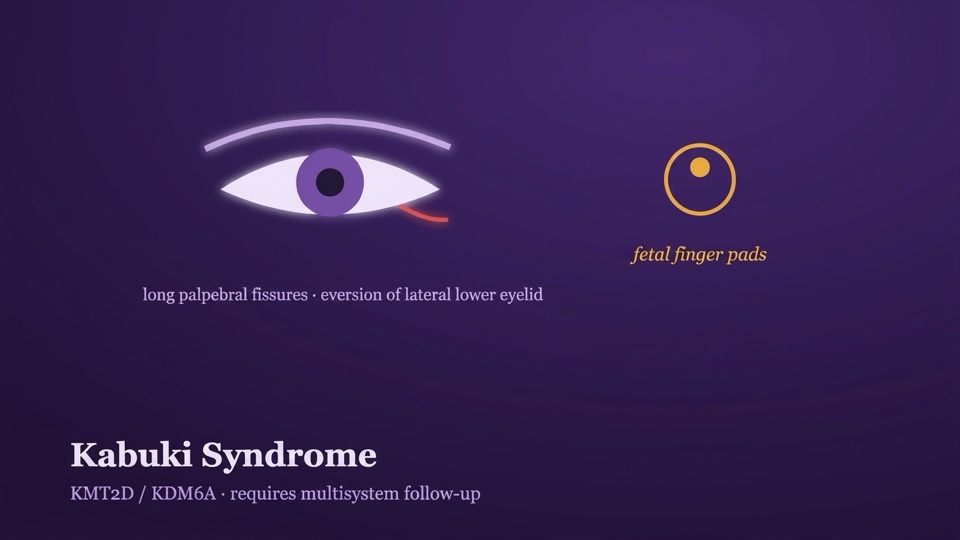
- Face: Long palpebral fissures, eversion of the lateral third of the lower eyelid, arched sparse lateral eyebrows, prominent ears
- Persistent fetal finger pads — a quick and valuable examination clue
Systems
- Feeding-growth: Hypotonia and feeding difficulty in the newborn (sometimes requiring a feeding tube), short stature; a tendency to weight gain in adolescence
- Heart (40-50%): Including coarctation and left heart outflow lesions — echocardiography at diagnosis
- Palate: Cleft/submucous cleft, velopharyngeal insufficiency → hypernasal speech; feeding and speech team involvement
- Immune system: Hypogammaglobulinaemia and frequent ear-lung infections; autoimmune comorbidities (ITP, vitiligo) may occur — IgG levels and vaccine responses should be assessed, with immunoglobulin support when needed
- Hearing: Chronic otitis with effusion is common; a sensorineural component may be present — regular audiology
- Endocrine: Early breast budding in girls (often benign), assessment of the growth hormone axis and thyroid; neonatal hypoglycaemia (hyperinsulinism) occurs in a subgroup
- Joint laxity-dislocations, vertebral anomalies, scoliosis; seizures in a minority; eye findings (ptosis, strabismus)
Diagnosis
- Clinical suspicion + panel/exome; when a VUS results, the methylation signature helps differentiate
- Should be considered in a hypotonic infant with feeding difficulty and a typical face, and in the picture of "developmental delay of unknown cause + frequent infection"
Follow-up and Treatment (summary checklist)
- At diagnosis: echocardiography, hearing, eye, palate-feeding assessment, IgG + vaccine responses, thyroid, hip-spine examination, renal ultrasound
- Annually: growth (endocrine if needed), hearing, eye, scoliosis, dental; immunology depending on frequency of infections
- Early intervention: physiotherapy, speech-language therapy (with VPI awareness), individualised education plan
- Surgeries (palate, heart, dislocation) at experienced centres with anaesthesia assessment
Prognosis — An Honest Framework
- Cognitive level is typically in the mild-moderate range: most individuals can read, communicate and work with support; visual learning is a strong channel
- Life expectancy is generally good with repair of the cardiac lesion and management of infections
- If speech intelligibility (palate function) is addressed early, social participation increases markedly
- Most cases are de novo; the transmission risk to the child of an affected individual is 50% — counselling is provided at the adolescent-adult transition
Research Horizon
- The epigenetic mechanism opens the door to the idea of drug-based "adjustment correction": learning gains with chromatin-modifying drugs have been reported in animal models — an area that is early for human studies but is being monitored
Daily Life
- Keep an infection diary (if frequency increases, this is evidence for immunology referral)
- Do not delay decisions on hearing aids/ventilation tubes — language development does not wait
- Guidance on sport selection for joint laxity (swimming is ideal)
- Kabuki family associations are valuable for sharing endocrine-immune experience