
Overview
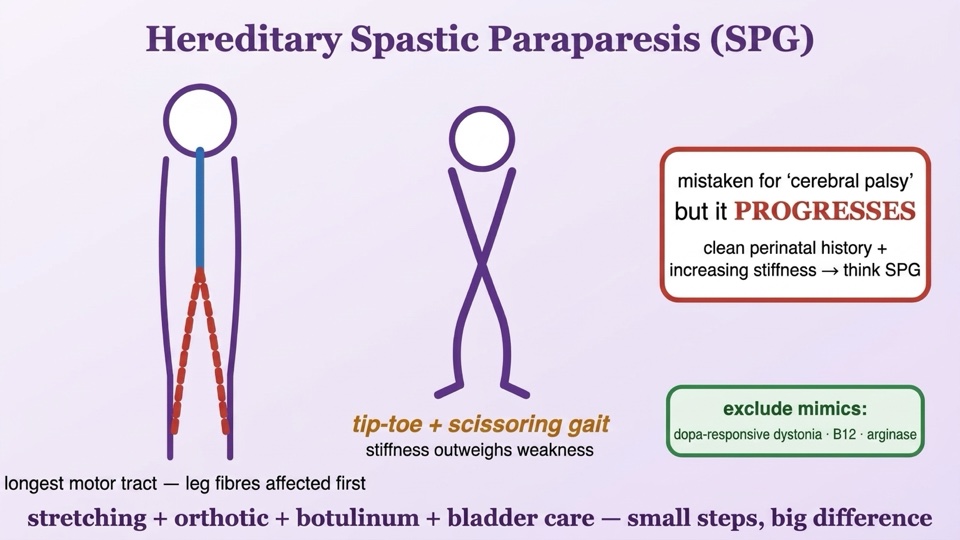
Hereditary spastic paraparesis (HSP; known by the gene family name SPG) is a length-dependent degeneration of the longest motor fibres descending from the brain to the legs (the corticospinal tract) — it can be thought of as the central-nervous-system mirror of CMT: there, peripheral wiring is affected at its farthest end; here, central wiring is. The result is stiffness (spasticity) in the legs rather than weakness: tip-toe walking, scissoring, frequent tripping and falling. The single most important sentence in paediatric neurology here is: in any child followed with a diagnosis of "spastic diplegia cerebral palsy" whose perinatal history is clean but whose findings PROGRESS over the years, SPG should be considered — CP does not progress, SPG progresses slowly. The second sentence is just as valuable: in the diagnostic work-up, treatable mimics (dopa-responsive dystonia, B12/folate pathway disorders, arginase deficiency) must always be excluded.
Genetic Cause and Main Types
- More than 80 SPG genes have been identified; the common thread is disruption of the "cargo transport and membrane-shaping" machinery of long axons. Inheritance can be dominant, recessive or X-linked depending on the type — the family tree is half the diagnosis.
- SPG4 (SPAST; dominant): overall the most common HSP; also seen in childhood; typically a "pure" presentation. A mildly affected parent ("a father who cannot walk fast, who struggles on stairs") should not lead to "no one in the family has it" without being examined.
- SPG3A (ATL1; dominant): one of the most common causes of childhood-onset pure HSP; often progresses very slowly and can remain almost stable for years — hence it is the group most often misdiagnosed as "CP".
- SPG11 / SPG15 (recessive): classics of the complicated end of the spectrum: in addition to spasticity, learning difficulty-cognitive impairment, a thin corpus callosum on MRI and neuropathy are added; findings become evident in adolescence and young adulthood.
- AP-4-associated HSP (SPG47 family; recessive): begins in infancy; developmental delay plus early spasticity — one of the most common genetic causes of "CP mimicry"; it is kept particularly in mind in families with parental consanguinity.
- SPG7 (recessive): overlaps with ataxia; more often adolescent-adult onset.
- VUS results are reclassified every 1-2 years; if the panel is negative but the clinical picture is strong, deletion/duplication analysis (common in SPAST) and the exome/genome step are discussed.
Clinical Picture
- Gait: toe-walking, foot dragging (the toe of the shoe wears out), scissoring, inability to run, frequent falls; stiffness increases with fatigue and cold.
- Examination: spasticity in the legs plus brisk reflexes plus Babinski sign; muscle strength is relatively preserved (an important difference from CP and neuromuscular diseases); pes cavus may accompany it.
- Bladder, a rarely asked finding: a feeling of urgency, urinary urgency, night-time incontinence — children do not volunteer this, and if not asked it is missed for years; it is a silent burden on quality of life.
- Pure vs complicated: in the pure form, findings are confined to the legs and bladder; in complicated forms, learning-cognitive impairment, neuropathy, ataxia and eye findings are added — the type and follow-up plan differ accordingly.
- Course: slow progression spanning years to decades; some childhood-onset types (especially SPG3A) have long plateaus. Intelligence is not affected in pure types; life expectancy is typically normal.
Diagnosis — and Mimics That Must Not Be Missed
- Genetics: HSP panel/exome (including deletion analysis for SPAST/ATL1); family examination (± parental testing). A history of consanguinity brings recessive types to the fore.
- MRI: brain (a thin corpus callosum → a sign pointing to SPG11/15) plus the entire spinal cord — cord compression, tethered cord and structural causes must be excluded once, without fail.
- Treatable mimics — mandatory stops in the diagnostic work-up: dopa-responsive dystonia (a picture that worsens through the day and is better in the morning; when in doubt, an L-dopa trial is both diagnostic and therapeutic — this opportunity must not be missed), B12/folate-methylation pathway disorders, arginase deficiency (screened for with ammonia-arginine). In addition, CP (static course plus perinatal history), leukodystrophies and neuromuscular diseases are distinguished by clinical-MRI-EMG findings.
Treatment — An Honest Framework
- At present there is no disease-modifying treatment specific to SPG; but it is a disease with "a great deal that can be done" — spasticity management genuinely changes daily life.
- Core package: regular physiotherapy plus a daily stretching programme (Achilles-hamstring-adductor), an AFO/orthosis (for walking safety and Achilles protection), suitable footwear; fatigue management.
- Botulinum toxin: in focal spasticity (calf-adductor) it can ease gait; its effect lasts 3-4 months and is planned together with stretching and physiotherapy.
- Oral medication: baclofen ± tizanidine (with physician titration; the balance between drowsiness and weakness is monitored). In selected, widespread-severe spasticity, an intrathecal baclofen pump is considered at an experienced centre.
- Orthopaedic surgery (Achilles-hamstring lengthening, etc.) in selected cases, with timing decided jointly — given the progressive nature of the disease, the expectation of a "one-time fix" should not be set.
- Bladder management: history-taking plus, if needed, residual-volume ultrasound/ urodynamics; medication for an overactive bladder (with urology); urinary tract infections are monitored.
- In complicated types, learning-cognitive support and neuropathy-ataxia management are added.
- Research horizon: gene-specific approaches (including the SPAST axis) are at the preclinical stage; at the research stage, not a recommendation for clinical use. Participation in natural-history registries is advised.
Three Critical Points in the Emergency Department
- 1 · Rapid worsening is not SPG: SPG progresses over years — increasing weakness/stiffness over days to weeks, new urinary retention or a sensory level → look for additional, treatable causes such as cord compression, transverse myelitis or B12 deficiency (have a low threshold for spinal cord imaging).
- 2 · Baclofen must never be stopped abruptly: sudden discontinuation of oral baclofen can cause agitation and rebound spasticity; intrathecal pump withdrawal syndrome IS AN EMERGENCY (high fever plus widespread rigidity plus altered consciousness → contact the pump team and plan a bridging dose). Temporary weakness for a few days after botulinum is a known effect.
- 3 · Bladder-UTI: do not skip urinalysis in a febrile presentation; ask about inability to void/a distended bladder. Assess for ankle trauma after a fall; factor in that prolonged immobilisation will increase spasticity when planning care.
Follow-up — Summary
The backbone of follow-up: physiotherapy-stretching goals plus review of the orthosis/AFO every 6 months · an annual video recording of gait (the cheapest way to objectively track progression; gait analysis if needed) · planning the botulinum programme (3-4-month cycle) · a bladder history at every visit (plus residual-volume ultrasound if needed) · a hip X-ray and scoliosis examination in early-onset/severe spasticity · asking about pain-cramps-fatigue · a school plan (adapted physical education, distance-stairs arrangements, extra time allowance for fatigue in written exams) · an annual learning-cognitive assessment in complicated types · family examination plus genetic counselling (dominant 50% / recessive 25%) · written documentation in the file that DRD-B12-arginase have been excluded · VUS reclassification. The detailed age-by-age table is in the Routine Follow-up Calendar document at the end of the article.
Prognosis — An Honest Framework for Families
- SPG progresses slowly; most individuals still walk in adulthood (with support if needed); life expectancy is normal in pure types. The issue is less "inability to walk" than the energy cost of walking, fall safety and the bladder — all three can be managed.
- Childhood-onset pure types (especially SPG3A) can have long plateaus; the expectation that "it will worsen every year" is not correct.
- In complicated types (SPG11/15, AP-4), the picture is broader; early diagnosis ensures that learning support and follow-up are set up correctly.
- Adherence to the stretching-orthosis routine reduces the need for contracture surgery over the years — small daily tasks, a large difference.
Daily Life
- Make stretching part of the daily routine like tooth-brushing (10 minutes morning and evening); it is easier after a warm shower.
- Record a gait video once a year in the same corridor — compare it with your doctor at the check-up.
- Do not keep bladder symptoms (urgency, incontinence) to yourselves; it is a finding that can be addressed.
- Wear at the toe of the shoe is an early sign of increasing toe-walking — bring the orthosis appointment forward.
- Give the school a written plan; ask for adapted participation in physical education rather than an "all or nothing" approach.
- Join HSP family associations and registries.
Downloadable Documents: Emergency Action Plan + Routine Follow-up Calendar (PDF)
Two documents have been prepared for children with SPG by Nörogender, under the guidance of Prof. Dr. Burak Tatlı. The Emergency Action Plan (3 pages): in this group the focus is not seizure but crisis — the rule "rapid worsening is not SPG → consider cord-myelitis-B12", the warning on baclofen withdrawal (pump syndrome is AN EMERGENCY) and a note on bladder-UTI; the identification section includes rows for spasticity medications plus pump/botulinum. The Routine Follow-up Calendar (2 pages): an age-by-age table and recording chart built around the stretching-orthosis routine, annual gait video, botulinum cycle, bladder history, hip-scoliosis and mimic-exclusion record.
📄 Emergency Action Plan (PDF, 3 pages) — in Turkish 📅 Routine Follow-up Calendar (PDF, 2 pages) — in Turkish
Fill in the documents together with your doctor; keep a copy at home and at school, and show the baclofen/pump information at every emergency presentation.