
Overview
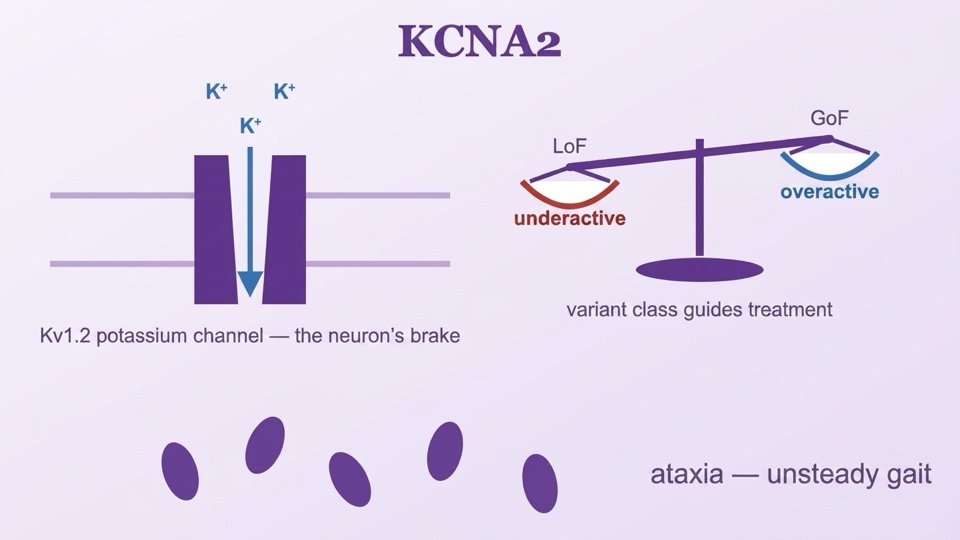
KCNA2-related developmental and epileptic encephalopathy results from disruption of the Kv1.2 potassium channel, one of the neuron's "brake cables", and is a textbook example of precision medicine: whether the variant makes the channel work too little (LoF) or too much (GoF) changes the clinical picture and the treatment strategy. The common ground is seizures starting in infancy-early childhood, developmental impairment, and, especially in the GoF group, marked ataxia (unsteady gait). This is why one of the first steps in this diagnosis is to clarify the functional class of the variant (LoF / GoF / mixed) in the genetic report.
Genetic Cause and Mechanism — Two Opposite Faces
- KCNA2 encodes the Kv1.2 channel that restrains firing in axons; variants are almost always de novo.
- Loss-of-function (LoF): the brake weakens → typically fever-triggered and predominantly focal seizures in infancy, with relatively milder developmental impairment; some follow a Dravet-like course.
- Gain-of-function (GoF): paradoxically, the network is silenced → earlier onset, generalised seizures predominantly of the absence-myoclonic type, marked ataxia and more severe developmental impairment.
- Mixed (LoF+GoF) variants are at the most severe end. Which class the variant in your report belongs to can be learned from published functional studies — your doctor/geneticist will check this; if the class is unknown, saying "unknown" is also an answer. VUS are reclassified every 1-2 years.
Clinical Picture
- Epilepsy: onset is usually in the first 1-2 years; febrile/focal in LoF, absence-myoclonic in GoF; status epilepticus can be seen in both groups. In a subset of patients, seizures decrease markedly by school age-adolescence.
- Ataxia: a hallmark finding, especially in GoF — wide-based, unsteady gait, tremulousness in fine motor skills; may fluctuate with fatigue and illness.
- Development: delay ranging from mild to marked; language and attention domains stand out; autistic features may accompany.
- EEG: focal or generalised spike-wave depending on phenotype; sleep activation may be seen.
Diagnosis
- Genetic testing: epilepsy panel/exome; parental testing if positive. The critical step after the report: confirming the variant's LoF/GoF class from the literature — this can change the treatment plan.
- Differential diagnosis: Dravet (in LoF-like fever-triggered onset), other channelopathies (SCN2A/SCN8A, KCNQ2), and, in epilepsy-ataxia combinations, CACNA1A and GLUT1 (excluded by CSF glucose/genetics — a mimic in which the ketogenic diet is therapeutic).
Treatment — An Honest Framework
- Standard drug selection is phenotype-based: in the generalised-myoclonic predominant picture (mostly GoF), the valproate/levetiracetam/ethosuximide-clobazam line is favoured, and this seizure type is approached with caution because of the risk of exacerbation with CBZ/OXC/phenytoin; in the focal-predominant picture (mostly LoF), a wide range including sodium channel blockers can be used. In other words, the "avoidance list" in this gene is based on seizure type, not on the gene itself — your doctor will mark the emergency card according to your child's type.
- Targeted hope — 4-aminopyridine (fampridine): this drug, which acts by blocking the channel in GoF variants, has shown responses in seizures and ataxia in international case series. At present it is an option evaluated case-by-case in specialist centres, within a research/off-label framework; it is not a recommendation for routine clinical use — and it is meaningful only in the GoF class (no expected benefit in LoF, and there is a theoretical concern). The final decision belongs to the treating physician.
- Ataxia-balance package: physiotherapy, fall safety (home arrangement, helmet if necessary), occupational therapy; writing and physical education adaptations at school.
- The ketogenic diet can be considered in resistant cases.
- In a drug-resistant course, risks including SUDEP are discussed openly with the physician; the rescue plan is kept up to date at every weight.
Three Critical Points in the Emergency Department
- 1 · The drug note is phenotype-dependent: check the family's emergency card — in the absence-myoclonic predominant picture, CBZ/OXC/phenytoin may cause exacerbation, and valproate/levetiracetam is preferred in status; in the focal-predominant picture, the standard steps are unrestricted.
- 2 · Prolonged drowsiness-grogginess may be absence status → it is confirmed with EEG and treated with benzodiazepine plus a suitable second-line agent.
- 3 · Ataxia baseline: newly marked unsteadiness is not always a "drug side effect" — in case of a change in level, check drug levels plus clinical assessment; do not forget a trauma assessment after a fall.
Follow-up — Summary
The backbone of follow-up: a seizure diary plus videos · the variant class (LoF/GoF) being recorded in the file and the emergency card being filled in accordingly · review of ataxia-gait safety every 6-12 months (with physiotherapy goals) · a low threshold for EEG in prolonged drowsiness · annual developmental-language and behavioural assessment plus a school plan · periodic re-evaluation of targeted options (4-AP) with a specialist centre in the GoF class · bone health (vitamin D) and dental care · genetic counselling plus VUS reclassification plus registry participation. The detailed age-by-age table is in the Routine Follow-up Calendar document at the end of the article.
Prognosis — An Honest Framework for Families
- The course differs by class: in the LoF group, seizures are often more manageable and a decrease with age is reported; in the GoF/mixed group, the epilepsy-ataxia-learning burden is more marked.
- Ataxia is more a fluctuating baseline problem than a progressive loss; physiotherapy and safety arrangements preserve independence.
- Targeted treatment research (4-AP and beyond) has made this gene one of the leading examples of precision medicine — registry participation is the way to early access to new options.
Daily Life
- Carry a copy of your genetic report and the variant class note in the emergency bag; make sure the drug line on the emergency card is filled in accordingly.
- During unsteady periods, arrange the home: sharp corners, wet floors, stair railings; a helmet is already a rule for cycling-skateboarding.
- Record videos of episodes and changes in gait — this supports dosing/diagnostic decisions.
- A written plan for school: flexible time for writing, fall-safe activities in physical education, and re-asking after lapses in attention.
- Join KCNA2 family communities and registries.
Downloadable Documents: Emergency Action Plan + Routine Follow-up Calendar (PDF)
Two documents have been prepared for children with KCNA2 by Nörogender, under the guidance of Prof. Dr. Burak Tatlı. The Emergency Action Plan (3 pages): alongside the 5-minute rule, a drug line filled in according to the variant class ("if absence-myoclonic predominant, CBZ/OXC/phenytoin may cause exacerbation"), the "prolonged drowsiness → EEG" rule, and a note on ataxia-falls. The Routine Follow-up Calendar (2 pages): an age-by-age table plus a tracking chart built around recording the variant class, ataxia-safety review, developmental-language assessment, and periodic evaluation of targeted options in GoF.
📄 Emergency Action Plan (PDF, 3 pages) — in Turkish 📅 Routine Follow-up Calendar (PDF, 2 pages) — in Turkish
Complete the documents together with your doctor; keep a copy at home and at school, and update the rescue medication dose as weight changes.