
Overview
KCNQ2-related epilepsy is the most common genetic cause of neonatal seizures, and brings together two opposite fates in a single gene: the benign familial form, which resolves spontaneously within weeks, and KCNQ2 encephalopathy, which can leave lasting developmental impairment. Because genetics answers the "which drug?" question in the neonatal intensive care unit, KCNQ2 is a showcase for precision medicine.
Genetic Cause
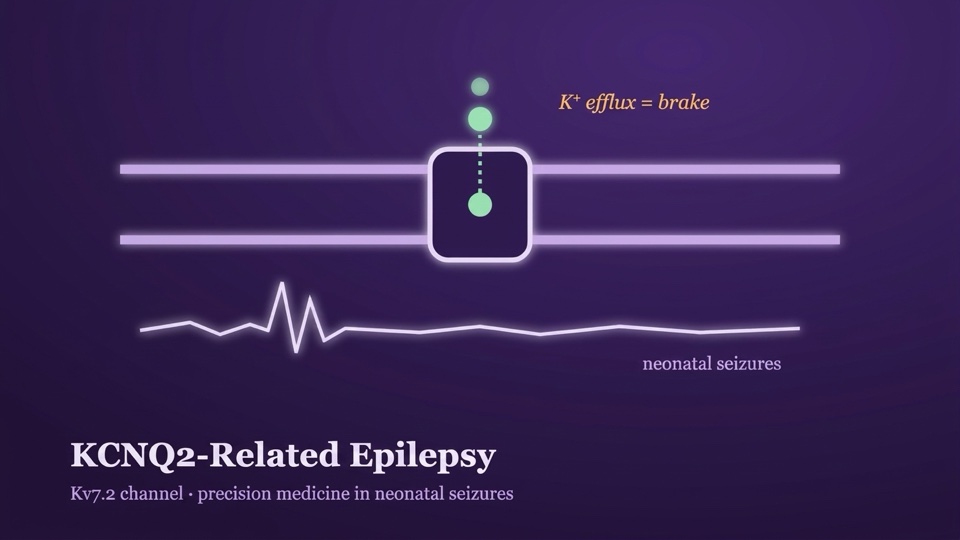
KCNQ2 encodes the Kv7.2 potassium channel, which brakes neuronal firing. In the benign form, the mutation is usually familial (autosomal dominant; look for a history of "seizures as an infant" in a parent!) and partially reduces channel function. In the encephalopathy form, changes are mostly de novo and severely disrupt the channel (sometimes dominant-negative).
Clinical Features
Benign familial neonatal epilepsy
- Brief tonic-clonic seizures starting on days 2-8 of life; the infant looks surprisingly well between episodes; background EEG is normal
- Seizures resolve spontaneously within weeks to a few months; development is normal
KCNQ2 encephalopathy
- Frequent, severe tonic seizures in the first days; the infant is hypotonic and non-interactive between episodes; EEG shows severe disturbance such as burst-suppression
- Seizures mostly settle within months to a few years; however, developmental impairment of varying severity remains
Diagnosis
- In neonatal seizures, a rapid genetic panel is now an early step; the result guides treatment within 1-2 weeks
- While waiting, certain clues guide decisions: family history + a well-appearing infant between episodes + normal background EEG → favours the benign form; severe background disturbance → raises concern for encephalopathy
- The functional interpretation of the mutation in the report (loss-of-function/dominant-negative) is the basis of the prognosis discussion
Treatment — Why Is Drug Choice Different?
- In KCNQ2 seizures, sodium channel blockers — especially carbamazepine/oxcarbazepine — are markedly effective and are the first choice in many centres; if clinical suspicion is strong, trying them without waiting for the genetic result is advocated
- Although phenobarbital is still the common first step, in a neonate who does not respond, the reflex of "could this be KCNQ2 → carbamazepine" saves days
- In the benign form, the aim is short-term control; the drug is usually discontinued within months
- In encephalopathy, after seizure control, emphasis shifts to the developmental package: physiotherapy, communication, vision-hearing assessment
Prognosis — An Honest Framework
- Benign form: Excellent. Development is normal; there is a mildly increased risk of febrile seizures/epilepsy later on (~10-15%) and the course is usually good again — families should hear this reassurance
- Encephalopathy: Settling of seizures is the rule; development, however, remains on a spectrum ranging from mild learning difficulty to severe impairment. Rapid control of the seizure burden in the early period is the most modifiable factor available
- There are "grey zone" cases between the two forms; the course in the first months is more determinative than the label
Treatment Pipeline and Research Horizon
- Kv7 channel openers: The first generation (ezogabine/retigabine) was withdrawn from the market due to adverse effects; new-generation Kv7 openers are in advanced-phase trials in adult epilepsy — renewing hope for a "drug that fits the mechanism exactly" for KCNQ2
- In loss-of-function cases, dosage-increasing (ASO/gene) approaches are at the preclinical stage
- International KCNQ2 registries are strengthening genotype-drug response matching
Daily Life
- In the familial form, inform relatives: a history of "seizures in infancy" can shorten another newborn's diagnosis to minutes
- At discharge, have a written plan: which drug, for how long, and at which findings to seek early review
- In the encephalopathy group, start the early intervention programme without losing time
Downloadable Documents: Emergency Action Plan + Routine Follow-up Calendar (PDF)
A 3-page emergency action plan prepared by Nörogender under the guidance of Prof. Dr. Burak Tatlı: fillable fields for your child's information and medications, what to do during a seizure and the 5-minute rule; KCNQ2-specific points for the emergency department team (including the particular effectiveness of sodium channel blockers in this condition); on the third page, a medical information note for health professionals (status steps, with the framework "the final decision belongs to the physician").
There is also a Routine Follow-up Calendar (2 pages): it structures follow-up along two paths according to phenotype (self-limited familial type / DEE) — in the familial type, a drug discontinuation plan after remission and inheritance counselling with up to 50% recurrence risk; in DEE, developmental support, autism-movement disorder screening and AAC under the principle of "seizures ending ≠ follow-up ending"; with an age-by-age table and a record chart.
📄 Emergency Action Plan (PDF, 3 pages) — in Turkish 📅 Routine Follow-up Calendar (PDF, 2 pages) — in Turkish
Fill in the form together with your doctor; keep one copy at home and one at school.