
Overview
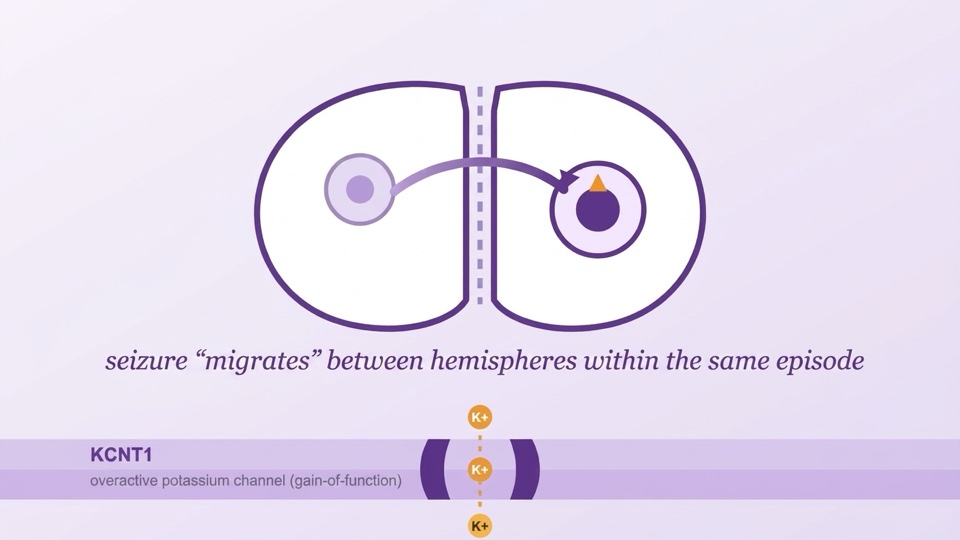
KCNT1 encodes the brain's largest sodium-activated potassium channel (KNa1.1 / "Slack"). Almost all disease-causing changes are of the gain-of-function type: the channel works more than it should, and the firing balance of neuronal networks is disrupted. At the severe end of the clinical spectrum is epilepsy of infancy with migrating focal seizures (EIMFS), one of the most difficult epilepsies of infancy — KCNT1 is the most common genetic cause of this condition. At the other end of the spectrum is sleep-related hypermotor epilepsy (SHE), in which intelligence is mostly preserved. Because the two ends of the same gene can be so different, the first task once a diagnosis is made is to name the phenotype.
Genetic cause and mechanism
- The channel: KCNT1/Slack is a potassium channel sensitive to intracellular sodium; gain-of-function mutations increase the current many times over. Although this may seem paradoxical (potassium current is normally "inhibitory"), the excess current disrupts the function of interneuron networks in particular, leading to severe epilepsy — this mechanism is the rationale for the drug-development strategy of blocking the channel.
- Inheritance: In EIMFS the mutation is usually de novo (occurring for the first time in the family); parental testing is still performed (low-rate mosaicism — sibling recurrence risk). The SHE/ADSHE form may be familial (autosomal dominant, with incomplete penetrance): transmission from an affected parent to a child is 50%, and mild to severe presentations can be seen within the same family.
- VUS note: "Variant of uncertain significance" reports should be re-queried with the laboratory every 1–2 years; if the classification changes, the follow-up and treatment strategy may also change.
Clinical presentations
1 · EIMFS — epilepsy of infancy with migrating focal seizures (severe end)
- Onset: within the first 6 months, often in the first weeks. Seizures are focal, but their hallmark is that within the same attack, the seizure "migrates" from one hemisphere to the other (the focus shifts location on EEG) — hence the name.
- Course: seizures occur in clusters, may be numerous during the day, and show marked drug resistance. Development is severely affected; acquired microcephaly, marked hypotonia and movement disorders (dyskinesia/dystonia) accompany it; cortical visual impairment is common.
- Non-neurological findings: Cardiac rhythm disturbances have been reported in some patients → a baseline ECG is needed at diagnosis and rhythm awareness during follow-up. Feeding-swallowing difficulty and reflux-constipation are common; the risk of early SUDEP/mortality is high and should be discussed openly with the family.
2 · SHE / ADSHE — sleep-related hypermotor epilepsy (mild end)
- Seizures occur during sleep, as sudden, brief, "storm-like" hypermotor attacks (screaming, pedalling, thrashing); they can cluster throughout the night. They may be mistaken for nightmares, night terrors or parasomnia for years before diagnosis — video plus sleep EEG is the distinguishing test.
- Intelligence mostly remains normal to borderline; in the KCNT1-related familial form, behavioural and psychiatric features (impulsivity, mood changes) may be more pronounced than in other causes of SHE — mental health screening should be part of follow-up.
3 · Intermediate forms
The same gene may also present with Ohtahara/West-like early encephalopathies, non-migrating drug-resistant focal epilepsies, and moderately severe developmental presentations. Practical rule: whatever the presentation is called, follow-up is organised according to the severity of the phenotype.
Diagnosis
- Genetic testing: epilepsy gene panel / exome — a picture of migrating focal seizures in an infant should directly raise suspicion of KCNT1. Parental testing is requested for subtype and inheritance counselling.
- EEG: in EIMFS, the shifting of the focus between hemispheres on ictal recording is diagnostic; interictal EEG may initially be deceptively quiet. If SHE is suspected, a sleep/night video-EEG is planned.
- Additional baseline assessment: cranial MRI (often normal at first; atrophy may develop over follow-up), baseline ECG, vision assessment, feeding-swallowing assessment.
Treatment — an honest framework
- This is a difficult epilepsy: classical antiepileptics are often insufficient in EIMFS; there is no syndrome-specific prohibition on drugs (sodium channel blockers may also be tried), and the aim is to reduce seizure burden and status episodes.
- The ketogenic diet is one of the options reported to give relatively good results in this group and should be considered early; in a child on the diet, sugar-containing drug syrups/intravenous fluids disrupt ketosis — all prescriptions must be coordinated with the dietary team.
- Quinidine (a channel blocker) strongly suppresses the KCNT1 current in the laboratory; unfortunately, clinical results have mostly been disappointing, and because of the risk of QT prolongation/arrhythmia, it is only tried in selected cases, in an experienced centre, with inpatient ECG-QTc titration and level monitoring. Quinidine also has strong drug interactions (CYP2D6 inhibition) — every new medication must be checked by a pharmacist/physician.
- Other steps: cannabidiol, vagus nerve stimulation, and a written emergency plan for drug-resistant status episodes. Surgery is generally not suitable in EIMFS because of its migrating, multifocal nature.
- Research horizon: ASO programmes targeting KCNT1 are at the preclinical/ early stage; in addition, trials of new molecules under the DEE umbrella (such as candidates like bexicaserin and relutrigine) may also include patients with KCNT1 — participation in patient registries is meaningful for trial eligibility. All of these are at the research stage; they are not a recommendation for clinical use.
Three critical points in an emergency
- 1 · Rescue plan: for clustering seizures or those lasting longer than 5 minutes, give rescue medication and call 112 (emergency services in Türkiye); migrating seizures can last a long time, and the plan should be updated for weight at every visit.
- 2 · If the child is on quinidine: an ECG/QTc check is needed in the emergency department; drugs that further prolong QT (ondansetron, macrolides, etc.) should be avoided; the interaction list should be checked.
- 3 · If the child is on the ketogenic diet: sugar-containing (dextrose) intravenous fluids and syrups should be avoided, and the dietary team should be contacted.
Follow-up — summary
The backbone of follow-up is organised according to phenotype: in EIMFS, frequent visits, head circumference, feeding-swallowing (gastrostomy if needed), vision, movement disorder, EEG and ECG (serial QTc while on quinidine); in SHE, overnight video recording, sleep hygiene, psychiatric screening and family testing. SUDEP precautions and genetic counselling are constant at both ends of the spectrum. A detailed year-by-year table is provided in the Routine Follow-up Schedule document at the end of this article.
Prognosis — an honest framework for families
- EIMFS is a severe condition: seizure control is difficult, developmental gains may be limited, and the risk of early mortality/SUDEP is high. Seizure burden may decrease somewhat over time; every gain (feeding, visual engagement, predictability of care) is directly reflected in quality of life.
- In the SHE form, life expectancy and cognitive function are mostly preserved; the problem is the effect of night-time seizures on sleep and mental health — the correct diagnosis (not parasomnia!) changes life.
- Even within the same family, severity can differ (incomplete penetrance) — knowing that "a family member had a mild form" is not enough for individual prognosis.
Daily life
- Keep the rescue medication plan written and available at home and school; train the carer/teacher.
- Film the seizures and movement disorder episodes on video — this is the most valuable information for treatment decisions.
- If the child is on the ketogenic diet, remind every pharmacist/physician contact of the "sugar-free medication" rule.
- Discuss night-time supervision/monitor options with your doctor (SUDEP precautions).
- Family associations and patient registries keep the door open in an era of new drug trials.
Downloadable documents: emergency response plan + routine follow-up schedule (PDF)
Two documents have been prepared for children with KCNT1 by Nörogender, under the guidance of Prof. Dr. Burak Tatlı. The Emergency Response Plan (3 pages) includes fillable identity/medication fields, what to do during a seizure and the 5-minute rule, along with KCNT1-specific warnings — QT/ECG checks and the interaction list for a child on quinidine, the prohibition on sugar-containing intravenous fluids/syrups on the ketogenic diet, and a note that sleep-related hypermotor seizures may be mistaken for parasomnia. The Routine Follow-up Schedule (2 pages) provides a two-track, year-by-year follow-up table and record chart according to phenotype (EIMFS / SHE).
📄 Emergency Response Plan (PDF, 3 pages) — in Turkish 📅 Routine Follow-up Schedule (PDF, 2 pages) — in Turkish
Complete the documents together with your doctor; keep a copy at home and at school, and update the rescue medication dose as the child's weight changes.