Overview
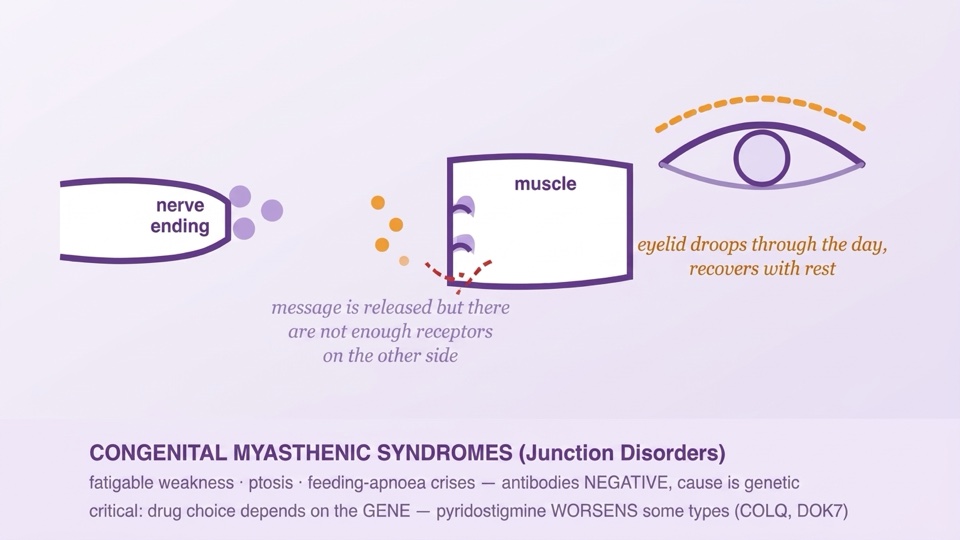
Congenital myasthenic syndromes (CMS) are genetic disorders of the point of communication between nerve and muscle — the neuromuscular junction. Their common language is fatigability: an eyelid that is fine in the morning droops by evening, sucking weakens after a few mouthfuls, the legs "give out" at the end of a flight of stairs. The antibodies seen in autoimmune myasthenia are negative here; the cause lies in the gene, and this difference has a vital consequence: drug choice depends on the gene — pyridostigmine, which works in most types, can worsen the picture in COLQ and DOK7 types. Another critical aspect is apnoea/respiratory crises in infancy (especially with CHAT and RAPSN): sudden respiratory arrest during a febrile infection can be the first and most dangerous presentation of undiagnosed CMS.
Genetic Cause and Main Types
- Receptor deficiency (mainly CHRNE): the most common group; eye findings are prominent, the course is relatively stable; good response to pyridostigmine. Mostly autosomal recessive (frequency increases with consanguinity; recurrence risk 25%).
- RAPSN: may present in infancy with episodic apnoea crises plus joint contractures; surprising wellness between crises; pyridostigmine is effective and the picture softens with age.
- CHAT: its hallmark is sudden apnoea attacks triggered by infection/fever — the child may appear normal in between; pyridostigmine is protective, and the family is equipped with an apnoea plan.
- DOK7: limb-girdle weakness predominating in the shoulders and hips; pyridostigmine can worsen it — effective treatment is salbutamol/ephedrine.
- COLQ: acetylcholinesterase cannot attach; pyridostigmine is contraindicated (it worsens the condition); salbutamol/ephedrine is used. A sluggish pupillary response can be a clue.
- Slow-channel syndrome (dominant): the channel stays open too long; pyridostigmine is not given; instead, channel-blockers such as fluoxetine/quinidine are used (a matter for specialist centres).
- GFPT1/GMPPB and glycosylation types: limb-girdle pattern; CK may be elevated in GMPPB (myopathy overlap).
Other Members of the Junction: Autoimmune and Transient Forms
- Juvenile myasthenia gravis: an antibody-positive (AChR, rarely MuSK) autoimmune disease occurring in school age-adolescence; its treatment differs (pyridostigmine + immunotherapy; thymus evaluation). A physician seeing "fluctuating ptosis + fatigability" should consider both doors at once: autoimmune if antibody-positive, genetic if antibody-negative with early onset.
- Transient neonatal myasthenia: transient weakness-feeding problems in the first weeks of life in an infant of a mother with myasthenia, due to antibodies crossing from the mother; it resolves spontaneously but may require support during those weeks.
Clinical Clues
- Fluctuation: ptosis, limited eye movement, swallowing-sucking weakness, and nasal speech that become more pronounced during the day and after exertion; partial recovery with rest.
- In infants: weak cry-sucking, feeding that tires the infant, recurrent "cyanosis/apnoea attacks", floppiness; marked worsening during febrile illness.
- CK is normal (apart from exceptions such as GMPPB) — junction disorders also fall into the "CK is normal, so it's not a muscle disease" misconception.
- If persistent ptosis in a child is obscuring vision, there is a risk of amblyopia (lazy eye) — eye follow-up is part of treatment.
Diagnosis
- EMG — repetitive nerve stimulation: looks for decrement, the electrical correlate of junction fatigue; single-fibre EMG if needed. A normal routine EMG does not rule out a junction disorder — targeted testing is performed if suspicion persists.
- Antibodies: AChR/MuSK — if positive, the autoimmune pathway; negative + early onset + family history/consanguinity → genetic panel (CMS genes).
- Treatment response is part of the diagnosis: a clear response to a pyridostigmine trial is supportive — but worsening also provides information (pointing towards COLQ/DOK7/slow-channel); therefore trials are carried out under physician supervision, in a controlled manner.
Treatment — An Honest Framework
- Drug according to gene: receptor deficiency/RAPSN/CHAT → pyridostigmine (± addition of 3,4-DAP at a specialist centre); DOK7/COLQ → salbutamol or ephedrine; slow-channel → fluoxetine/quinidine. This matching makes CMS one of the rare fields where "the genetic report dictates the treatment".
- In types with apnoea risk (CHAT, RAPSN): resuscitation training for the family, a home apnoea plan, and a follow-up/monitoring arrangement deemed appropriate by the physician; the rule of seeking early medical attention during febrile illness.
- Support package: feeding support (frequent small meals for fatiguing sucking, a feeding-tube bridge if needed), eye follow-up (amblyopia), scoliosis-orthopaedics, school accommodations for fatigability (exam breaks, adjustments to physical education).
- Research horizon: gene-targeted approaches (e.g. DOK7 gene therapy) are at the preclinical stage; all of these are at the research stage; this is not a recommendation for clinical use.
Three Critical Points in the Emergency Department
- 1 · Avoid drugs that disrupt the junction: aminoglycosides, fluoroquinolones, macrolides, IV magnesium, beta-blockers, procainamide/quinidine and botulinum — these can acutely worsen the myasthenic picture; if unavoidable, use with close respiratory monitoring.
- 2 · A crisis is a respiratory matter: in increasing weakness-swallowing difficulty during infection/fever, saturation is not enough — assess for hypoventilation (blood gas); keep the threshold for NIV/intubation low according to the clinical picture; check the child's gene-drug card — pyridostigmine worsens the condition in some types.
- 3 · Anaesthesia: there is marked hypersensitivity to non-depolarising muscle relaxants (low dose + monitoring); the response to succinylcholine is unpredictable — avoided when possible; prolonged postoperative respiratory support is planned.
Follow-up — Summary
The backbone of follow-up: updating the gene-drug card at every visit (which drug helps, which is forbidden) · drug titration and monitoring for adverse effects (palpitations-tremor with salbutamol; abdominal pain-salivation with pyridostigmine) · respiratory: annual PFT (at an age when the child can perform it) + a plan for infection periods; a home plan in types with apnoea · enquiry about feeding-weight and swallowing · eyes: ptosis-amblyopia follow-up (annually in children) · scoliosis examination · school accommodations · completing all vaccinations (infection = crisis trigger; including flu) · genetic counselling (most types are recessive — 25%) and VUS reclassification. The detailed age-by-age table is in the Routine Follow-up Calendar document at the end of the article.
Prognosis — An Honest Framework for Families
- Most CMS are not progressive; once the right drug is found, function improves markedly, and over the years the picture often stabilises or softens (crises become less frequent with age in RAPSN).
- The riskiest period is undiagnosed crises in infancy — diagnosis plus an apnoea plan makes this risk largely manageable.
- In types such as DOK7/COLQ, a history of "worsening with the wrong drug" is common; after the correct match, families often say "it's like a different child" — this is not an exaggeration but the nature of the mechanism.
- Intelligence is not affected; school and professional life continue with appropriate accommodations.
Daily Life
- Carry the gene-drug card (what helps me / what is forbidden for me) in a wallet; show it at every new contact with a doctor or pharmacist.
- Seek medical attention early in febrile illness; share your apnoea plan with carers and the school.
- Plan the day wisely: important tasks in the morning, rest breaks in between.
- Do not neglect ophthalmology follow-up for an eye with ptosis (visual development).
- Join CMS family communities; sharing experience by gene is especially valuable in this group.
Downloadable Documents: Emergency Response Plan + Routine Follow-up Calendar (PDF)
Two documents have been prepared for children with CMS by Nörogender, under the guidance of Prof. Dr. Burak Tatlı. The Emergency Response Plan (3 pages) carries the GENE-DRUG CARD that is at the heart of this group ("what helps me / what is FORBIDDEN for me" lines — with the COLQ/DOK7 warning), a list of drugs that disrupt the junction (IV magnesium, aminoglycosides…), and notes on the crisis-respiratory approach and anaesthesia (sensitivity to muscle relaxants). The Routine Follow-up Calendar (2 pages): an age-by-age table and record chart centred on drug titration, the apnoea plan, eye-amblyopia, respiration-swallowing and school accommodations.
📄 Emergency Response Plan (PDF, 3 pages) — in Turkish 📅 Routine Follow-up Calendar (PDF, 2 pages) — in Turkish
Fill in the documents together with your physician; keep a copy at home and at school, and update drug doses as weight changes.