Overview
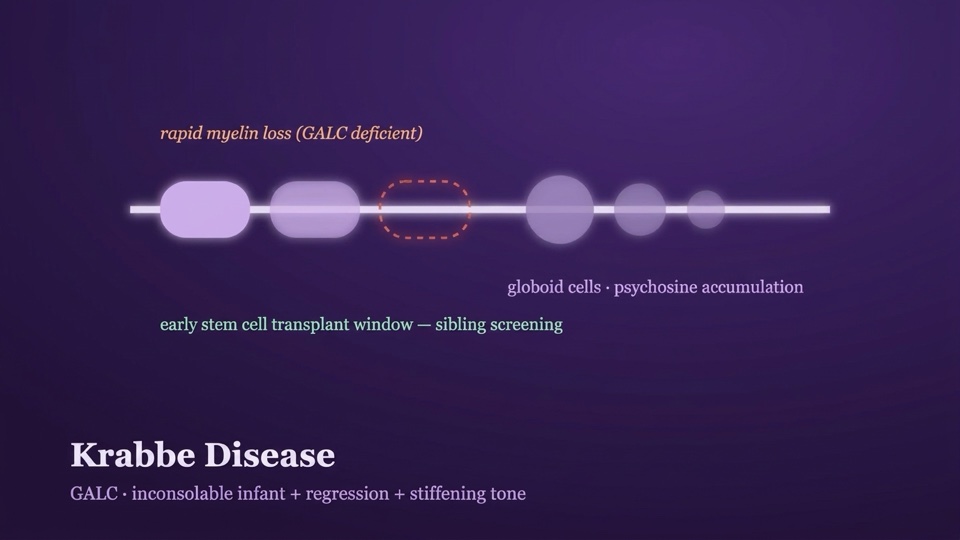
Krabbe disease (globoid cell leukodystrophy) is a rapidly progressive white matter disease in which psychosine, accumulating due to GALC deficiency, poisons the cells that make myelin. In the infantile form, it is a race against the clock: the only period in which stem cell transplantation works is the window in which symptoms have not yet begun.
Genetic cause and diagnostic tools
GALC mutations (autosomal recessive) lower enzyme activity. Diagnosis rests on a triad: GALC enzyme activity + GALC gene analysis + psychosine level. Psychosine (measured on dried blood spot) is particularly valuable: it distinguishes "low enzyme but not affected" pseudodeficiency cases from true disease, and it is the second tier of newborn screening.
Clinical course
Infantile form (most common) — stages
- Stage 1 (3-6 months): Inconsolable crying and irritability, exaggerated response to sound-light-touch, feeding difficulty, "fevers" without fever; development stalls
- Stage 2: Rapid regression — marked increase in tone (clenched fists, arching backward in spasm), seizures, loss of visual-auditory responses
- Stage 3: Profound neurological loss; care is entirely comfort-focused
Late-onset forms
- Late infantile/juvenile: gait disturbance, falls, vision loss (optic atrophy), school regression — the course is slower and more variable
- Adult: an insidious spastic gait disorder may be the only finding for years
Supporting findings: slowed nerve conduction velocities (peripheral involvement!), raised CSF protein, typical white matter involvement on MRI.
Treatment
Haematopoietic stem cell transplantation (HSCT)
- Who, and when? In the infantile form, meaningful benefit is seen only when transplantation is done before symptoms begin (ideally within the first weeks of life — in infants identified through screening or a sibling history); transplantation is not recommended in the infantile form once symptoms have started
- Post-transplant realities: Cognitive development and language are largely preserved; however, weakness and gait problems in the motor system (especially due to peripheral nerve involvement) may persist — "a child who has been saved but needs physiotherapy" is the realistic goal
- In late-onset forms, transplantation may be an option in the early-mild stage
Supportive care
- Management of irritability and pain (reflux, treatment of muscle spasm), nutrition (gastrostomy), seizure control, positioning — in advanced stages comfort is the primary goal
Prognosis — an honest picture
- The untreated infantile form is rapid; life is generally limited to 2-3 years of age — this fact is the whole rationale for sibling screening and newborn screening
- Presymptomatic transplantation transforms life and cognition; motor outcomes are variable and require lifelong rehabilitation
- In late forms the course can extend over decades; diagnosis matters for family planning and the timing of the transplant decision
Treatment pipeline and research horizon
- Gene therapy studies are at an early clinical stage — strategies are being tried both alone and combined with transplantation (using AAV to reach the peripheral nerve/brain regions that transplantation cannot reach); in infantile Krabbe, the "transplant + gene therapy" combination is the most encouraging direction in the field
- Newborn screening (implemented in some countries) together with psychosine confirmation is the proven method of catching the treatment window
Daily life
- For future sibling pregnancies, plan the prenatal/birth testing in advance — the window is measured in days
- During periods of irritability, reducing stimulation (a dim, quiet environment) is the most effective tool available to the family
- In children after transplantation, establish a long-term physiotherapy-orthotic routine
- Leukodystrophy family networks offer strong support, both for care and for information on research