
Overview
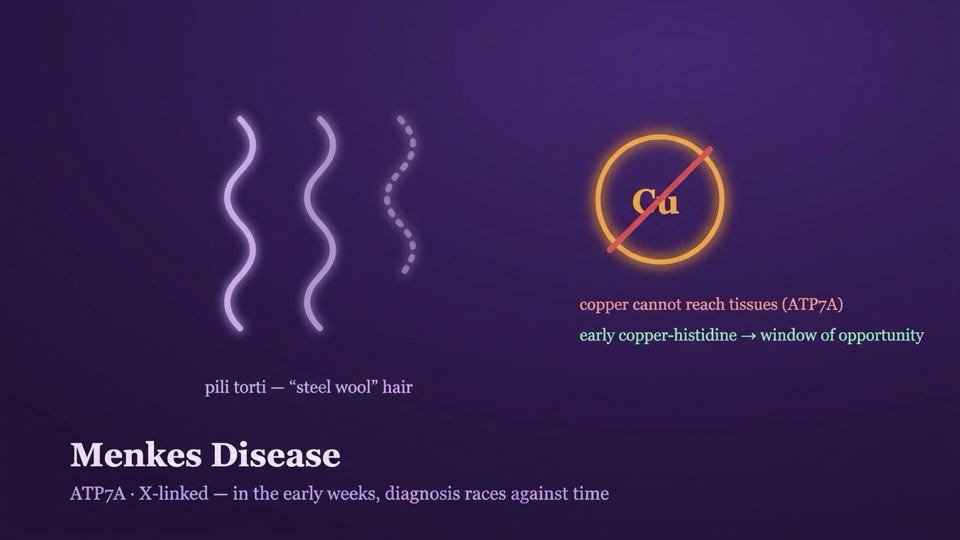
Menkes disease is an X-linked disorder in which copper fails to reach tissues because of ATP7A dysfunction. Copper is the key to not just one task but an entire family of enzymes — which is why the clinical picture is so multisystem. Timing is critical: the window in which parenteral copper can help is the first few weeks of life.
Mechanism — Which enzyme, which finding?
- Cytochrome c oxidase (energy) → seizures, regression, hypotonia
- Lysyl oxidase (connective tissue) → lax skin, vascular tortuosity, bladder diverticula, bone fragility
- Dopamine-beta-hydroxylase (autonomic) → temperature instability, hypoglycaemia-like episodes, ptosis
- Tyrosinase (pigment) → pale, dull hair and skin
- Hair shaft disorder (pili torti): the microscopic evidence behind the "steel wool" appearance
Clinical course
- 0-2 months: Often silent; clues are subtle: prolonged jaundice, low temperature, pectus, floppiness
- 2-4 months: Stalling-regression of development, drug-resistant seizures, marked hypotonia; hair shedding and breaking
- Later course: feeding difficulty, recurrent urinary tract infections (diverticula!), bone fractures and subdural collections
Important clinical warning: The combination of fractures and subdural haemorrhage in Menkes disease can be mistaken for abuse — in an unexplained-fracture hypotonic male infant, abuse should not be concluded without first requesting copper tests.
Diagnosis
- Low serum copper + caeruloplasmin is the basic test; but since these can be physiologically low in the first weeks, interpretation requires care
- In the early period, plasma catecholamine ratios (intermediates of the dopamine pathway) are a fast and sensitive clue (specialised laboratory)
- Definitive diagnosis: ATP7A analysis. If there is a family history of Menkes disease, a male infant should be tested at birth, and the treatment decision made within days
Treatment
- Parenteral copper-histidine: If started before symptoms become established (ideally within the first 4 weeks), it can meaningfully improve the neurological course; the response also depends on the residual function of the mutation. When started late, neurological benefit is limited; the decision should be discussed honestly with the family
- A standardised copper-histidinate formulation is going through the regulatory approval process — the route of access is planned with the centre
- Supportive care package: seizure treatment, nutrition (gastrostomy is often needed), urological follow-up (diverticula-UTI), bone health and safe handling, temperature management
Prognosis — An honest framework
- In untreated classic Menkes disease, survival is generally limited to the first 3 years
- In those identified at birth and treated early, the picture can change: children who are seizure-free, sit, and even walk and talk have been reported — the outcome remains a wide spectrum depending on the mutation
- The milder end (occipital horn syndrome) extends into adulthood with predominantly connective tissue findings
- This condition is one of the strongest candidates in the newborn screening debate; in at-risk families, testing at birth is a standard that can be applied today
Research horizon
- Molecules that can carry copper into cells independently of ATP7A (e.g. new chelator-carriers) are at the preclinical/early clinical research stage
- ATP7A gene therapy has shown encouraging results in combination with copper in animal models; preparation for human studies is ongoing
Daily life
- Receive injection training (copper treatment is continued at home); rotate sites and keep records
- Obtain an early culture for febrile urinary complaints (diverticula = recurrent UTI)
- Use gentle handling and dressing techniques against fracture risk; inform those around you about the infant's bone fragility
- Genetic counselling for carrier mothers and sisters (plan for early testing in a future pregnancy)