
Overview
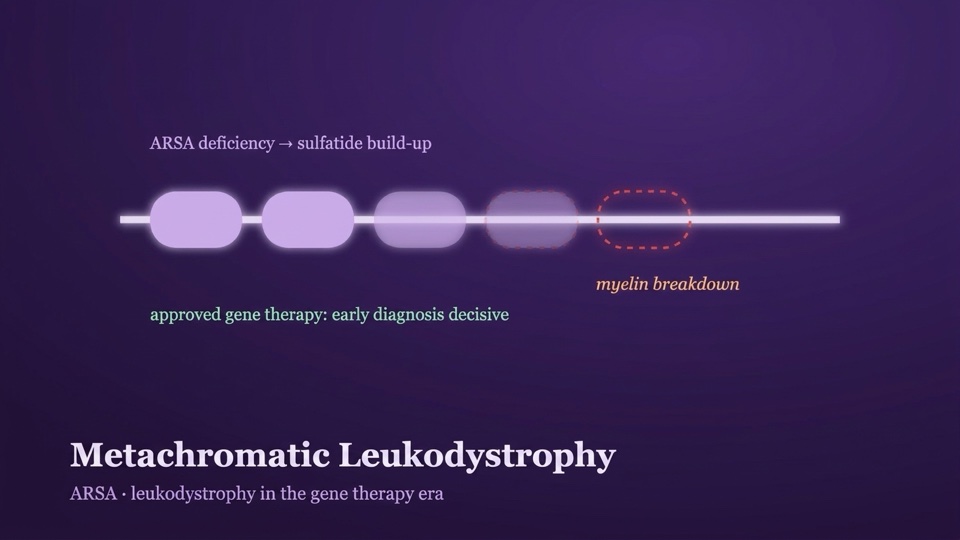
Metachromatic Leukodystrophy (MLD) progresses with the accumulation of sulphatides due to ARSA enzyme deficiency and the destruction of myelin in both the central and peripheral nervous systems. Being the first leukodystrophy with an approved gene therapy places MLD among the diseases where "early diagnosis matters minute by minute".
Genetic Cause and the Diagnostic Trap
ARSA mutations (autosomal recessive) reduce arylsulphatase A. The critical trap: commonly seen pseudodeficiency alleles in the population lower enzyme levels but do not cause disease. Therefore, low enzyme alone does not make the diagnosis; the diagnostic triad is: enzyme ↓ + urinary sulphatide ↑ + ARSA gene analysis. (The reverse also holds: if the clinical picture and MRI are consistent, a borderline-normal enzyme level can be misleading — confirm with genetics.)
Clinical Forms
Late infantile (~50-60%; fastest)
- Between 6 months and 2.5 years, deterioration of acquired walking: frequent falls, stiffness in the legs or, conversely, floppiness (peripheral nerve involvement!), loss of deep tendon reflexes
- Rapid decline within weeks to months; painful spasms and swallowing difficulty are added
Juvenile (2.5-16 years)
- Decline in school performance, behaviour-attention changes plus a narrowing gait; course is slower but progressive
Adult
- May begin with a psychiatric picture (psychosis-like) and cognitive decline; motor findings are added over the years
Diagnostic Pathway
- MRI: symmetric, periventricular "butterfly/tigroid" white matter involvement (U-fibres are initially spared)
- Slowing in nerve conduction velocities and increased CSF protein support the diagnosis (the combination of leukodystrophy and neuropathy suggests MLD)
- Confirmation: enzyme + urinary sulphatide + ARSA gene; in a family with a confirmed diagnosis, siblings should be screened within the same week
Treatment
Atidarsagene autotemcel — autologous gene therapy
- The patient's own stem cells are collected, a functioning ARSA gene is added, and the cells are reinfused after conditioning chemotherapy (busulfan); the cells then produce the enzyme in the brain as microglia
- Who is it for? Approved framework: pre-symptomatic in the late infantile form; pre-symptomatic or very early symptomatic (while independent walking is preserved) in the juvenile form. Once symptoms have become established, benefit is not expected in the late infantile form — the window is narrow
- Results: long-term data have shown that motor and cognitive functions are markedly preserved compared with the natural course in children treated before symptom onset (European approval 2020, US approval 2024)
Other
- In juvenile/adult pre-symptomatic cases, classic stem cell transplantation may be an option
- Intrathecal enzyme studies have been conducted; results are mixed
- Care at an advanced stage: management of spasticity-pain, nutrition (gastrostomy), respiratory support, seizure treatment — focused on quality of life
Prognosis — an Honest Framework
- The untreated late infantile form is rapid: walking is lost within months after symptoms begin; life expectancy is generally limited to childhood — this fact is the rationale for sibling screening and screening programmes
- In those who receive gene therapy before symptoms appear, the picture is entirely different: children who attend school, walk, and learn have been reported — "the same disease, two different fates"
- Juvenile/adult forms progress slowly; early diagnosis is the only way to catch the treatment window
- Some countries have begun adding MLD to newborn screening; the field is moving in this direction
Daily Life and Support
- The first question at the time of diagnosis: "Have the siblings been tested?" — the most concrete step to avoid missing the window
- Treatment centres are limited; clarify the referral-logistics plan (domestic/international) early
- A proactive plan for painful spasms at an advanced stage (positioning, medication) reduces the family's burden
- MLD family associations provide strong support in screening advocacy and experience sharing