
Overview
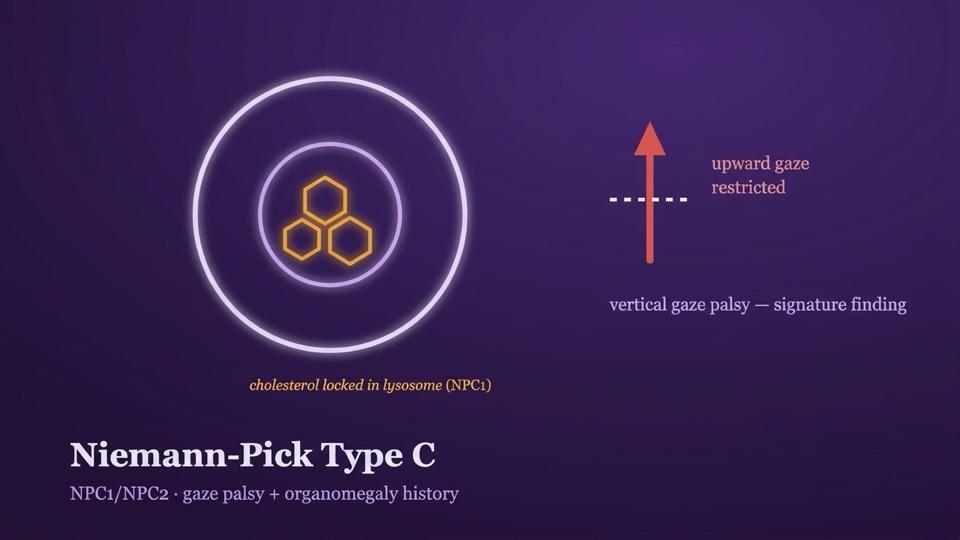
Niemann-Pick Type C (NPC) is an insidious storage disease that can begin at any age, caused by the failure of intracellular cholesterol transport. With the approval of two new drugs in 2024, NPC has moved up the list of "treatable conditions whose diagnosis must not be missed" — and the key to diagnosis is still a simple examination manoeuvre: checking up-and-down gaze.
Genetic Cause
NPC1 (~95%) or NPC2 mutations (autosomal recessive) lock cholesterol export from the lysosome; accumulation affects the cerebellum and brainstem circuits most.
Clinical Forms by Age
- Neonatal-infantile: prolonged jaundice/cholestasis, marked splenohepatomegaly; a subset has a rapid neurological form (hypotonia, developmental stagnation)
- Late infantile-juvenile (most typical): decline in school skills, clumsiness-ataxia, vertical gaze palsy, deterioration in speech-swallowing, dystonia; gelastic cataplexy (collapse with loss of tone while laughing) and seizures may be added
- Adolescent-adult: psychosis-like presentation + cognitive decline + ataxia — when "organic clues in a young psychiatric patient" are mentioned, NPC is on the list
Combination of clues: "history of splenomegaly in infancy + current school decline + restricted vertical gaze" → NPC, until proven otherwise.
Diagnosis
- First-line blood biomarkers: oxysterols (and lyso-sphingomyelin derivatives) — rapid and sensitive
- Definitive diagnosis: NPC1/NPC2 gene analysis; siblings are screened at the time of diagnosis
- Eye movement examination should be part of the routine of every neurological check-up (voluntary upward gaze deteriorates first; it may go unnoticed because reflex eye movements are preserved)
Treatment
- Miglustat: A substrate reduction agent; it has been shown to slow neurological progression (particularly in the swallowing and ataxia domains); it has been the standard in Europe for years. Gastrointestinal adverse effects are managed with dietary adjustment
- 2024 US approvals: Arimoclomol (as an add-on to miglustat) and levacetylleucine — both slowed neurological deterioration in studies; access and combination strategy are planned with the centre
- Supportive care package: swallowing assessment (aspiration is the main risk; timely gastrostomy saves lives), treatment of seizures and dystonia, medication for cataplexy when needed, physiotherapy, careful management of psychiatric symptoms (antipsychotic choice with the physician)
- Cyclodextrin (intrathecal/intracerebral administration) studies did not progress due to mixed results; gene therapy approaches are at the preclinical stage
Prognosis — An Honest Framework
- The course is determined by age at neurological onset: early onset follows a rapid course, the juvenile form generally follows a course spanning more than 10 years, and the adult form follows an even slower course
- The main life-threatening risks are loss of safe swallowing (aspiration pneumonias) and severe seizures — proactive swallowing follow-up directly affects prognosis
- Starting disease-modifying drugs (miglustat + the new approvals) early means years of preserved function; this is the rationale for early diagnosis and sibling screening
- Adult cases with a psychiatric onset may lose years before reaching a diagnosis — requesting NPC testing in the combination of "treatment-resistant psychosis + neurological findings" can be life-changing
Daily Life
- Signs of worsening swallowing (coughing while eating, prolonged meals, weight loss) should be taught to the family; early adoption of texture recommendations
- Safety for cataplexy: environmental arrangements against sudden collapses, precautions for cycling-stairs
- Adaptations for fatigue and loss of speed in the school/work plan
- NPC family foundations are a key resource for drug access programmes and trial announcements