
Overview
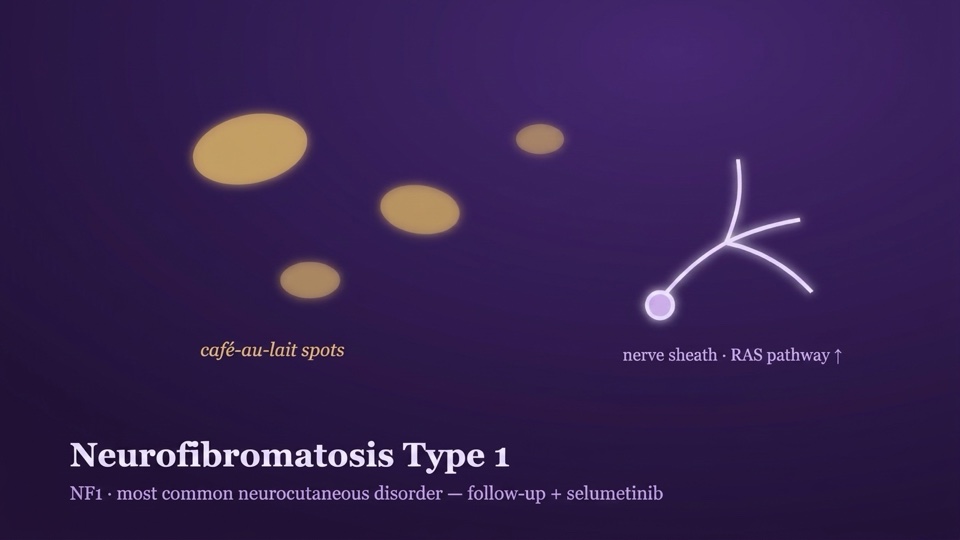
Neurofibromatosis type 1 (NF1) (~1/3,000) is one of the most common single-gene disorders. The course is favourable in the majority of children; the task is to catch the small number of serious components (eye, skeletal, tumour, learning) early with planned follow-up. With MEK inhibitors, NF1 has joined the group of diseases with targeted treatment.
Genetic Cause
The NF1 gene (neurofibromin) is the brake on the RAS pathway; loss of function releases cell proliferation. ~50% are de novo; autosomal dominant (50% transmission from an affected parent). Severity varies widely even within the same family — "it was mild in my father" is not a prediction for the child.
Diagnosis
At least two of the updated criteria: ≥6 café-au-lait macules (>5 mm before puberty), axillary/ inguinal freckling, ≥2 neurofibromas or 1 plexiform neurofibroma, optic pathway glioma, ≥2 Lisch nodules or a choroidal finding, a typical bone finding (sphenoid dysplasia, tibial bowing/pseudarthrosis), an NF1 variant, or an affected parent. A young child may have only spots — time establishes the diagnosis; genetic testing is valuable in uncertain cases and for family planning (including distinguishing Legius syndrome).
Follow-up Plan — What, and When?
- Every year: growth-head circumference, blood pressure (renal artery stenosis/phaeochromocytoma!), skin assessment, developmental-school enquiry, skeletal examination (scoliosis, tibia), pubertal assessment (may be early or late)
- Eye: annual examination up to age 8-10 — the aim is to catch optic pathway glioma (seen in ~15%; most are silent) before vision is impaired. Routine MRI is not required; MRI if there is decreased vision/squint/proptosis
- Learning: 50-60% have attention/learning difficulties — pre-school assessment and early support are the most commonly used part of NF1 care
- Plexiform neurofibromas: Imaging if there is growth, pain or loss of function; a rapidly growing, hardening, painful mass is assessed urgently at any age (malignant transformation — MPNST — is rare but must be kept in mind)
Treatment
- MEK inhibitors: Selumetinib (age 2+) is approved for symptomatic plexiform neurofibromas that are not suitable for surgery; the tumour shrinks and pain decreases in a substantial proportion of patients. Mirdametinib, approved in 2025 for children and adults, is a second option. Adverse-effect management: acneiform rash, diarrhoea, cardiac (EF) and eye checks, CK monitoring
- Optic glioma: Most are simply followed; chemotherapy (carboplatin-based) is the first option for those threatening vision; MEK inhibitors are increasingly used here as well. Radiotherapy is avoided in NF1 (risk of secondary tumours and vascular disease)
- Skeletal: Tibial pseudarthrosis and dystrophic scoliosis at an experienced orthopaedic centre
- Standard treatments for attention deficit (stimulants) are effective and safe in NF1
Prognosis — An Honest Framework
- The majority of individuals with NF1 lead a normal school-work-family life; the most common burden is not tumours but learning-attention difficulties (which can be supported)
- Life expectancy is somewhat reduced at the population level (mainly due to MPNST and vascular problems); individual risk is markedly reduced with regular follow-up and early presentation
- The cosmetic burden (cutaneous neurofibromas in adulthood) may require psychosocial support; laser/surgical options are available
- Genetic counselling for individuals planning pregnancy; neurofibromas may grow during pregnancy in mothers with NF1 — follow-up is planned
Treatment Pipeline and Research Horizon
- The family of MEK inhibitors is growing; studies continue for cutaneous neurofibromas and optic glioma
- Topical MEK inhibitors (skin lesions) and NF1 gene repair approaches are at an early stage
Daily Life
- "Number of spots" does not indicate disease severity — the sentence most often needed by families
- A brief note for school: the right to learning support, homework-attention arrangements
- Keep the annual checklist (eye, blood pressure, spine, development) on a single page
- Teach everyone at home the rule for a painful/rapidly growing lump: no waiting, go for assessment