
Overview
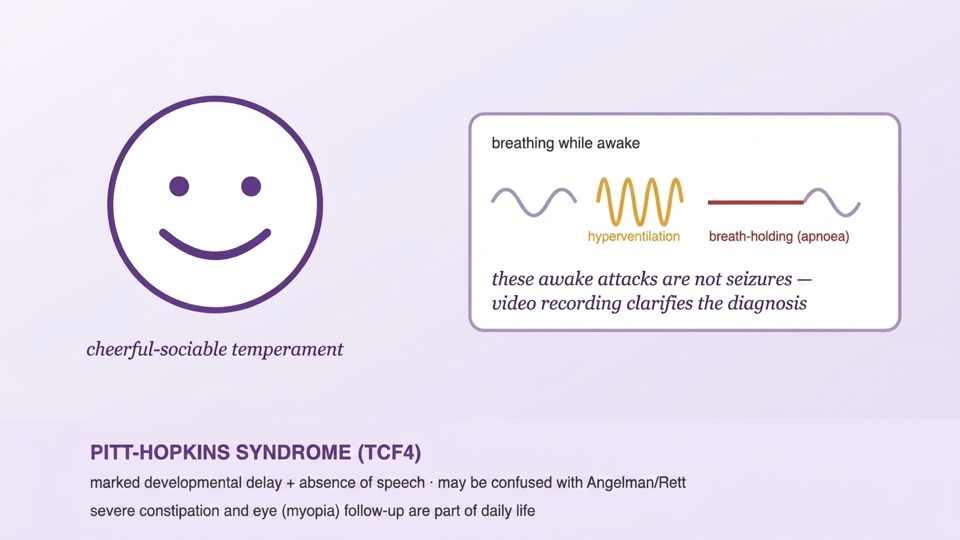
Pitt-Hopkins syndrome (PTHS) is a neurodevelopmental syndrome arising from insufficiency of the TCF4 gene, presenting with marked developmental delay, absent or very limited speech and a cheerful, sociable temperament. With this profile it is often mistaken for Angelman or Rett — the distinguishing hallmark, seen in most patients, is breathing attacks that occur while awake: minutes of rapid-deep breathing (hyperventilation) followed by cessation of breathing (apnoea), sometimes progressing to cyanosis. These attacks are not seizures; but because they are so often mistaken for them, a single phone video from the family can end years of uncertainty. TCF4 should come to mind in any "happy, non-verbal, ataxic" child whose Angelman/Rett panels are negative.
Genetic Cause and Mechanism
- TCF4 is a transcription factor that acts as one of the conductors of brain development; insufficiency of a single copy (haploinsufficiency — a point mutation or a deletion involving the gene on chromosome 18) leads to the syndrome.
- Cases are almost always de novo; sibling recurrence risk is low (~1%, allowing for gonadal mosaicism). VUS results should be reclassified every 1-2 years.
- In large 18q deletions, findings related to neighbouring genes may be added to the picture — the extent is reviewed in the deletion report.
Clinical Picture
- Development: Marked global delay; walking is acquired late and with a wide-based, ataxic gait (some never walk unsupported); speech mostly fails to develop or remains limited to a few words — comprehension is ahead of expression; early alternative communication (AAC) is essential.
- Temperament: A smiling, sociable profile that is easily pleased by music, water and light; hand stereotypies and hand-to-mouth movements may occur (the reason for confusion with Rett).
- Breathing attacks (~half of patients, often beginning at preschool-school age): Occur while awake, often with excitement or fatigue; hyperventilation → apnoea → sometimes a sensation of cyanosis/fainting; they disappear during sleep, which is typical (sleep-related breathing problems are assessed separately). The attacks are not epileptic; in cases confirmed by EEG, unnecessary antiepileptic burden is avoided.
- Epilepsy (40-50%): Types vary (focal, generalised); mostly manageable with treatment — video plus EEG correlation is important against the trap of assuming "every cyanotic attack is a seizure".
- Eyes: Marked myopia and strabismus are very common — uncorrected myopia can be a hidden cause of behaviour mistaken for "disinterest"; annual eye examination is a fixed part of follow-up.
- Digestive system: Severe constipation is among the greatest daily burdens of this syndrome (rare association with Hirschsprung disease has been reported); reflux is also common. In episodes of distress, the abdomen should be considered first.
- Facial features become more distinct over time (wide mouth, full lips, prominent nose) — not diagnostic on their own, but supportive.
Diagnosis
- Genetic: TCF4 sequence analysis plus deletion/duplication analysis (or exome/panel). In children who are "Angelman/Rett-like" but negative for Angelman methylation and MECP2, TCF4 ranks high on the differential list (along with Mowat-Wilson and Christianson).
- Video: Recording the breathing attacks (with the face and chest visible) is central to diagnostic and follow-up decisions; if necessary, saturation measurement during the attack and video-EEG are used to exclude seizures.
- MRI is not specific (supportive findings such as a thin corpus callosum may be seen); diagnosis is genetic.
Treatment — An Honest Framework
- Breathing attacks: In most children the attacks are short and self-limiting — staying calm, providing reassurance and recording them is the first step; if attacks are frequent/prolonged and involve cyanosis, assessment at a specialist centre is arranged (small case series in the literature report drug trials; the evidence is limited and the decision rests with the physician).
- Epilepsy: There is no syndrome-specific drug restriction; it is treated with standard choices.
- Constipation: Management should be continuous and preventive rather than "as needed" (diet plus a regular bowel programme plus physician-recommended laxatives/softeners); prolonged constipation warrants assessment for obstruction.
- Developmental package: Early and intensive physiotherapy (the window for walking), occupational therapy, early AAC; correcting vision (adapting to glasses takes patience but the benefit is substantial); sleep routine.
- Research horizon: Gene/ASO approaches aimed at increasing TCF4 expression are at the preclinical stage; all are at the research stage and are not a recommendation for clinical use. Joining PTHS family registries keeps the door open.
Three Critical Points in the Emergency Department
- 1 · A cyanotic attack is not always a seizure: A hyperventilation→apnoea attack while awake is a recognised feature of PTHS; consciousness is mostly preserved and the attack resolves on its own. Ask the family for a video; monitor saturation; look for EEG correlation before loading an antiepileptic.
- 2 · In a distressed, vomiting child, assess the abdomen: severe constipation/obstruction is the true emergency in this syndrome; the threshold for an abdominal examination/X-ray should be kept low.
- 3 · The child cannot speak but understands and is sociable — explain procedures and carry them out with the family present; smiling does not rule out pain.
Follow-up — Summary
The backbone of follow-up: monitoring breathing attacks daily and with video (centre assessment if frequency increases; a sleep study if there is a sleep problem) · continuous management of constipation and asking about it at every visit · annual eye examination (myopia-strabismus; a plan for adapting to glasses) · a seizure diary and EEG as clinically indicated · updating developmental goals every 3-6 months plus AAC · physiotherapy and orthotic assessment for gait-balance; scoliosis-hip examination in those who walk little · sleep and behaviour · dental review (every 6 months) · bone health (annual vitamin D) · genetic counselling plus VUS reclassification. The detailed age-by-age table is in the Routine Follow-up Calendar document at the end of this article.
Prognosis — An Honest Framework for Families
- PTHS is not a progressive, degenerative disease: gains are slow but they accumulate; walking is achieved in some children, even if late, and communication can be established with AAC.
- Breathing attacks are frightening but mostly benign; the main daily burden is constipation, sleep and communication — all three are manageable.
- Life expectancy data are largely reassuring; when the fixed points of follow-up (eyes, bowel, seizures) are not neglected, a healthy transition to adulthood is expected.
- The warmth of the child's temperament is the strength families most often mention — the educational plan should be built on this social motivation.
Daily Life
- Record the breathing attacks on video (face plus chest) and keep an "attack diary" — noting the trigger (excitement? fatigue?).
- Set up a scheduled routine for constipation; follow the physician's plan rather than waiting until "it's been 3 days".
- Turn getting used to glasses into a game; increase the duration with short, rewarded trials.
- Provide the school with a written plan: what to do during a breathing attack ("stay calm, lay the child on their side, time it, record it"), a seizure action plan, and AAC goals.
- Join PTHS family associations and registries.
Downloadable Documents: Emergency Action Plan + Routine Follow-up Calendar (PDF)
Two documents have been prepared for children with Pitt-Hopkins by Nörogender, under the guidance of Prof. Dr. Burak Tatlı. The Emergency Action Plan (3 pages): alongside the seizure section and the 5-minute rule, it includes warnings specific to PTHS — "a cyanotic hyperventilation-apnoea attack is not a seizure" (the video plus saturation rule), the note that severe constipation/obstruction is a true emergency, and that "smiling does not rule out pain". The Routine Follow-up Calendar (2 pages): a breathing attack diary, continuous constipation management, annual eye (myopia) follow-up, and an age-by-age table plus record chart built around AAC.
📄 Emergency Action Plan (PDF, 3 pages) — in Turkish 📅 Routine Follow-up Calendar (PDF, 2 pages) — in Turkish
Complete the documents together with your doctor; keep a copy at home and at school, and update the rescue medication dose as weight changes.