
Overview
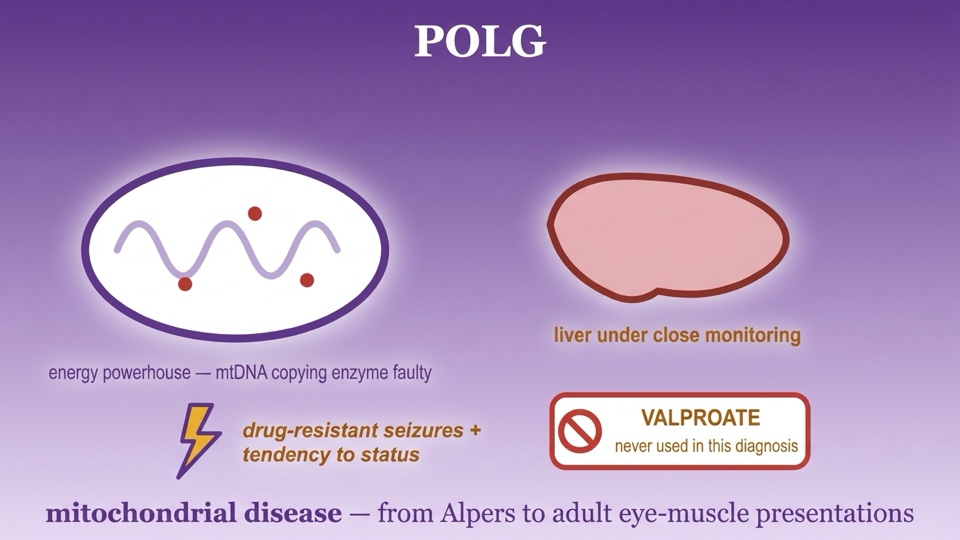
POLG-related disorders are a family of diseases caused by impairment of the enzyme (polymerase gamma) that copies the mitochondria's own DNA, whose most severe childhood face is Alpers-Huttenlocher syndrome: the triad of drug-resistant seizures + liver involvement + developmental regression. Its later-onset faces are ataxia-neuropathy presentations and, in adulthood, eye-muscle involvement with drooping eyelids (PEO). The one sentence in this guide that every family and every physician must know by heart is this: in a POLG diagnosis (or strong suspicion), VALPROATE IS NEVER USED — this drug can trigger fulminant liver failure, which can be fatal in children with POLG. This is paediatric neurology's clearest gene-drug ban and belongs at the very top of the emergency card.
Genetic Cause and Mechanism
- POLG encodes the only enzyme that copies and repairs mitochondrial DNA (mtDNA); when it is impaired, mtDNA depletion or multiple deletions accumulate in tissues — the most energy-dependent organs (brain, liver, muscle, nerve) are affected most.
- Inheritance is autosomal recessive in childhood presentations: the parents are healthy carriers, and the recurrence risk in each pregnancy is 25%; dominant inheritance is also seen in families with adult-onset PEO. Genetic counselling + sibling evaluation are part of the diagnosis.
- Some common variants (e.g. Ala467Thr, Trp748Ser) are relatively frequent in population carrier rates; the "two carrier parents" scenario is less rare than assumed. VUS classifications are revisited every 1-2 years.
Clinical Presentation — Faces by Age
Alpers-Huttenlocher (infancy-early childhood)
- Often after development that started normally, the disease frequently opens with drug-resistant seizures triggered by an ordinary infection: focal, myoclonic, a tendency to status epilepticus, and epilepsia partialis continua (rhythmic twitching of a limb lasting hours to days); occipital (visual) features in the background are common.
- Liver: may be silent at first; during illness episodes, transaminase elevation, coagulopathy, hypoglycaemia — it can progress to failure even without valproate exposure, and is accelerated by valproate.
- Stepwise regression with episodes; visual impairment; the course is severe — care goals are discussed with the family honestly and compassionately.
Childhood-adolescence: ataxia-neuropathy presentations (MIRAS/SANDO family)
- Imbalance, sensory neuropathy (loss of position sense), dysarthria; migraine-like headaches and visual auras; seizures (often of occipital onset) may be added.
Adult: PEO
- Progressive drooping eyelid + restricted eye movements, exercise intolerance; clues such as "an aunt who had eyelid surgery" in family screening are valuable.
Diagnosis
- Genetics is essential: POLG sequence analysis (panel/exome) — "drug-resistant focal seizures + elevated liver enzymes", "status + EPC", "unexplained ataxia-neuropathy" and liver deterioration after valproate should trigger POLG testing; valproate is not given while awaiting the result.
- Supportive findings: slowing/discharges with occipital predominance and the RHADS pattern on EEG; thalamic-occipital signal changes on MRI; elevated lactate (blood/CSF) supports the diagnosis but a normal value does not exclude it; baseline liver enzymes-INR-glucose.
- Differential diagnosis: other mitochondrial syndromes, herpes encephalitis (in acute presentation — the threshold for aciclovir is kept low), other progressive epilepsy-ataxia presentations.
Treatment — An Honest Framework
- Absolute rule — the valproate ban: not used in any form, oral or IV; it must be written on the emergency card, in the school file and on the pharmacy note. Caution is also advised with high-dose/long-term phenobarbital and other liver-straining drugs.
- Seizure treatment: levetiracetam, clobazam, lacosamide, oxcarbazepine/carbamazepine (for the focal component), topiramate, zonisamide — combinations titrated by the physician; early and effective intervention is essential in status and EPC (below). The goal may not be "zero seizures"; fewer-shorter-safer is the realistic target.
- Liver-metabolic care: regular liver panel (ALT-AST-GGT, bilirubin, INR, albumin, glucose); on illness-vomiting days, avoid prolonged fasting and give early sugary support (this is the opposite of GLUT1 — here glucose is a friend); early evaluation with fever.
- Support package: physiotherapy (ataxia-strength), nutrition, visual support, management of painful neuropathy; eyelid surgery in PEO in selected cases.
- "Mitochondrial cocktail" (coenzyme Q10, carnitine, riboflavin, etc.): evidence is limited; no harm is expected; the decision to use rests with the physician; products with exaggerated claims should be avoided.
- Liver transplantation is controversial in Alpers (neurological progression does not stop with transplantation); it is discussed only in highly selected cases, with an experienced centre's board.
- Research horizon: approaches targeting mtDNA maintenance are at the preclinical/early stage; they are at the research stage, not a recommendation for clinical use.
Three Critical Points in the Emergency Department
- 1 · DO NOT GIVE VALPROATE — in any form, including IV: remove valproate from your status steps in this diagnosis; it can trigger fulminant liver failure. Alternatives: benzodiazepine → IV levetiracetam → lacosamide/fosphenytoin → early ICU-midazolam; an early anaesthetic step in refractory status is justified in this group.
- 2 · Status and EPC are inherent to this disease: do not miss prolonged focal twitching (EPC); keep a low threshold for continuous EEG; treat the triggering infection alongside.
- 3 · Liver-glucose: check ALT-AST-INR-glucose at every presentation; do not allow prolonged fasting, give early dextrose-containing fluid; vomiting-inability to feed is a warning sign of decompensation; also consider hepatic encephalopathy in impaired consciousness.
Follow-up — Summary
The backbone of follow-up: the valproate ban being written on the emergency card and on all prescriptions · liver panel + INR + glucose (every 3-6 months in stable periods; at every illness episode) · seizure diary + EPC education (prolonged twitching = call) · illness-day plan (early sugar, early presentation) · development-vision-hearing follow-up · ataxia-neuropathy evaluation (EMG if needed) · nutrition-weight · eye follow-up on the PEO end · genetic counselling (AR; sibling risk 25%) + VUS reclassification. The detailed year-by-year table is in the Routine Follow-up Calendar document at the end of the article.
Prognosis — An Honest Framework for Families
- The Alpers end is severe: the goal is to reduce seizure burden and admissions, to increase pain-free, comfortable time, and not to leave the family alone; when the palliative care team is involved early, quality of life clearly improves.
- The ataxia-neuropathy and PEO ends extend over years; a long and productive life is possible with supports that preserve independence.
- Adherence to the valproate ban prevents the greatest preventable catastrophe — carrying this information to the school, emergency department and pharmacy chain is the family's strongest protective tool.
- The risk for siblings is 25%; early genetic counselling and, if desired, testing are planned.
Daily Life
- A card in the wallet and on the fridge: "POLG — VALPROATE MUST NOT BE USED"; show it to every new physician-pharmacist.
- No delay on illness-vomiting days: early sugary fluid + early presentation.
- Do not mistake prolonged single-limb twitching (EPC) for a "tic" — record it on video and call your physician.
- Energy economy: split up activity on tiring days; bring fever down early.
- Join mitochondrial disease family associations; do not take steps towards products with exaggerated claims without consulting your physician.
Downloadable Documents: Emergency Action Plan + Routine Follow-up Calendar (PDF)
Two documents have been prepared for children with POLG by Nörogender, under the guidance of Prof. Dr. Burak Tatlı. Emergency Action Plan (3 pages): the VALPROATE BAN in the top band, status steps without valproate, an EPC recognition box, and the liver-INR-glucose + early dextrose rule. Routine Follow-up Calendar (2 pages): a year-by-year table and record chart centred on the liver panel schedule, the illness-day plan, and development-vision and ataxia-neuropathy follow-up.
📄 Emergency Action Plan (PDF, 3 pages) — in Turkish 📅 Routine Follow-up Calendar (PDF, 2 pages) — in Turkish
Fill in the documents together with your physician; keep a copy at home, at school and at your pharmacy.