
Overview
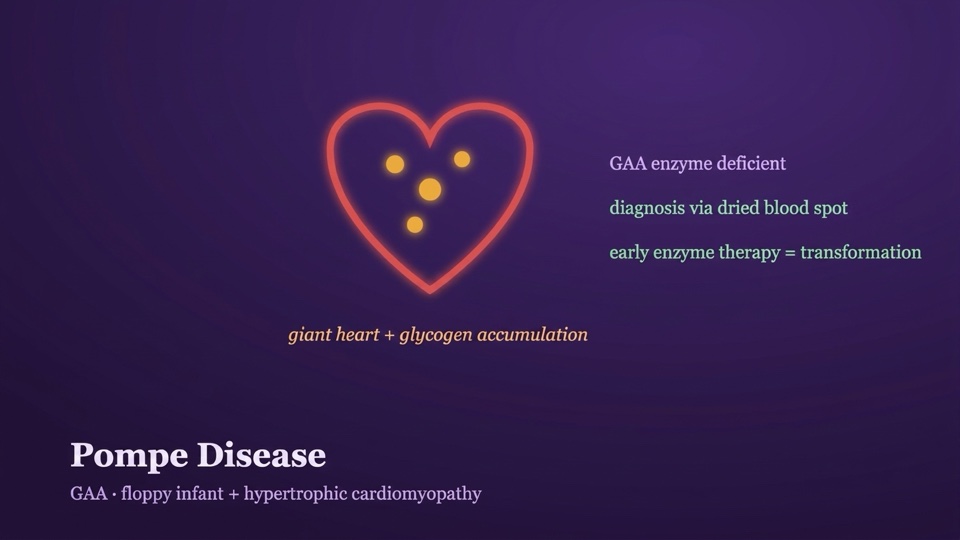
Pompe disease is the accumulation of glycogen in muscle and heart due to lysosomal GAA deficiency. In the infantile form, the "floppy infant + giant heart" picture is an emergency against the clock; the late-onset form, on the other hand, presents over years with progressive girdle weakness and respiratory impairment. Enzyme therapy has changed the game in both forms — but the gain depends on how quickly treatment is started and on immune management.
Genetic Cause
GAA mutations (autosomal recessive); the residual enzyme level determines the form. The common cause of the late-onset form is a widespread splice variant that leaves partial function.
Clinical Features
Infantile form (IOPD)
- In the first months: marked hypotonia, sucking-swallowing difficulty, failure to thrive; hypertrophic cardiomyopathy (a hugely enlarged heart on chest X-ray, typical changes on ECG), macroglossia, hepatomegaly, frequent lung infections
Late-onset form (LOPD)
- In childhood-adulthood: difficulty on stairs, inability to run, hip-shoulder girdle weakness, marked respiratory involvement (breathlessness when lying down, morning headache, daytime sleepiness) — the heart is generally spared
- CK is mildly elevated; it should be considered in young people labelled with "idiopathic muscle disease"
Diagnosis
- First step: GAA activity on dried blood spot; confirmation by GAA gene analysis
- When IOPD is suspected (hypotonia+cardiomyopathy), the result should be obtained within days; in some countries it has been added to newborn screening, making presymptomatic diagnosis possible
- In LOPD, girdle weakness plus a decline on respiratory tests (the difference between sitting and supine FVC) is a strong clue
Treatment
Enzyme replacement therapy (ERT)
- The era that began with alglucosidase alfa continues with new generations that target muscle better: avalglucosidase alfa and (in adult LOPD) an enzyme+chaperone combination — the choice is made by the centre according to form, age and access
- In IOPD, speed is everything: starting treatment within days reverses the heart muscle and transforms survival
CRIM status and immune management (the critical detail in IOPD)
- Infants who cannot produce any enzyme protein at all (CRIM-negative) may develop high-titre antibodies against ERT and lose their response → in this group, an immune tolerance protocol is applied together with ERT. CRIM/genotype assessment is part of the treatment plan
Support Package
- Cardiology follow-up (IOPD), respiratory follow-up plus nocturnal NIV and cough support when needed (the backbone of LOPD care), physiotherapy, nutrition-swallowing, scoliosis-osteoporosis monitoring
- Anaesthesia caution: sedation risk is high in infants with cardiomyopathy — procedures should be carried out at an experienced centre
Prognosis — An Honest Framework
- Untreated IOPD is lost within the first year; with early ERT the heart recovers rapidly, and a significant proportion of children sit and walk. The gain is not complete: residual musculoskeletal weakness, speech-swallowing problems, and the need for respiratory support in some children may persist; the CRIM-negative group has a more difficult course
- Infants started presymptomatically (through screening) have the best outcomes — this is the rationale for screening
- In LOPD, ERT slows/stabilises the loss of strength and respiratory function; early initiation gives better results here too. Life planning (work, exercise) can be built on long-term stability
Treatment Pipeline and Research Horizon
- New enzymes with increased muscle targeting and dosing strategies are in clinical development
- Gene therapy (continuous enzyme production via liver/muscle) is in early-phase studies; the aim is independence from infusions every two weeks
Daily Life
- An infusion-day routine (ask about the home infusion option); keep a reaction plan in the bag
- In LOPD, do not skip annual respiratory tests; report snoring and morning headache
- Give a written "Pompe + cardiomyopathy/respiratory" warning before surgery
- Pompe associations provide guidance in screening advocacy and access processes