
Overview
Prader-Willi Syndrome (PWS) (~1/15,000-25,000) is recognised by two opposite faces: in the newborn, a hypotonic infant who cannot feed, and in childhood, an individual with no sense of satiety. Modern follow-up (early growth hormone + food safety + a behaviour plan) has fundamentally improved the natural course; a new era began in 2025 with the approval of the first drug for hyperphagia.
Genetic Cause
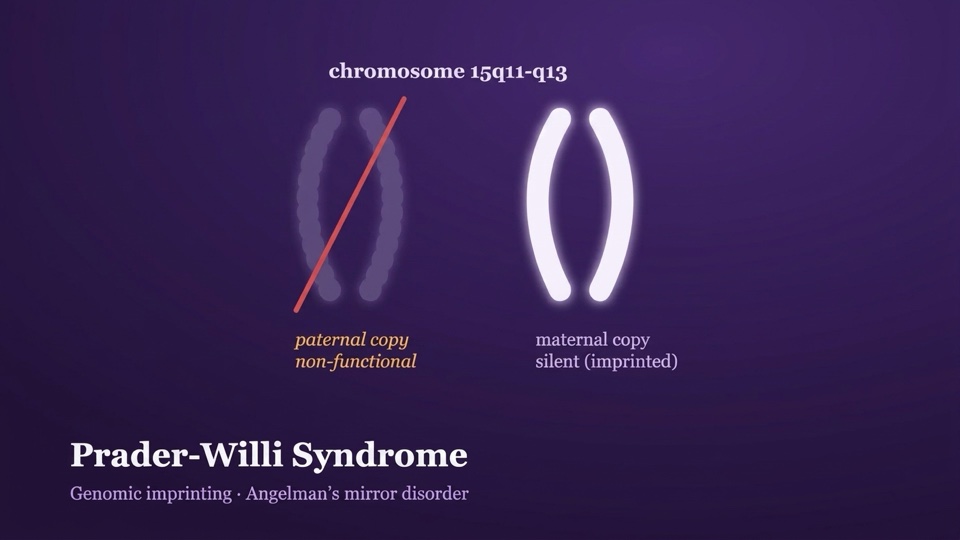
Loss of function of paternally inherited genes in the 15q11-q13 region: deletion (~60-70%), two maternal copies (maternal UPD, ~25-30%), imprinting defect (~1-3%). Loss of the maternal copy of the same region causes Angelman syndrome. The subtype matters: in UPD, the risk of psychosis is higher in adolescence-adulthood; in some imprinting defects the recurrence risk is increased → the mechanism must always be clarified after methylation testing.
Clinical Course — Feeding Stages
- Prenatal: Reduced fetal movements, breech presentation is common
- Stage 1 (0-9 months): Severe hypotonia, weak suck — often tube feeding required; weak cry, tendency to sleep
- Stage 2 (~9 months-2 years): Feeding normalises, the misconception of "recovery"
- Stage 3 (~2-4 years): Weight gain begins without an increase in appetite (metabolism is slow!)
- Stage 4 (after ~4-8 years): Hyperphagia: there is no satiety signal; food seeking, hoarding, kitchen raids at night — rapid severe obesity in an unsupervised environment
Associated features: short stature, small hands and feet, hypogonadism (undescended testes, delayed puberty), scoliosis, high pain threshold (injuries/abdominal problems are noticed late!), sleep apnoea, behavioural features (stubbornness, temper outbursts, skin picking).
Diagnosis
- In every hypotonic newborn without an explained cause, the first test is methylation analysis (sensitivity ~99%); if positive, deletion/UPD/imprinting defect are distinguished
- Early diagnosis = correct management of the tube-feeding period + early initiation of growth hormone + preparing the family for the hyperphagia stage years in advance
Treatment and Follow-up
Growth hormone (GH)
- It is standard in PWS and not only for height: it has proven benefits on muscle mass, motor development, body composition and head circumference-cognitive development; it is often started within the first year
- Sleep apnoea assessment (sleep study if necessary, examination of tonsils-adenoids) and scoliosis follow-up are performed before starting and during follow-up
Food safety — not a behaviour issue, but environmental treatment
- Hyperphagia is not a "matter of willpower"; the solution is environmental: a locked kitchen/cupboard, a fixed meal schedule, removing "uncertainty about access to food" (uncertainty magnifies anxiety and anger)
- Low-calorie balanced nutrition + daily structured exercise
Medicines and hormones
- Diazoxide choline (extended release): the first drug approved for hyperphagia (US, 2025) — it showed a reduction in hunger-driven behaviour; access/suitability is planned with the physician
- Puberty induction for hypogonadism; thyroid and (when needed) adrenal assessment
- A behavioural plan is the primary approach for behaviour; N-acetylcysteine may be tried for skin picking; early specialist support for psychiatric symptoms
Follow-up list
- Height-weight-BMI at every visit; scoliosis examination; sleep history; glucose-lipids (if obesity is present); mental state screening in adolescence (especially for psychosis symptoms in the UPD subtype)
Prognosis — An Honest Framework
- The single major variable determining the course is weight management: if obesity is prevented, life expectancy and quality improve dramatically; the main risks are complications of obesity (sleep apnoea, type 2 diabetes, heart disease) and severe hyperphagia-related accidents (choking, gastric over-distension — abdominal pain/vomiting must be assessed as an EMERGENCY in PWS)
- Cognitive level is usually in the mild impairment-borderline range; many individuals learn to read and write and work in supported employment
- Behavioural features require lifelong management; structure and predictability are the strongest "medicine"
- Supported living models in adulthood (food-safe homes specific to PWS) give the best outcomes
Treatment Pipeline and Research Horizon
- The hyperphagia field is active: following the approval of diazoxide choline, oxytocin-pathway drugs and candidates targeting appetite circuits continue to be studied
- Oxytocin studies in early infancy (on suckling-bonding) are ongoing
- In the long term, reactivation of imprinted genes (the SNORD116 region) is at the laboratory stage
Daily Life
- Prepare for the hyperphagia stage while still in stage 2: household organisation, educating the extended family and school ("just one bite" does not exist)
- Because of the high pain threshold, "it doesn't hurt much" is unreliable — seek early medical attention for vomiting without fever or abdominal distension
- In the school plan: cafeteria supervision, physical education adaptation, a calming protocol for episodes of anger
- PWS family associations are the best guide for food safety practices and the transition through adolescence-adulthood