
Overview
PRRT2-related disorders are among the most gratifying diagnoses in paediatric neurology — because treatment is small, the effect is large: most presentations respond rapidly to low-dose carbamazepine/oxcarbazepine. The same gene has two main faces, ordered by age: self-limiting familial infantile epilepsy in infancy (afebrile seizure clusters that resolve spontaneously by around age 2) and paroxysmal kinesigenic dyskinesia (PKD) in childhood-adolescence — contraction attacks triggered by sudden movement, lasting seconds, without loss of consciousness. PKD is often mistaken for epilepsy or "psychological" problems for years; yet a phone video plus the right question ("does it happen when they jump up?") establishes the diagnosis, and a single low-dose tablet changes life.
Genetic Cause and Mechanism
- PRRT2 encodes a protein that brakes release at the synaptic terminal (it works with SNAP25); the insufficiency of a single copy leads to networks "sparking" at moments of rapid movement/transition — the triggering of attacks by movement onset is the signature of this mechanism.
- Inheritance is autosomal dominant and familial clustering is common: a parent's history of "stiffening on sudden standing in youth" is not volunteered unless asked; due to incomplete penetrance, it may skip a generation. De novo cases occur, as does loss within a 16p11.2 microdeletion — in children with the deletion, a developmental/autism component may be added to the picture, and distinguishing this in the report is important.
- The same gene is also associated with familial hemiplegic migraine and rare episodic ataxia presentations (the cautions in the CACNA1A guide apply to that phenotype).
Two Main Faces
1 · Self-limiting familial infantile epilepsy
- Between 3-12 months (typically 4-7 months), afebrile, brief focal seizures — often occurring in clusters lasting several days; the infant is completely normal in between, and development is not affected.
- Response to treatment is rapid and complete (including low-dose CBZ/OXC); seizures resolve spontaneously by around age 2 — the medication is stopped without difficulty according to the physician's plan.
- The language of "severe epilepsy" should not be used for this presentation; the family should be told early that the condition is benign in nature.
2 · Paroxysmal kinesigenic dyskinesia (PKD)
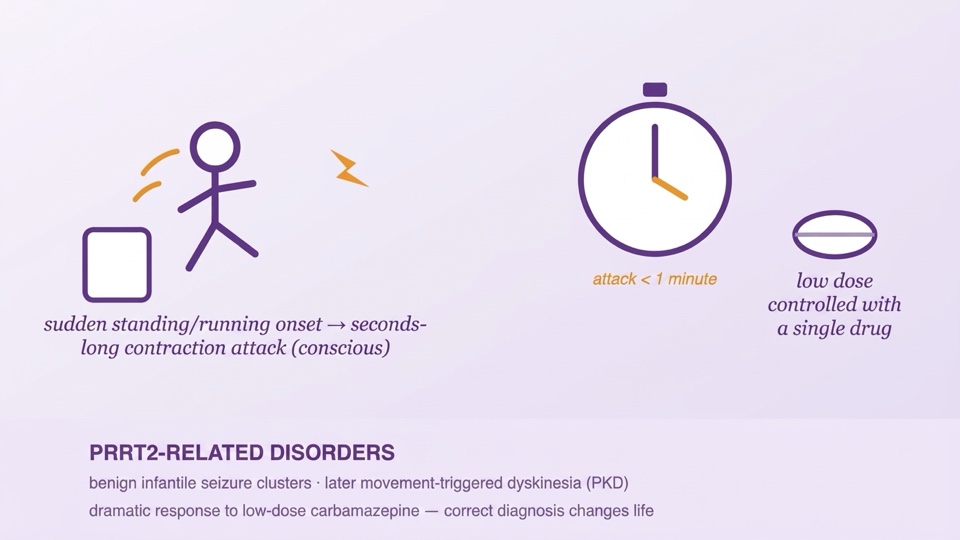
- Onset is usually between 6-16 years; attacks are triggered by sudden onset of movement (jumping up from sitting, starting to run, being startled); a unilateral or bilateral dystonic/choreic contraction lasts 5-60 seconds, consciousness remains clear, and it is painless; a brief "it's coming" sensation (aura-like) may precede it.
- Dozens of attacks can occur per day — when standing up between lessons, running to the break... The child gets labelled as "walking/standing oddly"; the EEG is normal.
- Treatment changes the picture: low-dose carbamazepine (even below standard epilepsy doses) usually stops attacks completely; oxcarbazepine is an alternative. Attacks also tend to become less frequent spontaneously with age.
- The co-occurrence of infantile seizures plus PKD in the same individual/family (ICCA) is typical.
Diagnosis
- Video plus the right question is half the diagnosis: "Do the attacks occur at the onset of sudden standing/running? Is consciousness preserved? How many seconds does it last?" — if all three answers are yes/short, the door to PKD opens.
- Genetics: PRRT2 sequence analysis (panel/exome); if negative and the clinical picture is strong, 16p11.2 deletion analysis. History-taking and examination of family members strengthens both the diagnosis and counselling.
- Differential diagnosis: focal epilepsy (consciousness/EEG/duration), tics (suppressibility), psychogenic attacks (trigger pattern), and other paroxysmal dyskinesias — PKD's kinesigenic triggering and response to CBZ are distinguishing features. A "dramatic response to CBZ" is itself a diagnostic clue.
Treatment — An Honest Framework
- PKD: low-dose carbamazepine is the first choice (often adequate at doses below standard antiepileptic doses); oxcarbazepine is an equivalent, practical alternative. The response is typically evident within days and is dramatic; non-response should prompt reconsideration of the diagnosis.
- Infantile seizure clusters: short-term low-dose CBZ/OXC (or an equivalent preferred by the physician) — because of the self-limiting nature, a discontinuation plan around age 1-2 is discussed from the outset.
- The "avoid CBZ" rules that apply in other DEEs do NOT apply here — PRRT2 is the exception gene where this rule is reversed; this is written explicitly on the emergency card to prevent confusion.
- Trigger management is supportive: softening sudden rising movements, avoiding sleep deprivation and caffeine; once attacks are controlled with treatment, these restrictions are relaxed.
- Research horizon: studies on the mechanism (synaptic braking) are ongoing; the real "innovation" in clinical practice is shortening the delay to diagnosis.
Three Critical Points in the Emergency Department
- 1 · A PKD attack is not a seizure: consciousness is preserved, duration is <1 minute, and it is triggered by movement → do not load benzodiazepines/antiepileptics; request a video and refer to neurology.
- 2 · Do not label it "psychogenic": the attacks are real and treatable; a normal EEG does not exclude the diagnosis — it supports it.
- 3 · If a prolonged seizure occurs in the infantile phenotype, standard steps apply; in this diagnosis CBZ/OXC belongs to the first-choice family (do not apply the avoidance reflex used in other infantile epilepsies).
Follow-up — Summary
The backbone of follow-up: an attack video archive and trigger diary · a rescue plan for the infantile phenotype plus a discontinuation plan around age 1-2 · asking about "stiffening on sudden standing" at every visit from age 5 onwards (so PKD is caught early) · low-dose titration in PKD and tapering/discontinuation trials with age · school information ("the attack is not a seizure; no intervention is needed, wait for it to pass") · counselling at driving-licence age · family history-taking and examination (AD; incomplete penetrance) · if there is a 16p11.2 deletion, developmental/autism follow-up is added · reclassification of VUS. The detailed, age-by-age table is in the Routine Follow-up Schedule document at the end of the article.
Prognosis — An Honest Framework for Families
- This is among the most benign presentations in neurogenetics: infantile seizures resolve spontaneously, development is normal; PKD is usually fully controlled with treatment and often becomes less frequent or disappears spontaneously in adulthood.
- The real harm comes from delayed diagnosis: years of high-dose wrong medication, unnecessary restriction, or psychological labelling. A correct diagnosis reverses all of this.
- For family planning: a 50% transmission rate, but the condition in those who inherit it also remains of the same benign nature — counselling is given with this balance in mind.
Daily Life
- Record attacks on video; note the "trigger-duration-consciousness" triad.
- A single paragraph for the school: "A short contraction attack may occur on sudden standing; consciousness remains clear, no intervention is needed, it passes within 1 minute."
- Medication should be taken regularly even at low dose; discontinuation trials only with the physician's plan.
- Look into similar histories in the family — an undiagnosed parent/uncle may also benefit from treatment.
Downloadable Documents: Emergency Response Plan + Routine Follow-up Schedule (PDF)
Two documents have been prepared for children with PRRT2 by Nörogender, under the guidance of Prof. Dr. Burak Tatlı. Emergency Response Plan (3 pages): alongside the 5-minute rule for the infantile phenotype, a box stating "a PKD attack is not a seizure — no intervention is needed", and a note for the emergency team that "in this diagnosis, CBZ/OXC is the first choice; the avoidance rules are reversed". Routine Follow-up Schedule (2 pages): an age-by-age table and record chart built around the discontinuation plan in the infantile period, asking about PKD at every visit, the school letter, and family screening.
📄 Emergency Response Plan (PDF, 3 pages) — in Turkish 📅 Routine Follow-up Schedule (PDF, 2 pages) — in Turkish
Complete the documents together with your physician; keep a copy at home and at school.