
Overview
Rett syndrome is a neurodevelopmental disorder that predominantly affects girls and runs a course of loss of acquired skills (incidence ~1/10,000-15,000 female births). With the approval in 2023 of the first disease-specific drug and the move of gene therapy studies into humans, Rett has moved out of the "no treatment available" category.
Genetic Cause and Mechanism
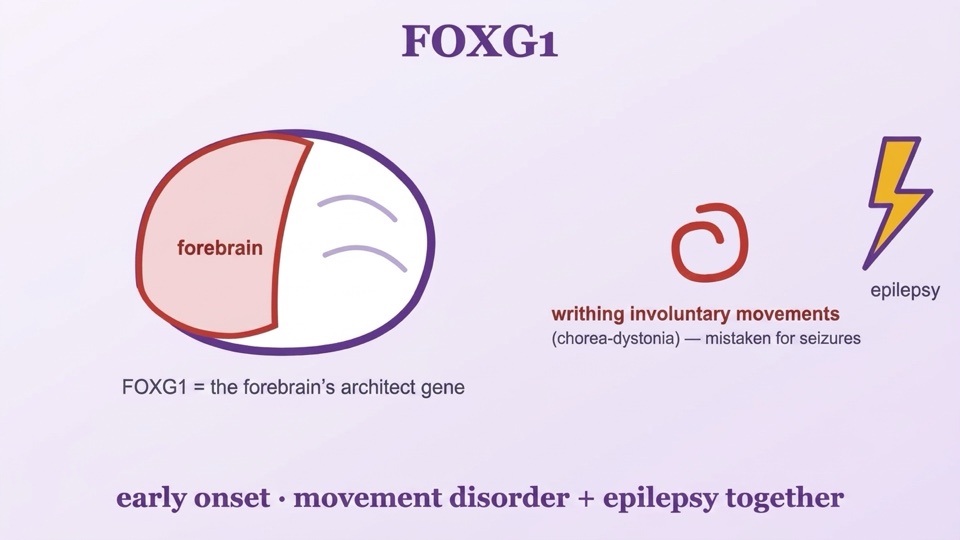
In 95% of cases there is a change in the MECP2 gene on the X chromosome; the mutations are almost always de novo. MeCP2 is a "conductor" that regulates thousands of genes — its absence disrupts neuronal maturation and synapse maintenance. A critical point: too little of this protein is harmful, and too much is harmful (an excess causes MECP2 duplication syndrome); this is why dose control is central in gene therapy. In girls the picture is mosaic because of cell-to-cell variation in X-inactivation; in boys, an MECP2 mutation usually results in much more severe early encephalopathy. In atypical forms, CDKL5 and FOXG1 are also assessed.
Clinical Course — Four Stages
Stage 1: Stagnation (6-18 months)
- Development is initially normal or near-normal; then progress quietly stalls, eye contact decreases, and head circumference percentile falls back (acquired microcephaly)
Stage 2: Regression (1-4 years, over weeks to months)
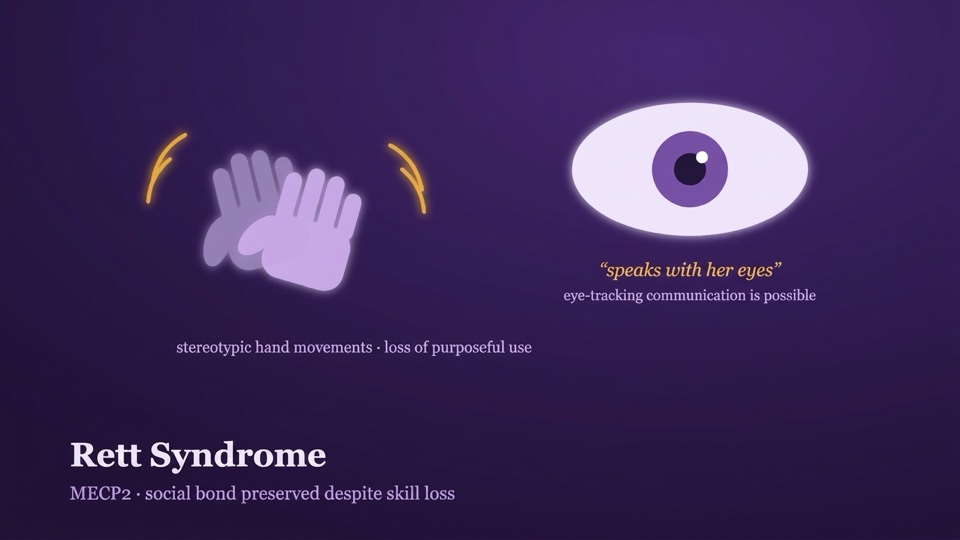
- Loss of purposeful hand use, replaced by hand-washing/wringing-to-mouth stereotypies — the hallmark of the disease
- Loss of spoken words and social interaction; at this stage the picture can be confused with autism
- Irritability, screaming episodes, disrupted sleep; those who walk become unsteady
Stage 3: Plateau / "awakening" (preschool-school age, lasting years)
- Regression stops; eye contact and social interest return notably — the period of the "child who speaks with her eyes"; the most productive age for communication with eye-gaze devices
- Seizures often begin in this period (60-80%); breathing irregularities (breath-holding / hyperventilation episodes while awake) become more prominent
Stage 4: Late motor deterioration (adolescence-adulthood)
- Seizures mostly ease, whereas dystonia-rigidity increases, walking can become more difficult, and scoliosis may progress
Diagnosis
- Diagnosis is made on clinical criteria and confirmed by MECP2 analysis (sequencing + deletion testing)
- A history of "she was normal at first, then stopped using her hands" plus hand stereotypies → Rett, until proven otherwise
- Regular measurement of head circumference is the cheapest early-warning tool
Treatment and Follow-up — Multisystem Care
Disease-specific drug
Trofinetide is the first approved drug specific to Rett (USA 2023; a positive scientific opinion in Europe in 2026): it showed measurable improvement in communication and hand use. The most common adverse effects are diarrhoea and weight loss, managed together with a nutrition plan. Access conditions in Türkiye are planned with the physician.
Fenfluramine — what it showed beyond seizures
Fenfluramine is licensed for Dravet and Lennox-Gastaut syndromes; it acts via serotonergic pathways and the sigma-1 receptor. It is not licensed for Rett syndrome, but a study published in September 2026 showed that the drug may affect not only seizures but also other domains in this disease.
The study, published in Epilepsia Open by the team at Hospital Infantil Universitario Niño Jesús in Madrid, is prospective, open-label and single-centre. It enrolled 8 patients carrying a pathogenic MECP2 variant with classic Rett and drug-resistant epilepsy; median age 12 (6-17), with a median of 5 (2-10) previously failed antiepileptic drugs. Assessments were done at baseline, month 3 and month 6.
- Seizures: more than 50% reduction in seizure frequency in all patients
- Overall disease severity: significant improvement in physician-rated CGI-I, Clinical Severity Scale (CSS) and Motor Behaviour Assessment (MBA) scores
- Behaviour: change in the family-rated Rett Syndrome Behaviour Questionnaire (RSBQ) score of -7 at month 3 and -9 at month 6
- Sleep: SDSC scores returned to the normal range in all patients at month 6
- Breathing: breathing irregularity, including hyperventilation-related symptoms, improved throughout follow-up
- Neurophysiology: auditory evoked potentials showed improvement in attention and auditory discrimination processing in a subset of patients
- Adverse effects: seen in 71% of patients, most commonly drowsiness; no one discontinued the drug due to tolerance issues
Breathing irregularity, sleep disturbance and behavioural problems make up a large part of families' daily burden in Rett and are problems independent of seizures. What is notable about this study is that a single drug showed change across several of these domains at once.
The study's limitations are not small, and the authors themselves state this. Eight patients is a small number; there is no control group; the study is open-label, meaning both physician and family knew the child was receiving the drug. Scales such as the RSBQ and CGI are open to expectation effects in this design. Results from a single centre cannot be generalised without confirmation at other centres. In their conclusion, the authors state directly that prospective controlled studies are needed.
In a small retrospective multicentre series from Italy published the same year (4 children with MECP2-related Rett and drug-resistant epilepsy), seizure frequency decreased in 3 patients, exceeding 50% reduction in 2 of them; the 1 non-responding patient discontinued the drug. One patient showed apathy and psychomotor slowing, which resolved after a brief treatment pause. No cardiac adverse effects were reported in this series.
Cardiac monitoring is not up for debate with this drug. Because fenfluramine carries a risk of heart valve disease and pulmonary arterial hypertension, echocardiography is mandatory before starting treatment, at regular intervals throughout treatment, and once after the drug is stopped. Since QT prolongation already needs to be monitored in Rett, cardiac assessment is required in these children for two separate reasons.
Where things currently stand: a phase 3 study run by UCB (NCT07503444) started on 14 July 2026 and recruitment is ongoing. The randomised, double-blind, placebo-controlled design is followed by an open-label extension period; 200 participants aged 5-35 with a documented MECP2 variant are targeted. Primary completion is projected for February 2029. What stands out is the choice of endpoints: the primary measures are the RSBQ total score at week 14 and the physician's clinical global impression of change — not seizure count. Change in seizures is among the secondary measures. Echocardiographic screening for valve disease and pulmonary hypertension is included among the protocol's safety measures. The study is being conducted in the USA as well as Belgium, France, Germany, Hungary, Italy, Japan, Poland and Spain.
For families: this is not a licence, and it does not mean a treatment that can be requested today with a Rett diagnosis. If your child's presentation resembles the group enrolled in the study — drug-resistant seizures, together with a significant burden of breathing, sleep and behavioural problems — it is reasonable to discuss this with your own physician. The first step of that conversation is cardiac assessment, not efficacy.
Sources: Gonzalez-Alguacil E et al. Fenfluramine in Rett syndrome: A multidimensional clinical study. Epilepsia Open, 29 September 2026. doi:10.1002/epi4.70355 (PMID 42811632) · Boeri S et al. Use of fenfluramine in MECP2-related Rett syndrome: a retrospective multicenter pediatric case series. Epilepsy & Behavior 2026;178:110920. doi:10.1016/j.yebeh.2026.110920 · ClinicalTrials.gov NCT07503444.
Symptom management
- Seizures: Valproate, levetiracetam and lamotrigine are commonly used options; breath-holding episodes can be mistaken for seizures — video recording makes the distinction easier
- Cardiac monitoring: QT prolongation can occur in Rett → a baseline ECG at diagnosis, followed by ECG/QTc measurement once a year, and a repeat ECG whenever any new QT-prolonging drug is started; a list of drugs to avoid that prolong QT (including certain antibiotics/antipsychotics) should be in every file
- Scoliosis (50-80%): Examination every 6-12 months; every 6 months during adolescence (the rapid growth period), with imaging if there is doubt; surgical assessment at an experienced spine centre should not be delayed in rapidly progressing curves
- Nutrition-GI: Reflux, constipation and low weight are actively managed; gastrostomy, when needed, improves quality of life; vitamin D/bone health is monitored
- Sleep: Melatonin and sleep routines; in night-time screaming episodes, sources of pain (reflux, teething, constipation) are ruled out
Communication and physiotherapy
- Eye-gaze devices have changed the rules of the game in Rett: they make visible that non-verbal children understand and can make choices — they should be started early
- Physiotherapy is used to preserve walking, hand splints to reduce stereotypies and support function, and hydrotherapy for muscle-joint health
Prognosis — An Honest Framework for Families
- Life expectancy: most people with Rett reach adulthood; many individuals reach their 40s-50s. The risk of death is higher than in the general population; the main causes are severe seizures, breathing irregularities and cardiac events — this is why QT monitoring and seizure control matter.
- Skills: Speech generally does not return; however, receptive language and social connection are preserved, and expression becomes possible with eye-gaze technology. Hand use remains limited; walking varies from person to person (some never lose it).
- Seizures mostly ease after adolescence, whereas motor problems and scoliosis are the main concerns of the late period.
- The trofinetide era has changed expectations: the goal is no longer only to prevent complications but also to widen the window for communication and hand function.
Treatment Pipeline — A Detailed Look
Gene therapies: a new generation with "dose braking"
- TSHA-102: carries a shortened MECP2 via AAV9; the miRARE regulatory system, which limits production in each cell, brakes the risk of "too much MeCP2". It is administered intrathecally; dose escalation is progressing in early-phase studies.
- NGN-401: full-length MECP2 plus EXACT dose-control technology; administered into the brain ventricle. Following a serious immune-related safety event at the high-dose step, the study is continuing at a lower dose — a live example of the field's lesson in "dose sensitivity".
Longer term: waking up one's own gene
In girls' cells, an intact copy of MECP2 waits ready on the silent X; selectively waking it up (X-reactivation) is the ideal of "one's own gene, at the natural dose" — this is still at the laboratory stage.
For a current stage-by-stage table, see: Gene Therapies — Rett treatment pipeline.
Daily Life and Support
- Early assessment for an eye-gaze device; having alternative communication written into the official plan at school
- Gently managing hand stereotypies during meals/communication moments (techniques that free one hand)
- Sharing the medication list at every physician visit with a note to "avoid QT-prolonging drugs"
- Participation in family associations and natural history registries — the way to be ready for studies in the gene therapy era
Downloadable Documents: Emergency Action Plan + Routine Follow-up Calendar (PDF)
You can download the 3-page emergency action plan prepared for children with Rett syndrome by Nörogender, under the guidance of Prof. Dr. Burak Tatlı. The form includes fillable fields for your child's information and medications, step-by-step actions to take during a seizure, a section on the 5-minute rule and rescue medication, and two Rett-specific critical warnings for emergency department staff: the risk of QT prolongation (ECG plus a list of QT-prolonging drugs to avoid) and the fact that breath-holding episodes can be mistaken for seizures. The third page is a medical information note for health professionals summarising status epilepticus steps and cardiac precautions.
There is also a Routine Follow-up Calendar (2 pages): what needs to be done at the time of diagnosis, an age-by-age follow-up table (annual ECG/QTc, scoliosis examination intervals, communication/AAC and bone health) and a record chart to be filled in at check-ups.
📄 Emergency Action Plan (PDF, 3 pages) — in Turkish 📅 Routine Follow-up Calendar (PDF, 2 pages) — in Turkish
Fill in the form together with your physician; keep one copy at home and one at school, and update the rescue medication dose as weight changes.