
Overview
SCN2A and SCN8A are genes for sodium channels in the brain and are among the leading causes of early infantile epilepsies. These two genes are among the clearest examples in which the genetic result directly determines drug choice — different mutations in the same gene may require opposite treatments.
Genetic Cause and Mechanism
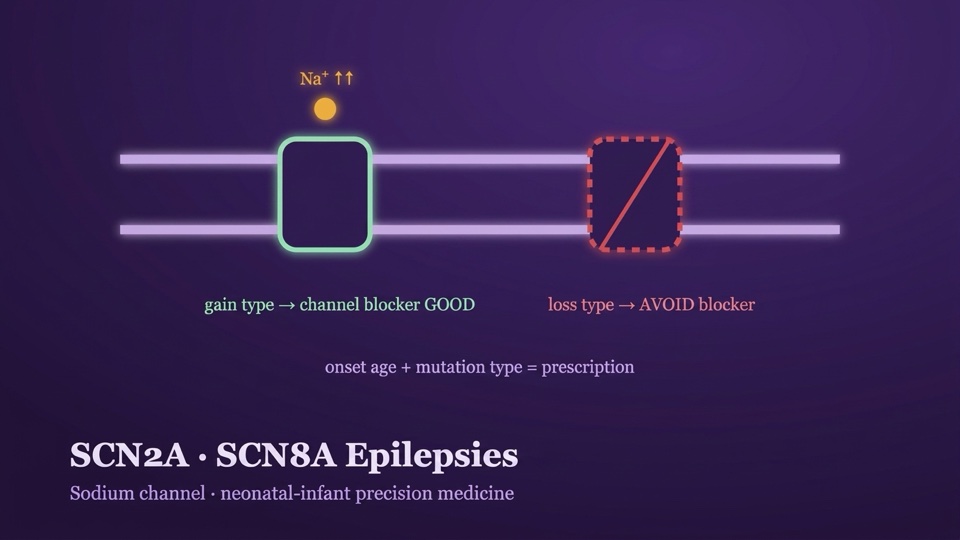
Mutations fall into two main groups: those that make the channel overactive (gain of function) and those that weaken it (loss of function). As a rule:
- Early onset (first 3 months) = mostly gain of function → good response to sodium channel blockers
- Late onset, or autism/developmental delay without epilepsy (particularly in SCN2A) = mostly loss of function → sodium channel blockers do not help and may worsen the picture
Clinical Signs
- Tonic/focal seizures in the newborn period-early infancy, which may occur in clusters
- In SCN8A, seizures often begin around 3-6 months; they may be sudden and severe
- Developmental involvement is variable: ranging from benign familial forms to severe encephalopathy
- In the SCN2A loss-of-function type, epilepsy may begin late or may never occur; autism may be the predominant feature
Diagnosis
In early infantile seizures, a rapid gene panel is now part of treatment planning; the result must be interpreted together with the mutation type (the "function" information in the laboratory report is critical for the physician).
Treatment — Precision Medicine
- In gain-of-function mutations, sodium channel blockers (carbamazepine/oxcarbazepine, at high dose if necessary; phenytoin in the acute period) are often markedly effective.
- In the loss-of-function type, these drugs are avoided; levetiracetam, valproate and other options are evaluated individually.
- New channel-specific molecules and antisense approaches are at the clinical research stage.
For the current status table, see Genetic Treatments — SCN2A treatment pipeline.
Key Message
An SCN2A/SCN8A diagnosis is not a "label" but a prescription note: age of onset plus mutation type largely indicates which drug will work.
Downloadable Documents: Emergency Action Plan + Routine Follow-up Calendar (PDF)
A 3-page emergency action plan prepared by Nörogender under the guidance of Prof. Dr. Burak Tatlı: fillable fields for your child's information and medicines, what to do during a seizure and the 5-minute rule; a two-pathway drug guide for the emergency department team based on mutation type (sodium channel blockers preferred in the gain-of-function type, avoided in the loss-of-function type); on the third page, a medical information note for health professionals (status steps, within the framework that "the final decision rests with the physician").
Also a Routine Follow-up Calendar (2 pages): gain/loss classification of the variant and card marking, reclassification of VUS variants every 1-2 years, baseline ECG (particularly for SCN8A), autism-movement disorder screenings, and an age-by-age follow-up table plus a recording chart.
📄 Emergency Action Plan (PDF, 3 pages) — in Turkish 📅 Routine Follow-up Calendar (PDF, 2 pages) — in Turkish
Fill in the form together with your physician; keep one copy at home and one at school.