
Overview
Cerebral creatine deficiency syndromes are three disorders in which the brain's energy buffer, creatine, cannot be produced (GAMT, AGAT) or cannot be transported into the brain (SLC6A8). Their importance can be summed up in two sentences: synthesis disorders can be treated with supplementation, and screening is inexpensive — it should come to mind at least once in every child who is "non-verbal + has seizures".
The Three Types — Shared and Distinguishing Features
- GAMT deficiency: The most severe end of the spectrum — marked developmental delay + drug-resistant epilepsy + movement disorder (dystonia-chorea) + severe behavioural problems. The toxic intermediate guanidinoacetate (GAA) accumulates (an additional cause of seizures)
- AGAT deficiency: The rarest and mildest form — developmental delay + muscle weakness-fatigue predominate; seizures are less common
- Creatine transporter (SLC6A8) deficiency: The most common member of the group; X-linked. In boys, disproportionate speech delay + autism-like behaviour + epilepsy; some carrier girls have mild learning-behaviour findings
Diagnosis
- First-line urine testing: creatine, creatinine and GAA — the profile distinguishes the three types from one another (GAA↑ in GAMT; GAA↓ in AGAT; raised urine creatine/creatinine ratio in transporter deficiency)
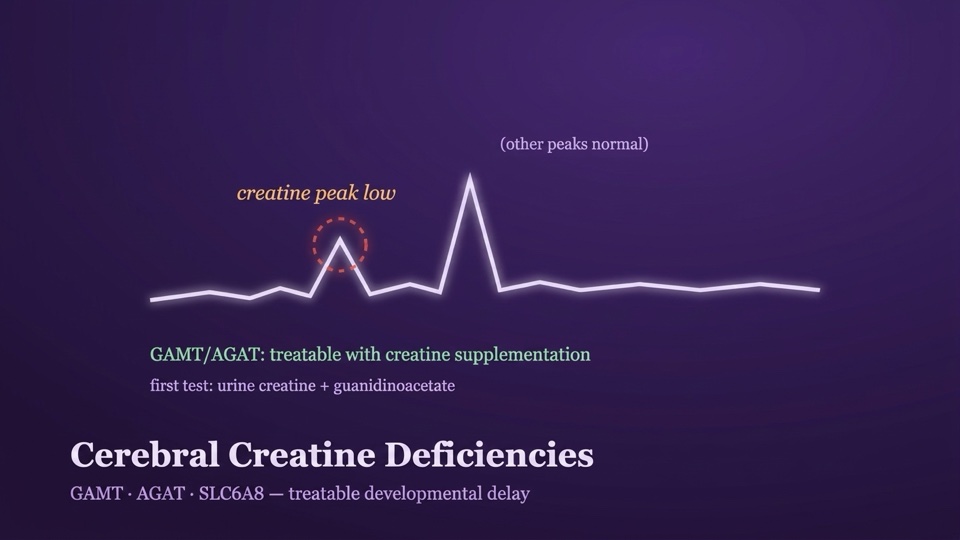
- MR spectroscopy: a low/faint creatine peak in the brain — a confirmatory finding common to all types
- Definitive diagnosis is made by gene analysis (GAMT, GATM, SLC6A8); evaluation of girls in the transporter type is planned separately
- Can be missed even in the exome era: biochemical screening (urine + MRS) should be requested separately
Treatment — By Type
- GAMT: High-dose creatine monohydrate plus ornithine supplementation to lower GAA, and an arginine-restricted diet (some centres add sodium benzoate). Seizures mostly decrease markedly, and behaviour improves
- AGAT: Creatine supplementation alone is usually sufficient; muscle strength and development respond
- Transporter deficiency: Since the supplement cannot enter the brain, the response is limited; a combination of creatine + arginine + glycine is tried, with variable gains. Supportive education and seizure management are essential
- Treatment is lifelong; follow-up with MRS can show that brain creatine has been replenished
Prognosis — An Honest Picture
- Early-started GAMT/AGAT treatment changes the course: seizure control, behavioural improvement and cognitive gains are reported; normal development has been reported in siblings treated presymptomatically — sibling screening is as important as "treatment" in this condition
- In late diagnosis, supplementation is still beneficial, but established cognitive impairment may not fully reverse
- Expectations should be kept more modest in the transporter type; communication supports (AAC) should start early
- Some countries have added GAMT to newborn screening; the field is expanding in this direction
Research Horizon
- For transporter deficiency, creatine derivatives that can enter the brain independently of the transporter have been tried; first-generation programmes faced difficulties — new compounds and gene therapy approaches are continuing at the preclinical stage
- SLC6A8 gene therapy and X-inactivation-based strategies are being investigated in the laboratory
Daily Life
- Keep the supplement schedule fixed (a written plan if a dose is needed at school); powder forms can be incorporated into a drink routine
- In the GAMT diet, protein sources are balanced with a dietitian — "self-imposed protein restriction" should not be done
- Once diagnosed, draw up a testing plan for maternal-side males (in the transporter type) and for all siblings
- Participation in patient registries also fuels advocacy for screening