
Overview
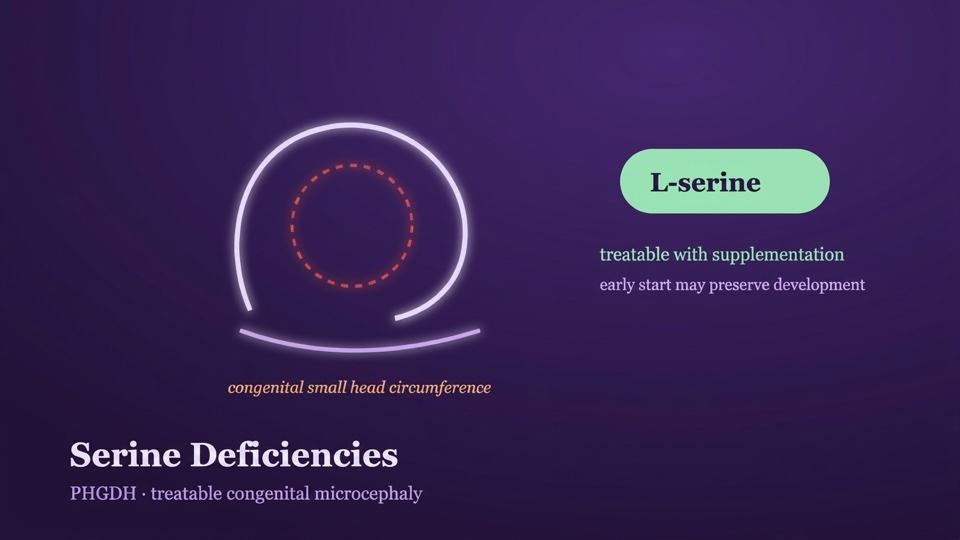
Serine biosynthesis disorders occur when the brain cannot make its own serine amino acid. They are rare but textbook-important: when correctly recognised, a simple amino acid supplement can stop seizures, allow head circumference to catch up — and if started during pregnancy, can prevent the clinical picture altogether.
Genetic Cause
The enzymes of the serine synthesis chain — most often PHGDH, and also PSAT1 and PSPH — are disrupted in an autosomal recessive manner. Serine is not only a building block for protein synthesis but also the raw material for myelin lipids, nucleotides, and D-serine, the NMDA-receptor co-agonist — its deficiency affects the developing brain through many pathways.
Clinical Spectrum
- Severe extreme (Neu-Laxova): Severe growth-brain involvement beginning in pregnancy; may be incompatible with life
- Classic infantile form: Microcephaly at birth + seizures beginning in the first months (often drug-resistant, including a West syndrome presentation) + marked developmental delay, irritability, spasticity; delayed myelination-thinned white matter on MRI
- Juvenile/mild form: Learning-behavioural problems at school age, mild seizures; cases even recognised in adulthood through polyneuropathy have been reported
Diagnosis
- Clue test: fasting plasma amino acids — serine low or at the lower limit (it may not be reported as "below normal"; serine near the lower limit + compatible clinical picture = keep the suspicion alive)
- CSF amino acids are more sensitive: low CSF serine is diagnostic
- Definitive diagnosis is by genetic analysis; counselling is provided for siblings and future pregnancies
- In the combination of "congenital microcephaly + seizures," the amino acid profile is a cheap, fast step that should not be skipped
Treatment
- L-serine (in divided doses, with a high-dose regimen) is the mainstay of treatment; glycine is added for drug-resistant seizures
- The response is tangible: reduction/cessation of seizures, increased alertness-interaction, recovery of the head circumference curve, progression of myelination on MRI
- Treatment during pregnancy: In subsequent pregnancies of families with a known diagnosis, cases have been reported in which the mother was started on L-serine and the baby was born with a normal head circumference and developed normally — one of the most striking prevention examples in neurometabolic medicine
- Follow-up: amino acid levels, growth-head circumference, developmental tests; treatment is lifelong
Prognosis — An Honest Framework
- The single factor that determines the outcome is the timing of treatment initiation: near-normal development with presymptomatic (or in-utero) treatment; seizure control and meaningful developmental gains if started in early infancy; with late diagnosis, seizures and behaviour improve but the cognitive gap largely remains
- In mild forms, supplementation clearly supports quality of life and learning
- Sibling screening is the most realistic way of catching the "treatable microcephaly" window
Research Horizon
- Whether it can be added to newborn screening (via the amino acid profile) is under discussion; D-serine and receptor-level treatments are at the research stage
Daily Life
- Divide the supplement across meals and tie it to a routine; prepare a written plan for the school dose
- Also track the head circumference curve as a family — the most visible indicator of treatment response
- When planning a subsequent pregnancy, discuss the "serine in pregnancy" protocol with the metabolism team in advance