
Overview
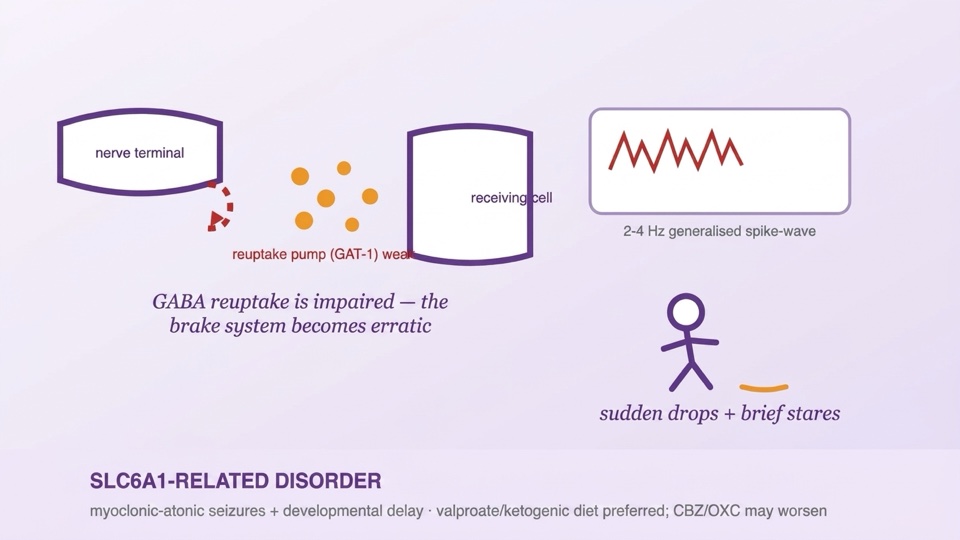
SLC6A1-related disorder results from the insufficiency of a single copy of the brain's "brake recycling pump" (the GABA transporter GAT-1), and it brings together two headline features: developmental delay/autism features together with predominantly myoclonic-atonic epilepsy typically starting at 2-4 years of age (a Doose-syndrome-like picture: sudden falls, brief staring spells, jerks). With the spread of gene panels, it has become clear that this is one of the most common single causes within this group. There are two practical rules: valproate and the ketogenic diet come to the fore; carbamazepine-oxcarbazepine-phenytoin can worsen these seizure types.
Genetic Cause and Mechanism
- GAT-1 is the main transporter that reuptakes GABA released into the synaptic cleft; with loss of function, the timing of GABA signalling is disrupted — the brake system starts working in an "all or nothing" manner. This dysregulation of the thalamocortical loop underlies generalised discharges of the absence/myoclonic-atonic type.
- Variants are mostly de novo (sibling recurrence risk ~1%, with a contribution from gonadal mosaicism); inherited families have also been reported — parental testing is performed. VUS results are reclassified every 1-2 years.
- The haploinsufficiency mechanism is a suitable target for ASO/gene therapy strategies aimed at increasing expression (discussed below, in research terms).
Clinical Picture
Development and behaviour
- Mild-to-moderate developmental delay and hypotonia in the early period; language is often the most affected area. Delay may also be present before seizures begin — the baseline should be well documented to guard against the misconception that "it got worse because of the medication".
- Autism spectrum features (in about half), attention problems, anxiety and behavioural fluctuations; mental health follow-up is needed in adolescence.
- On the motor side, a wide-based/ataxic gait and tremor may accompany the picture.
Epilepsy
- Typical onset is at 2-4 years: atypical absences (brief staring spells, eyelid twitching), myoclonic jerks and atonic drops — a cause of head/chin injuries; in some children a history of febrile seizures precedes onset.
- On EEG, 2-4 Hz generalised spike-wave discharges are typical; sleep activation may be seen.
- Prolonged periods of drowsiness/grogginess may represent atypical absence status — this should not be dismissed as "tiredness/medication effect" and should be investigated with EEG (the same rule as in SYNGAP1/Angelman syndrome).
Diagnosis
- Genetic testing: an epilepsy/neurodevelopmental panel or exome; parental testing when the result is positive. The combination of "a Doose-like picture plus marked language delay/autism" points towards SLC6A1.
- EEG: generalised spike-wave discharges; the nature of drop attacks (atonic/myoclonic) is clarified with video-EEG — this informs helmet and medication decisions.
- Differential diagnosis: Doose syndrome (myoclonic-atonic epilepsy — SLC6A1 is already the cause in some of these cases), a Lennox-Gastaut-like course, GLUT1 (a mimic in which the ketogenic diet is curative — if suspected, check CSF glucose/genetics), Angelman syndrome and SYNGAP1.
Treatment — An Honest Framework
- First steps: valproate is the drug with the most consistent reported response in this phenotype; ethosuximide can be added for staring spells; clobazam and (with care) lamotrigine are other options.
- The ketogenic diet has good reports in drug-resistant cases and should be considered early — the same general rule as for Doose-like pictures applies here too.
- To be avoided: carbamazepine, oxcarbazepine, phenytoin (and high-dose vigabatrin) — these can aggravate absence/myoclonic seizures; this note should be written on the emergency card.
- Fall safety: while atonic drops continue, a helmet should be considered; corner/staircase precautions should be taken at home and school.
- Behaviour-development package: early and intensive language therapy; autism/behavioural intervention; school accommodations; sleep routine.
- Research horizon: gene therapy/ASO programmes aimed at increasing SLC6A1 expression are at the preclinical-early stage; international SLC6A1 registries are collecting natural history data. All of this is at the research stage; it is not a recommendation for clinical use.
Three Critical Points in the Emergency Setting
- 1 · Medication note: this is a generalised/myoclonic-atonic syndrome — do not load with CBZ/OXC/phenytoin; use valproate-preferred steps in status epilepticus.
- 2 · Prolonged grogginess = EEG: this may be atypical absence status; it is treated with benzodiazepine plus valproate/levetiracetam, with response confirmed by EEG.
- 3 · Assess for head-chin trauma after a fall; if a helmet is used, remind the family of this at discharge.
Follow-up — Summary
The backbone of follow-up: a seizure diary plus videos (falls/staring/jerks labelled separately) · review of helmet/fall safety every 6-12 months · a "not CBZ/OXC" check at every prescription · a low threshold for EEG in prolonged grogginess · annual developmental-language and behaviour/autism assessment plus a school plan · age-appropriate monitoring with valproate use and reproductive-age counselling for adolescent girls · enquiry about sleep and anxiety · bone health (annual vitamin D) · genetic counselling plus VUS reclassification · participation in SLC6A1 registries. The detailed year-by-year table is in the Routine Follow-up Calendar document at the end of the article.
Prognosis — An Honest Framework for Families
- Seizures are variable: in one group of children, good control is achieved with valproate/the diet, and seizure burden often decreases towards adolescence; in another group, the course is fluctuating-resistant.
- Development does not show progressive loss; language may remain limited — early language therapy and, if needed, AAC always support communication.
- The main long-term agenda is in the area of behaviour-learning-anxiety; regular screening and school cooperation clearly improve outcomes.
- Life expectancy is close to normal; fall injuries and periods of status epilepticus are risks that can be managed with a plan.
Daily Life
- Record drop attacks and staring spells on video; a note of "what time of day" helps with medication adjustment.
- Resist the tendency to postpone the helmet decision — chin/teeth injuries most often occur during this period.
- A written school plan: repeating the question after a staring spell, seating arrangements for falls, fatigue breaks.
- Carry a card in the wallet: "SLC6A1 — do not use CBZ/OXC/phenytoin".
- Join SLC6A1 family communities and registries — this is the way to prepare for the era of gene therapy.
Downloadable Documents: Emergency Action Plan + Routine Follow-up Calendar (PDF)
Two documents have been prepared for children with SLC6A1 by Nörogender, under the guidance of Prof. Dr. Burak Tatlı. The Emergency Action Plan (3 pages): alongside the 5-minute rule, it covers avoidance of CBZ/OXC/phenytoin, the rule that "prolonged grogginess = atypical absence status → EEG", and the preference for valproate in status epilepticus, together with a note on falls and helmet use. The Routine Follow-up Calendar (2 pages): a year-by-year table and recording chart built around helmet/fall safety, annual developmental-behavioural assessment, prescription checks and valproate counselling.
📄 Emergency Action Plan (PDF, 3 pages) — in Turkish 📅 Routine Follow-up Calendar (PDF, 2 pages) — in Turkish
Complete the documents together with your doctor; keep a copy at home and at school, and update the rescue medication dose as weight changes.