Overview
Smith-Lemli-Opitz syndrome (SLOS) is a multisystem metabolic-genetic disorder caused by the body's inability to produce its own cholesterol. Cholesterol is a building block of cell membranes, myelin, bile acids and steroid hormones — its deficiency therefore affects both the body and the brain. The spectrum of severity is very wide: it ranges from mild forms noticed at school age to severe forms that are not compatible with life in the newborn.
Genetic Cause and Mechanism
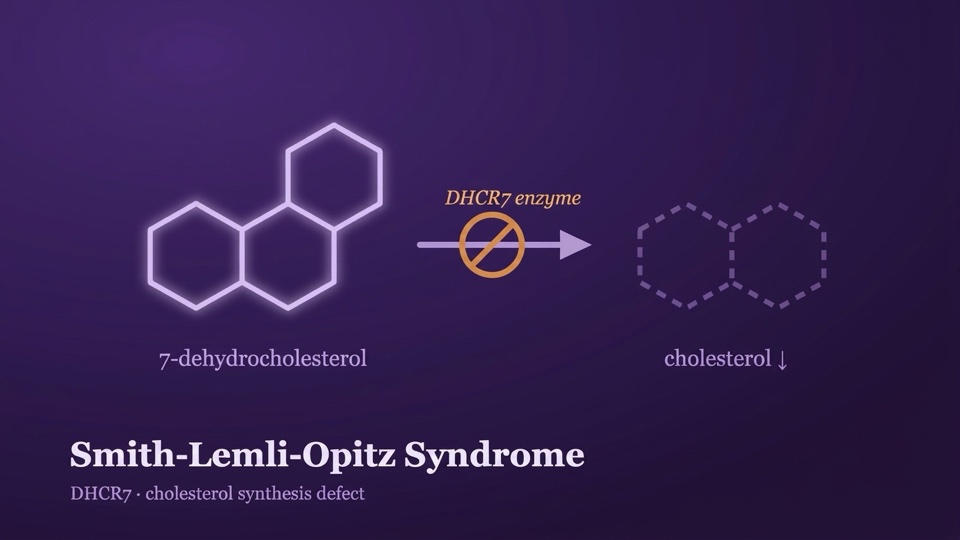
Mutations in the DHCR7 gene block the final step of cholesterol synthesis (7-dehydrocholesterol → cholesterol); inheritance is autosomal recessive. The result is two-fold: cholesterol deficiency and accumulation of the precursor 7-DHC (7-DHC can convert into harmful products on interaction with light — the cause of the skin's sun sensitivity).
Clinical Features
Key clue on examination
- Y-shaped fusion (syndactyly) of the 2nd and 3rd toes — present in more than 95% of patients; a glance can open the door to diagnosis
Other findings
- Microcephaly, ptosis (drooping eyelid), short upturned nose, small chin; cleft palate may occur
- Genital developmental anomalies in male infants (ranging from hypospadias to ambiguous genitalia)
- An extra finger on the small finger side (postaxial polydactyly) may be seen
- Congenital heart, kidney and intestinal (Hirschsprung disease, pyloric stenosis) anomalies may accompany
- Marked feeding difficulty, vomiting, growth retardation
- Behavioural profile: autistic features, sleep irregularity (short, fragmented sleep), sensory over-reactivity and self-injurious behaviour (particularly hand biting) are characteristic
- Sun sensitivity: redness-burning of the skin even with brief sun exposure
Diagnosis
- Biochemical signature: elevated plasma 7-DHC (diagnostic); cholesterol may be low, but normal cholesterol does not exclude the diagnosis — 7-DHC must always be requested when there is suspicion
- DHCR7 gene analysis confirms the diagnosis; prenatal diagnosis is possible for subsequent pregnancies (recurrence risk 25%)
- The combination of "syndactyly + microcephaly + feeding difficulty + genital anomaly" is the first diagnosis to consider
Treatment and Follow-up
- Cholesterol supplementation (diet + pharmaceutical suspension) is the standard approach; improvement has been reported in growth, resistance to infections and behaviour (particularly restlessness and self-injury) — however, since cholesterol crosses the blood-brain barrier to a limited extent, its cognitive effect is limited
- Simvastatin (aimed at reducing 7-DHC) is only considered by decision of a research/specialist centre; it is not routine
- During severe periods (illness, surgery), the need for stress-dose steroids should be kept in mind (steroid hormone synthesis also depends on cholesterol)
- Nutrition team (tube feeding if necessary), eye-hearing screenings, cardiac-renal evaluation
- Sun protection: high-factor UVA-protective cream, hat, shade arrangement
- Behaviour-sleep: melatonin, behavioural approach; protective strategies for self-injury and medication support if needed
Prognosis — An Honest Framework for Families
- Severity is the determining factor: newborns with severe internal organ anomalies may be lost; most children with moderate-mild forms reach adulthood.
- Cognitive level is typically in the moderate-severe impairment range; in mild forms there are individuals with borderline intelligence who speak and attend school.
- Behaviour and sleep are the main determinants of family quality of life — a structured behaviour plan can change "everything."
- The overall course has been observed to be more favourable in children started on cholesterol treatment early; sibling screening and early diagnosis are therefore valuable.
Research Horizon
- Antioxidant strategies aimed at reducing the harmful products of 7-DHC and statin combinations are being studied
- Gene- and mRNA-based approaches in cell models are at an early stage
- The relationship of the behavioural phenotype (autism-like) with cholesterol metabolism is also a research window for autism biology in the field
Daily Life and Support
- Shifting outdoor activity plans away from sunny hours; a sun protection protocol with the school
- Feeding diary and weight monitoring; early presentation during periods of vomiting-constipation
- Sharing "SLOS + stress-dose steroid" information with the team before surgery/anaesthesia
- Sharing experience through family associations; coordinating the behaviour crisis plan between home and school