
Overview
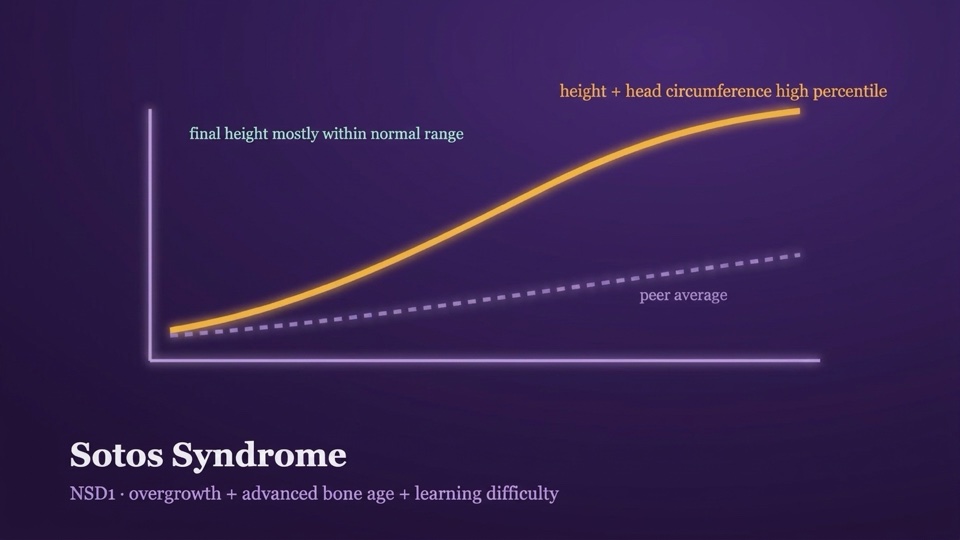
Sotos syndrome (~1/14,000) is the leading genetic cause of childhood overgrowth: a child born large, who grows rapidly and has advanced bone age — and behind this bodily "largeness" may lie hypotonia, coordination difficulties and learning needs.
Genetic Cause
NSD1 mutations/deletions (autosomal dominant; mostly de novo). NSD1 is an epigenetic regulator; it governs the "setting genes" of growth and neuronal networks. The transmission risk from an affected individual to their child is 50%. In the differential diagnosis, other overgrowth syndromes (Weaver, Malan, Beckwith-Wiedemann) are considered together with panel testing.
Clinical Course
Newborn-infancy period
- Large birth size; a history of prolonged jaundice and feeding difficulty is typical
- Marked hypotonia → delayed head control-sitting-walking (walking often at 15-24 months+)
- Height, weight and head circumference at high percentiles; bone age is advanced
Childhood
- The typical face (long face, broad forehead, frontotemporal recession, pointed chin) becomes more pronounced
- Motor clumsiness-coordination difficulty (handwriting, ball games); speech delay
- The learning profile varies: from normal intelligence to moderate impairment; the majority are in the borderline-mild range and continue in mainstream education with support
- Behaviour: attention deficit, anxiety, preference for rigid routines; autism features in a subgroup
- Seizures (often starting with fever) in ~15-25%; usually well controlled
Diagnosis and Screening
- Diagnosis is made by NSD1 analysis; requested in the triad of "large + hypotonic + learning difficulty"
- At diagnosis: cardiac assessment (PDA etc. ~20%), renal ultrasound (~15% anomaly/reflux), eye-hearing, spine (scoliosis) examination
- Tumour risk is slightly increased (rare cases) — routine aggressive screening is not recommended; awareness of early presentation for unexplained mass, pallor, abdominal distension is sufficient
Treatment and Support
- Early physiotherapy (hypotonia-coordination), speech-language therapy, occupational therapy for fine motor skills
- At school: reducing writing load/using a keyboard, adapting physical education, predictable structure for anxiety; standard treatments are effective for ADHD
- Monitoring for scoliosis and flat feet; a febrile seizure plan
- Growth itself does not require treatment — adult height generally remains at the upper limit of normal; this reassurance should be given to the family early
Prognosis — An Honest Framework
- Sotos is not a "progressive" disease; the gaps tend to close with age — motor skills and speech recover markedly by school age
- In adulthood, many individuals live and work with support or close to independently; anxiety management is a key aspect of quality of life
- Life expectancy is normal; the follow-up burden is light (annual check-up + targeted screenings)
- The environment should be warned against the trap of "large child = expectations beyond their age": expectations should be set according to chronological age and developmental level
Research Horizon
- The epigenetic network of NSD1 is an active area of research for understanding the overgrowth-learning relationship; behaviour-anxiety intervention studies are ongoing
Daily Life
- Solve practical "size" problems such as clothing-furniture with planning, not humour (ergonomic desk, suitable scissors-pencils)
- Discuss age-related confusion in peer relationships with the teacher ("5 years old but looks 8")
- Home arrangements for falls-clumsiness; sports that foster coordination, such as swimming
- Sotos family networks are a rich resource for examples of school adaptation