Overview
Spinal Muscular Atrophy (SMA) causes progressive muscle weakness through the loss of motor nerve cells in the spinal cord (~1/10,000 births). With three approved treatments and newborn screening within a decade, SMA has become the symbol of the treatment era in genetic diseases: today the questions are not "is there a treatment?" but "which treatment, when, and how is follow-up carried out afterwards?"
Genetic Cause and Mechanism
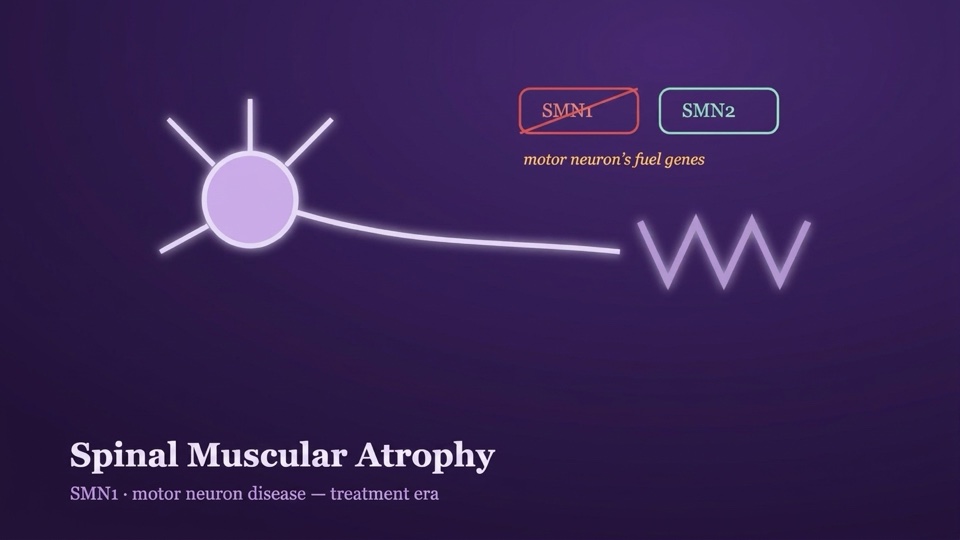
The SMN1 gene is deleted/mutated; motor neurons cannot survive without SMN protein. The backup gene SMN2 produces the same protein, but most of its message is incompletely processed — the full-protein share is ~10%. This is why SMN2 copy number is the main determinant of severity (2 copies → mostly type 1; 3 copies → type 2-3...). Inheritance is autosomal recessive; in the population approximately one in every 40-50 people is a carrier.
Clinical Types
- Type 1 (first 6 months): "Floppy baby", weak cry-suck, frog-leg posture; sitting without support is never achieved; without treatment, in the natural course, respiratory failure occurs before age 2
- Type 2 (6-18 months): Sits, cannot walk; scoliosis and respiratory involvement develop over time
- Type 3: Girdle weakness beginning after walking is achieved; difficulty with stairs/running
- Type 4: Adult-onset, the mildest
Important: In the treatment era, these classes define a starting point, not "fate".
Diagnosis and Screening — Why Are the First Days Golden?
- Diagnosis: SMN1 deletion analysis + SMN2 copy number (MLPA/qPCR)
- Newborn screening in Türkiye is in place: a positive heel-prick result → confirmation and reaching a treatment centre must happen within days; motor neuron loss begins before symptoms appear, and lost cells do not return
- In a baby presenting with symptoms (weak suck + hypotonia + tongue fasciculation), CK may be normal/slightly elevated — when in doubt, go directly to genetic testing
Treatment — Three Approved Approaches
- Nusinersen (ASO): Corrects the SMN2 message; intrathecal — 4 loading doses + maintenance every 4 months. This treatment has the longest follow-up data; in those who have had scoliosis/rod surgery, an administration plan must be made in advance
- Onasemnogene abeparvovec (gene therapy): Delivers a working copy of SMN1 intravenously as a single dose; typically used in younger infants (subject to weight/antibody conditions). Testing for AAV9 antibodies and liver-platelet monitoring alongside steroid use are mandatory
- Risdiplam (oral, daily): A small-molecule SMN2 corrector; due to ease of swallowing/access, it is a strong option across a wide age range
How is the choice made? Age-weight, SMN2 copy number, antibody status, scoliosis/surgical history, family preferences, and access/reimbursement conditions in the country are evaluated together; there is no "single correct answer" — starting early is the common principle across all options.
Supportive treatment is not skipped
- Respiratory: sleep respiratory testing, cough-assist devices, non-invasive ventilation when needed
- Feeding-swallowing assessment; reflux-constipation management; bone health (vitamin D)
- Physiotherapy + orthoses; scoliosis monitoring and timely surgery
- Complete vaccination schedule; early intervention for respiratory infections
Prognosis — An Honest Framework in the Treatment Era
- Most infants treated before symptom onset achieve sitting-walking milestones close to their peers — this is the entire rationale for screening
- In those starting treatment after symptoms appear, treatment halts progression/restores some function but does not bring back lost motor neurons: gains are proportional to the initial reserve; the need for swallowing-respiratory support may continue
- In type 2-3, treatments slow/stabilise loss of strength; a reduction in fatigue is commonly reported
- Life expectancy has markedly increased across all types; the focus of follow-up is now on scoliosis, bone health, weight, and participation/independence
Treatment Pipeline — A Detailed Look
- Second wave of muscle-targeted therapies: Apitegromab (a myostatin-pathway antibody) showed a significant improvement in motor function in phase 3; the approval process is ongoing — it is expected to open an era of "SMN therapy + muscle-strengthening agent" combinations
- High-dose/optimised SMN therapies and additional post-treatment needs (fatigue, fine motor function) are an active area of research
- Studies on an intrathecal form of gene therapy and its use in older children are ongoing
Current pipeline status table: Genetic Therapies — SMA treatment pipeline.
Daily Life and Support
- When the positive screening call comes: what is needed is speed, not panic — a reference centre appointment within the same week
- Fix treatment days (maintenance doses) into the family calendar; make a school absence plan
- View physiotherapy as an equal partner of treatment, not just its helper
- Family associations are a strong resource for sharing experience and advocacy in device-orthosis processes
Downloadable: SMA Emergency Response Plan (PDF)
You can download the 3-page emergency response plan for children with SMA, prepared by Nörogender under the guidance of Prof. Dr. Burak Tatlı. This form focuses not on seizures but on respiratory crises: sick-day steps at home/school, thresholds requiring a call to 112, and three critical warnings for the emergency team — that oxygen alone may mask CO₂ accumulation (NIV priority), low tolerance to prolonged fasting (early dextrose-containing fluids), and the prohibition of succinylcholine. The identification section has dedicated spaces for the disease-modifying treatment (nusinersen/risdiplam/gene therapy) and home respiratory devices. The third page is a medical information note for health professionals, containing treatment-specific notes (including follow-up after gene therapy).
There is also a Routine Follow-up Calendar (2 pages): a disease-modifying treatment schedule, motor scale, respiratory-swallowing assessments, and an age-by-age table plus recording chart covering scoliosis-hip and bone health.
📄 Emergency Response Plan (PDF, 3 pages) — in Turkish 📅 Routine Follow-up Calendar (PDF, 2 pages) — in Turkish
Fill in the form together with your doctor; keep one copy at home and one at school, and show it to the team before every operation/anaesthesia.