
Overview
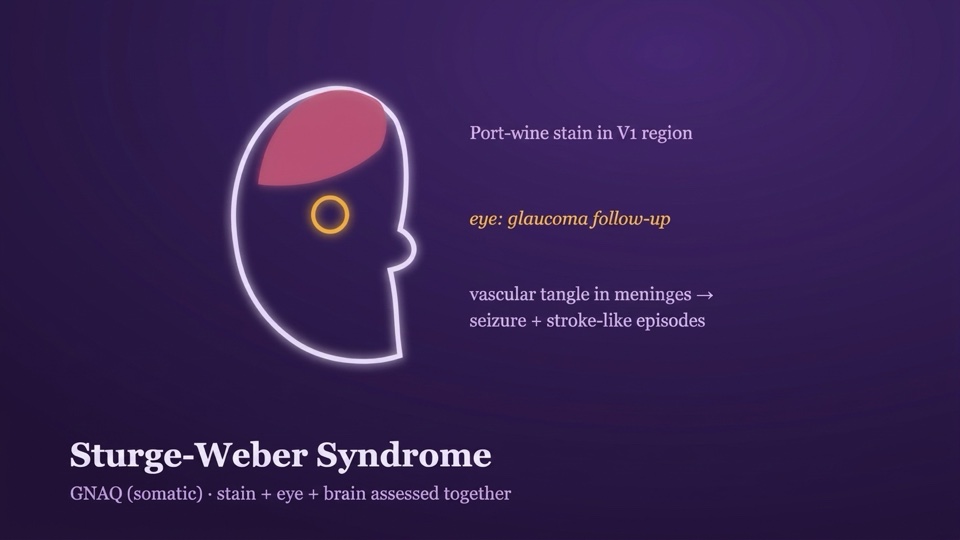
Sturge-Weber Syndrome (SWS) is the variable combination of a facial capillary malformation (port-wine stain), eye involvement (glaucoma) and a tangle of vessels in the brain's meninges (leptomeningeal angioma). It is not inherited — it results from a mosaic GNAQ mutation arising in a single cell during development; one of the first things to tell the family is that it is no one's fault and it will not recur.
Who is at risk? — From stain to risk
- Risk is associated with the stain involving the forehead–upper eyelid (V1) region; the likelihood of brain involvement increases especially with hemifacial/median wide stains (overall, SWS develops in a minority of infants with a V1 stain — the stain is most often just a stain)
- Isolated brain involvement without a facial stain is also rarely seen
Assessment and follow-up
- Eye: every infant with a V1 stain should have an examination in the first weeks plus lifelong regular eye pressure monitoring (glaucoma has two peaks: infancy and school age)
- Brain MRI (with contrast): may appear normal in the early months; many centres image at around 1 year of age if there are no symptoms, and immediately if symptoms are present. A normal early MRI does not rule out involvement — clinical follow-up continues
- Family education: the first seizure often occurs during a febrile illness and in clusters; rescue medication and a written emergency plan should be given even before the MRI result
Clinical problems and management
Seizures
- Typically occur in the first 2 years, focal; triggered by fever/illness and may extend into status
- As SWS is a focal disease, oxcarbazepine/carbamazepine and levetiracetam are often preferred; the goal is early, stable control (seizure burden is the main determinant of development)
- Epilepsy surgery (focal resection/hemispherectomy) should be considered early in drug-resistant cases — outcomes are good in appropriately selected young children
Stroke-like episodes
- Transient hemiparesis/vision loss episodes; seizure, migraine and vascular events are intertwined
- Practical measures: avoiding dehydration, treating fever early, protecting the head from blows; many centres use low-dose aspirin to reduce episode-seizure burden (the evidence is observational; the decision is individualised)
Other
- Glaucoma: active treatment with drops/surgery — preserves vision
- Hemiparesis-visual field loss: physiotherapy, constraint-induced movement programmes for the arm/hand, vision rehabilitation
- Facial stain: laser treatment can be started in infancy; it is also valuable psychosocially
- Headache-migraine is common; school-learning support and attention screening should not be neglected
Prognosis — An honest framework
- The determining triad: extent of brain involvement (unilateral/bilateral), age at seizure onset and speed of control, episode burden
- In unilateral involvement and those with well-controlled seizures, a significant proportion lead a normal or near-normal school life; adaptation is achieved even with hemiparesis/visual field loss
- Early-onset drug-resistant seizures increase cognitive risk — in this group, not delaying surgery changes the prognosis; bilateral involvement is the most difficult end of the spectrum
- If glaucoma is monitored regularly, vision is mostly preserved
Research horizon
- Drugs targeting the GNAQ pathway (mTOR/MEK axis) are of laboratory and early clinical interest
- Studies are ongoing to identify at-risk infants in advance using EEG/MRI markers in the presymptomatic period and to trial preventive treatment
Daily life
- Febrile illness = alarm level: antipyretic early, plenty of fluids, rescue medication at hand
- Visual field/hemiparesis accommodations and a seizure plan for school
- Early, open conversation about peer bullying regarding the stain; discuss the laser option together with the child
- SWS foundations' family networks are valuable for experience in managing episodes