
Overview
STXBP1-related disorder is a condition caused by deficiency of one of the core proteins of synaptic transmission, and it is among the most common single causes of developmental and epileptic encephalopathies. It carries two important facts together: seizures settle over time in most patients, while the developmental need is lasting — the care plan is built around these two axes.
Genetic Cause
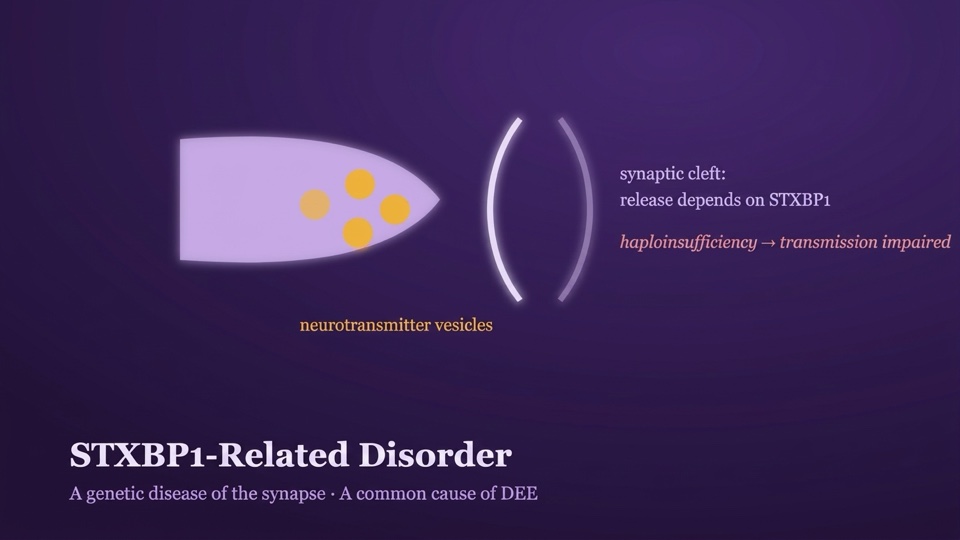
STXBP1 (Munc18-1) is an indispensable part of the release machinery of neurotransmitter vesicles; loss of a single copy (haploinsufficiency) weakens transmission. Mutations are almost always de novo → sibling recurrence risk is low (~1% with the share of gonadal mosaicism), and this can be stated clearly to the family.
Clinical Spectrum
Group with epileptic onset
- Tonic/spasm-type seizures in the first weeks-months; it is among the leading genetic causes of Ohtahara and West presentations
- The EEG evolution is typical: burst-suppression → hypsarrhythmia → multifocal deterioration
Group without epilepsy/with few seizures
- In a considerable portion of patients, developmental delay is at the forefront; seizures may never occur or may occur late and infrequently — the misconception that "STXBP1 = epilepsy gene only" should not be adopted
Common findings
- Marked hypotonia; movement findings such as tremor and ataxia-dyskinesia — sometimes confused with seizures, video-EEG differentiation is valuable
- Severe limitation of speech (most individuals remain non-verbal or stay at a few words), autism features, sleep problems
Diagnosis
- Gene panel/exome in early infantile seizures and unexplained severe developmental delay — STXBP1 is a member of standard panels
- Early diagnosis sets up a realistic prognosis discussion, ends unnecessary rounds of metabolic investigation, and opens doors to registries/studies
Treatment
- Seizures: There is no single "correct drug"; phenobarbital, levetiracetam, valproate, and during the spasm period vigabatrin/hormone therapy are commonly used; in drug-resistant periods, ketogenic diet and VNS are options. Treatment should be reviewed as the seizure type changes
- Movement findings: Drug trials when needed for tremor-dyskinesia; but first the question "is this attack a seizure or a movement?" should be clarified with video (this prevents unnecessary drug burden)
- Developmental package: Physiotherapy, occupational therapy, swallowing-feeding follow-up, and early alternative communication (pictures/signs/eye-tracking) — time should not be lost waiting for speech
Prognosis — An Honest Framework
- Seizures: In a significant proportion, they decrease markedly after the first years; in some, complete remission is seen — the assumption of "lifelong drug-resistant epilepsy" is often wrong in STXBP1
- Development: Cognitive impairment generally remains moderate-to-severe and lasting; walking is achieved in a portion of patients (often late and with support), accompanied by tremor-balance problems
- Communication: Even if verbal language remains limited, expression of intent-wish can be developed with alternative systems; comprehension is ahead of expression
- Life expectancy data are largely reassuring; risks are limited to severe seizure periods and respiratory-feeding complications
Research Horizon and Treatment Pipeline
- Dosage-increasing strategies: ASO and gene therapy programmes that increase production from the intact copy are at the preclinical development stage; the haploinsufficiency mechanism is ideal for this approach
- Chemical chaperones (e.g. phenylbutyrate) have been tried in small series; the evidence is at an early stage
- International STXBP1 registries and natural history studies are preparing the benchmarks for future trials — participation is valuable
Three Critical Points in the Emergency Department
- 1 · Standard steps apply in prolonged seizures; there is no syndrome-specific drug prohibition. Spasm clusters in an infant should be evaluated on the same day.
- 2 · Tremor-dyskinesia should not be mistaken for a seizure: The movement findings of STXBP1 are often confused with epileptic attacks — a video should be requested from the family before drug escalation in the emergency department.
- 3 · Aspiration should be kept in mind against a background of hypotonia-feeding difficulty; a new event in an individual whose seizures settled years ago should not automatically be regarded as "seizure recurrence" (video + EEG).
Follow-up — Summary
The backbone of follow-up: attack diary + video archive (seizure/tremor differentiation) · frequent EEG and spasm awareness in infancy; afterwards according to the clinical picture · a medication simplification plan once seizures settle (gain in alertness-learning) · updating developmental goals every 3-6 months + early AAC · monitoring of movement findings (tremor-ataxia-dystonia); questioning parkinsonism-like findings in adulthood · feeding-swallowing and weight follow-up · autism/behaviour and sleep screening · bone health (annual vitamin D) · genetic counselling + VUS reclassification · participation in STXBP1 registries. The detailed age-by-age table is in the Routine Follow-up Calendar document at the end of the article.
Daily Life
- Keep an archive of attack videos (the distinction between seizure and tremor changes treatment)
- Have communication goals written into the school plan; challenge the bias that "non-verbal = not understanding"
- Plan medication simplification with the physician once seizures settle (gain in alertness-learning)
- Join the registry efforts of STXBP1 family foundations
Downloadable Documents: Emergency Action Plan + Routine Follow-up Calendar (PDF)
Two documents have been prepared for children with STXBP1 by Nörogender, under the guidance of Prof. Dr. Burak Tatlı. The Emergency Action Plan (3 pages): identity/medication fields and the 5-minute rule, along with STXBP1-specific warnings — confusion of tremor/dyskinetic attacks with seizures (the video rule), same-day presentation for spasm clusters, and a note on aspiration. The Routine Follow-up Calendar (2 pages): a simplification plan once seizures settle, early AAC, movement findings, and an age-by-age table including questioning of parkinsonism in adulthood, plus a registry chart.
📄 Emergency Action Plan (PDF, 3 pages) — in Turkish 📅 Routine Follow-up Calendar (PDF, 2 pages) — in Turkish
Fill in the documents together with your physician; keep a copy at home and at school, and update the rescue medication dose as weight changes.