Overview
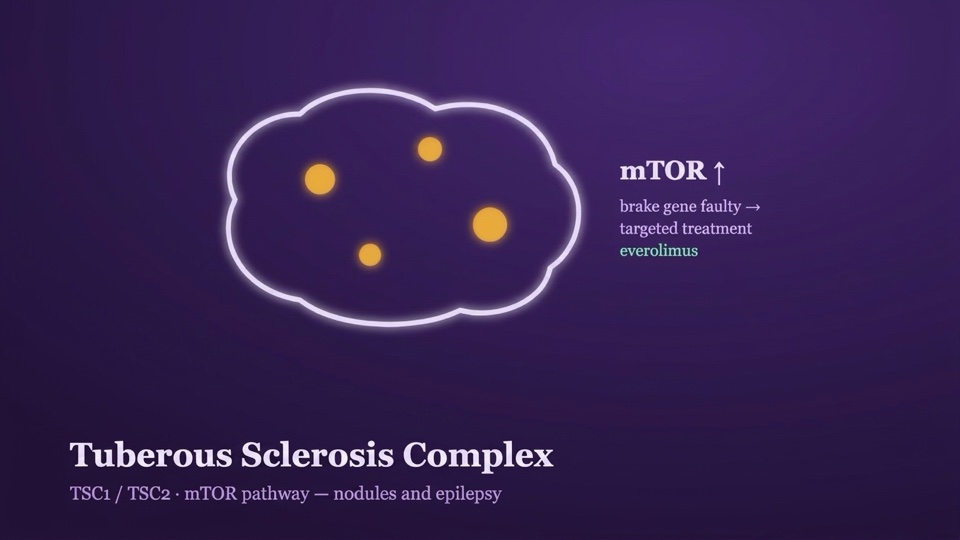
Tuberous Sclerosis Complex (TSC) arises from the breakdown of the brakes on the mTOR pathway (the TSC1/TSC2 genes), the main switch controlling cell growth, and leads to benign growths in many organs (incidence ~1/6,000 births). Its importance in paediatric neurology is two-layered: epilepsy that can start early and run an aggressive course (infantile spasms, often in the first year) together with accompanying developmental-behavioural problems (TAND). TSC is also one of the landmarks of modern neurogenetics: it is one of the first diseases in which a treatment that directly targets the disrupted mechanism (mTOR inhibition — everolimus) has worked in the clinic.
TSC is not a "single-organ" disease; a good outcome is achieved through a planned, lifelong follow-up calendar. In the middle of this article you will find an age-by-age / year-by-year follow-up table from the time of diagnosis into adulthood.
Genetic Cause
Loss-of-function mutations in the TSC1 gene (chromosome 9; hamartin protein) or the TSC2 gene (chromosome 16; tuberin protein) cause the disease. The two proteins together form a complex that brakes the mTOR pathway; when the brake is released, cells grow in an uncontrolled manner in places (tubers, nodules, angiomyolipomas, rhabdomyomas).
- TSC2 mutations are generally associated with an earlier and more severe phenotype (more tubers, earlier seizures, more pronounced kidney involvement); TSC1 tends on average to be milder — but a definite prediction cannot be made at the individual level.
- TSC2-PKD1 contiguous gene deletion: TSC2 lies next to PKD1, the polycystic kidney disease gene; deletions removing both genes add an early and pronounced polycystic kidney picture — in these children, kidney follow-up is planned more frequently.
- About two-thirds of cases are de novo (occurring for the first time in the family). In 10-15% of cases no mutation is found on a blood test (usually due to mosaicism); clinical criteria alone are sufficient for diagnosis, and failure to find the gene does not rule out the diagnosis.
- Inheritance is autosomal dominant: an affected individual has a 50% chance of passing it on to each child. A mildly affected ("silent") parent may be missed — the parents of every diagnosed child should also be assessed with a skin examination (Wood's lamp), kidney imaging and, if necessary, genetic testing; this forms the basis of counselling for future pregnancies.
Symptoms: Organ by Organ and Age by Age
The findings of TSC appear on stage in order with age — knowing which finding is expected in which period also explains the logic of the follow-up calendar:
| Period | Prominent findings |
|---|---|
| Before birth | Cardiac rhabdomyoma on fetal echocardiography — the strongest early warning sign for TSC; most shrink spontaneously and are followed for arrhythmia. |
| Newborn - 1 year | Milk-white leaf-shaped skin patches (hypomelanotic macules; become more visible under Wood's lamp), cortical tubers and subependymal nodules in the brain; the risk of infantile spasms peaks around 3-7 months; focal seizures may start even earlier. |
| 1-5 years | Angiofibromas begin to appear on the face (the butterfly area over the nose and cheeks), a rough shagreen patch on the lower back; drug-resistant epilepsy and TAND components (autism, language delay) become evident in this period. |
| School age - adolescence | The risk of SEGA (subependymal giant cell astrocytoma) continues throughout childhood and growth may accelerate in adolescence (MRI follow-up until age 25); periungual fibromas and renal angiomyolipomas begin to grow; attention and learning problems become apparent at school. |
| Adulthood | The main concern is the kidney (growth of angiomyolipomas and risk of bleeding); women are screened for pulmonary LAM (lymphangioleiomyomatosis); the risk of SEGA decreases notably after age 25. |
Other findings: retinal hamartomas (mostly silent), dental enamel pits, intraoral fibromas, hepatic angiomyolipomas and bone lesions — most require not treatment but deliberate follow-up.
Epilepsy: The Neurological Core of TSC
Epilepsy develops in 80-90% of children with TSC, and the first two years are the decisive window:
- Infantile spasms: Sudden forward bending of the trunk/arm opening movements occurring in clusters (often on waking). Unlike other causes, the first-choice drug for spasms in TSC is vigabatrin; if there is no response, hormone therapy (ACTH/steroid) is added within days. A delayed diagnosis directly worsens the developmental outcome: the family should be shown spasm videos at the time of diagnosis and told to present on the same day if in doubt.
- "The EEG deteriorates before the seizure": In TSC, epileptiform EEG abnormality can appear weeks to months before a clinical seizure. For this reason, frequent EEG follow-up is performed in the first year; the approach of starting treatment (preventive vigabatrin) once the EEG deteriorates, without waiting for a seizure, is a strategy shaped by the EPISTOP and PREVeNT studies and has entered the protocols of many centres — differences in practice between centres persist, so ask about the plan at the centre where you are followed.
- Focal seizures: Originate from tubers; the picture becomes predominantly focal with age. The seizure type may vary in the first years.
- Steps in drug-resistant epilepsy: everolimus (approved as add-on therapy), cannabidiol (approved), the ketogenic diet, VNS — and epilepsy surgery. The view that "there are too many tubers, surgery is not possible" in TSC is outdated: if the dominant tuber initiating the seizures can be identified, surgical results are good; when two appropriate drug trials fail, surgical evaluation should be requested without delay.
TAND: The Invisible Burden
TAND (TSC-Associated Neuropsychiatric Disorders) is an umbrella concept covering autism spectrum disorder (25-50%), attention-deficit hyperactivity disorder (30-50%), intellectual disability (~50%), anxiety-mood problems, sleep disorders and learning difficulties. The strongest determinant of the family's quality of life is often not seizures but TAND — and it remains invisible if not asked about. The international recommendation is a brief TAND enquiry at every visit, a comprehensive screening once a year (TAND checklist), and formal neuropsychological assessment at key transition periods (pre-school, school entry, adolescence, transition to adulthood). Components such as sleep, ADHD and anxiety are treatable — this is the quickest gain available to the family.
How Is It Diagnosed?
According to current international criteria, diagnosis can be made in two ways: (1) Genetic: demonstrating a pathogenic mutation in TSC1 or TSC2 is sufficient on its own. (2) Clinical: the presence of two major findings (hypomelanotic macules ≥3, angiofibroma, ungual fibromas, shagreen patch, retinal hamartomas, cortical dysplasia/tuber, subependymal nodule, SEGA, cardiac rhabdomyoma, LAM, angiomyolipoma ≥2), or one major plus two minor findings, is diagnostic. In practice the pathway is often: fetal rhabdomyoma or skin patches plus seizures in an infant → brain MRI + genetic testing → diagnosis.
What Must Be Done at the Time of Diagnosis (Baseline Assessment)
At the moment of diagnosis — regardless of age — the following "point zero" map is drawn up:
| Area | At time of diagnosis |
|---|---|
| Brain | Contrast-enhanced brain MRI (tuber, nodule, SEGA) + EEG (even without a history of seizures) + spasm-video education for the family in infants |
| Development/TAND | Age-appropriate developmental assessment + TAND checklist |
| Kidney | Abdominal MRI (preferred; ultrasound as an alternative) + blood pressure + kidney function (GFR) |
| Heart | Echocardiography + ECG (rhabdomyoma and rhythm) |
| Eyes | Dilated fundus examination (hamartoma; baseline before vigabatrin) |
| Skin-teeth | Full skin examination (Wood's lamp) + dental examination |
| Lungs | Baseline high-resolution chest CT (LAM) in women over 18; at any age if symptomatic |
| Family | Parental screening (skin + kidney imaging ± genetic testing) + genetic counselling |
Follow-up Calendar: Age by Age / Year by Year
The table below is a summary of the international TSC follow-up recommendations (2021 update) organised by age period. The personal calendar is intensified by your doctor according to findings — for example, the MRI interval shortens to months with a growing SEGA.
| Age period | What needs to be done |
|---|---|
| 0-12 months (the most critical year) | EEG: every 4-6 weeks (to catch deterioration before spasms/seizures) · Brain MRI: at diagnosis; repeat after 1-2 years if uncomplicated · Echo + ECG: at diagnosis, every 6-12 months until a rhabdomyoma shrinks · Kidney imaging + blood pressure: at diagnosis · Eyes: at diagnosis; eye check every 3 months if vigabatrin is started · Development: at every visit · Spasm-video education and an emergency plan for the family |
| 1-3 years | EEG: according to clinical course if seizures are present; every 3-6 months, spacing out, if seizure-free · Brain MRI: every 1-3 years (SEGA) · Kidney MRI: every 1-3 years + blood pressure at every visit · Echo: rhabdomyoma follow-up (interval widens if shrinking); ECG annually · Eyes: annual · TAND: brief enquiry at every visit + checklist once a year; autism screening (18-24 months) · Dental: every 6 months |
| 3-6 years | Brain MRI: every 1-3 years · Kidney MRI: every 1-3 years + blood pressure · EEG: with seizures/clinical change and at routine intervals · TAND: formal pre-school developmental-neuropsychological assessment (the basis of the school plan) · Eyes annually · ECG annually · Dental every 6 months |
| 6-12 years | Brain MRI: every 1-3 years · Kidney MRI: every 1-3 years + blood pressure + GFR annually · TAND: annual screening; school performance-attention enquiry; formal assessment if necessary · Eyes annually · ECG annually (12-lead at least every 3-5 years) · Dental every 6 months · Skin: annually (angiofibroma treatment plan — topical sirolimus/laser) |
| 12-18 years (adolescence) | Brain MRI: every 1-3 years — SEGA growth may accelerate in this period, and the interval may be shortened · Kidney MRI: every 1-3 years (angiomyolipomas grow in this period; a plan is made as they approach 3 cm) + blood pressure + GFR · TAND: adolescent screening (including anxiety-depression) + transition to adult care plan (begins at age 12-14) · LAM information for girls · Eye/ECG/dental routines continue |
| 18-25 years | Brain MRI: continues every 1-3 years until age 25 (the age limit at which SEGA follow-up ends; if there is no SEGA at 25, routine brain MRI can be discontinued) · Kidney MRI: every 1-3 years, for life + blood pressure + GFR annually · Chest CT in women: baseline at age 18; every 5-10 years if no problem is found + symptom enquiry (breathlessness, pneumothorax) · Transfer to the adult healthcare system is completed |
| 25 years + | Kidney: MRI every 1-3 years + blood pressure/GFR annually (the main source of adult morbidity) · Lungs (women): CT every 5-10 years / according to clinical course if LAM is present · Skin-teeth-eyes: annual routines · TAND: annual enquiry (anxiety-depression, work-life functioning) · Brain MRI only if there is a history of SEGA/symptoms |
Practical suggestion: Personalise this table with your doctor and turn it into a one-page "follow-up chart"; write down the date each examination was performed and the next date.
Emergencies: Four Red Flags
Situations requiring emergency presentation in TSC are not limited to seizures:
- 1 · New-onset spasm clusters / prolonged seizure: Suspected spasms should be assessed on the same day; for a seizure lasting more than 5 minutes, give rescue medication and call 112 (emergency services in Türkiye).
- 2 · SEGA / acute hydrocephalus: Gradually increasing headache, morning vomiting, reduced alertness, eye movement disturbance/double vision → urgent brain imaging.
- 3 · Renal angiomyolipoma bleeding: Sudden flank/abdominal pain, blood in urine, paleness, a drop in blood pressure → urgent imaging + interventional radiology (embolisation).
- 4 · Rhythm disturbance: Palpitations, fainting → ECG (rhabdomyoma-related arrhythmia).
A downloadable emergency response plan summarising these four situations and the approach to a child on everolimus in the emergency department, all on one page, is at the end of this article.
Treatment
- Infantile spasms: The first choice in TSC is vigabatrin (with visual field monitoring); if there is no response, hormone therapy (ACTH/prednisolone) is added without delay.
- Drug-resistant epilepsy: Everolimus is approved as add-on therapy (it targets the seizure mechanism itself); cannabidiol is an approved option; epilepsy surgery, the ketogenic diet and VNS are considered as steps in suitable cases.
- SEGA: Everolimus shrinks a growing tumour; surgery takes priority in acute hydrocephalus/rapid growth.
- Renal angiomyolipoma: Above ~3 cm, preventive action is taken before bleeding occurs: everolimus is the first choice; embolisation is used for large or bleeding lesions (a kidney-sparing approach is essential, and nephrectomy is avoided).
- Skin: Topical sirolimus (approved) and laser for angiofibromas.
- Practical notes on everolimus: Used with blood level monitoring; mouth sores, susceptibility to infection and lipid-glucose changes are monitored. Drug interactions are critical: macrolide antibiotics (clarithromycin) and azole antifungals dangerously raise the level; carbamazepine/phenytoin/rifampicin lower it. Live vaccines are not given during treatment; for planned surgery, drug management is required because of delayed wound healing. The family is taught the rule of early contact in intercurrent febrile illness.
Prognosis — An Honest Picture
- The spectrum is very wide: about half of individuals fall within the normal/near-normal intelligence range. The strongest determinants are the seizure burden in the early period (particularly rapid control of spasms), the early course of the EEG and the type of mutation (TSC2 is on average more severe).
- Epilepsy is easily controlled in roughly one-third, follows a fluctuating course in one-third, and is drug-resistant in one-third; surgical evaluation should not be delayed in the drug-resistant group.
- Life expectancy is close to that of the general population; the main risks are drug-resistant epilepsy (including SUDEP), SEGA complications, and in adulthood renal bleeding/failure and LAM in women — all of these are risks that can be anticipated with the follow-up calendar and mostly prevented.
- TAND is the greatest determinant of the family's quality of life and includes treatable components (sleep, ADHD, anxiety).
Treatment Pipeline and Research Horizon
TSC is one of the first neurogenetic diseases in which a "mechanism-targeted drug" has worked in the clinic; today's research agenda includes earlier and smarter use of approved tools (EEG-based preventive treatment), new-generation mTOR strategies, and studies targeting TAND itself. For the current picture of candidate approaches, see: Genetic Treatments — TSC treatment pipeline.
Daily Life
- The family's first task: watching spasm-recognition videos; filming a video and presenting on the same day if in doubt.
- Put the follow-up calendar into a one-page chart (brain/kidney/eye/EEG/echo dates) — this is the best way not to miss appointments.
- If everolimus is being used: early contact in febrile illness, arranging the live-vaccine plan with the doctor, and checking every newly prescribed medicine (including antibiotics) for interactions.
- Bring TAND awareness into the school plan: attention and learning support, a behaviour plan, a seizure action plan.
- Sun protection and skin care (the laser/topical treatment plan for angiofibromas, together with dermatology).
Downloadable Documents: TSC Emergency Plan + Routine Follow-up Calendar (PDF)
You can download the 3-page emergency response plan prepared for children with tuberous sclerosis by Nörogender, under the guidance of Prof. Dr. Burak Tatlı. The form includes fillable fields for your child's information and medicines, step-by-step actions to take during a seizure, a section on the 5-minute rule and rescue medication, and TSC-specific warnings for the emergency department team: three non-seizure emergencies (SEGA/hydrocephalus, renal bleeding, arrhythmia) and drug interaction/infection notes for a child on everolimus. The third page is a medical information note for health professionals summarising the priority of vigabatrin in infantile spasms and the steps for status epilepticus.
A printable version of the age-by-age follow-up table above — together with the baseline checklist at diagnosis, the age-period table and a follow-up record chart to be filled in at check-ups — has also been prepared as a separate document.
📄 Emergency Response Plan (PDF, 3 pages) — in Turkish 📅 Routine Follow-up Calendar (PDF, 2 pages) — in Turkish
Fill in the form together with your doctor; keep one copy at home and one at school, and update the rescue medication dose as weight changes.