
Overview
Williams syndrome (~1/7,500-10,000) is recognised by an overly social-warm temperament, a distinctive cognitive profile, and vascular involvement due to elastin deficiency. Follow-up rests on two constant pillars: lifelong cardiovascular monitoring and an education plan tailored to the child's strong and weak areas.
Genetic Cause
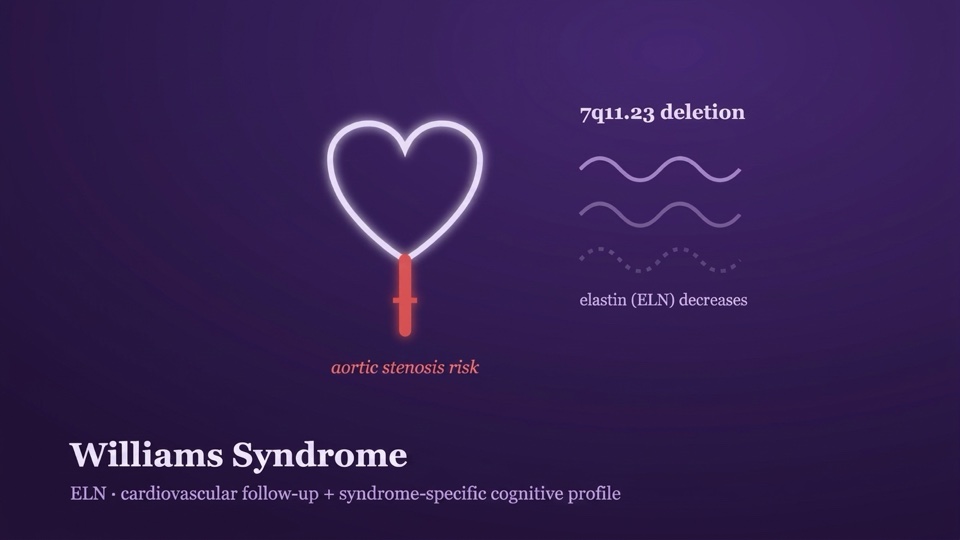
Deletion of ~25-27 genes (including ELN) in the 7q11.23 region; almost always de novo. Loss of ELN reduces the elasticity of the vessel wall → stenoses and high blood pressure; other genes in the region (the GTF2I family, etc.) contribute to the cognitive-behavioural profile. Diagnosis is made by microarray/targeted deletion testing; the risk of transmission from an affected individual to their child is 50%.
Clinical Features
Cardiovascular (the most critical area)
- Supravalvular aortic stenosis (SVAS) in ~70%; peripheral pulmonary stenoses are common in infancy (most resolve spontaneously, SVAS may progress)
- Hypertension is common at any age (including renal artery stenosis) — blood pressure should be measured in both arms
Infancy
- Feeding difficulty, colic-irritability, constipation; hypercalcaemia episodes (irritability-vomiting); growth delay
Development-Behaviour
- Strengths: language, verbal memory, music, face recognition. Weaknesses: visual-spatial processing (writing, drawing, mathematics, direction)
- Excessive sociability + absence of stranger wariness (requires safety training); accompanied by widespread anxiety and specific phobias, sound sensitivity (hyperacusis), attention problems
Follow-up Plan
- Cardiology: Echocardiography at diagnosis and at regular intervals; assessment of four-limb pulses/blood pressure at every visit; continues into adulthood
- Calcium: Frequent in infancy, annual thereafter (including urinary Ca); standard multivitamins containing vitamin D are not given, vitamin D only by physician decision
- Thyroid, hearing-vision (strabismus), dental, renal ultrasound (structural anomaly/nephrocalcinosis), glucose (adult), joint-spine follow-up
- Developmental assessment + building the school plan around the strong/weak profile
⚠️ Anaesthesia and Procedure Safety
In Williams syndrome, anaesthesia carries a specific risk due to the possibility of SVAS + coronary involvement (rare sudden cardiac events have been reported). Any form of sedation/anaesthesia must be planned with a prior cardiology assessment, at an experienced centre. This warning includes dental treatment and MRI sedation — it should be carried in writing on a family card.
Treatment
- Surgical/percutaneous intervention for stenoses when needed; hypertension is actively treated
- Dietary adjustment and hydration for hypercalcaemia; specialist management in resistant cases
- Cognitive-behavioural approach for anxiety and SSRIs when needed; sound management strategies for hyperacusis
- Early intervention: support for the motor-visual area even though language is strong; concrete materials for mathematics
Prognosis — An Honest Framework
- Most individuals reach adulthood well; the main long-term concern is vascular health (blood pressure!) and anxiety management
- Cognitive level is typically in the mild impairment-borderline range; reading is usually acquired, independence may be partial (supported living/work models are successful)
- Social temperament is a major strength; it should be balanced with stranger-safety training
- Glucose metabolism and weight should be monitored in adulthood
Research Horizon
- Approaches targeting elastin biology (strengthening the vessel wall) and the neurobiology of anxiety-social behaviour are active research areas; Williams syndrome offers a distinctive contribution to science as a natural model for "social brain" studies
Daily Life
- Teach "not everyone is a friend" early, with concrete rules (who to go with, who to hug)
- Headphones for noisy environments; advance notice before school events
- Keep the surgery-sedation warning card in a wallet/school file
- Music education both nurtures the strong area and reduces anxiety — consider it a serious tool