
Overview
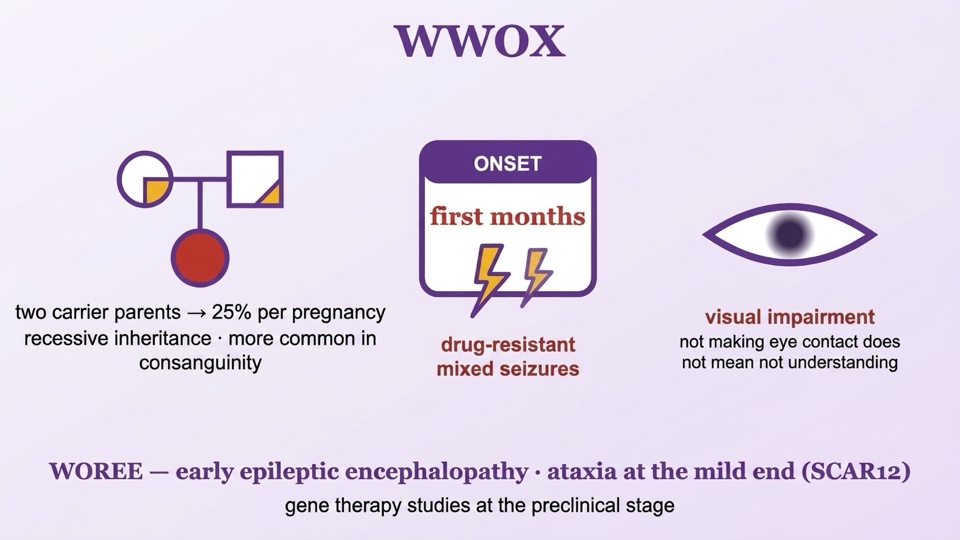
WWOX-related disorders are an autosomal recessive disease family in which the same gene has two opposite-severity faces. The severe and more commonly recognised face is WOREE syndrome (WWOX-related epileptic encephalopathy): very drug-resistant mixed seizures beginning in the first weeks-months of life; failure to establish/loss of eye contact (marked visual impairment), severe developmental impairment, acquired microcephaly and movement disorder. The milder face is SCAR12: seizures starting in childhood that are mostly controllable + cerebellar ataxia + moderate learning impairment. Parents are healthy carriers, and the recurrence risk is 25% in every pregnancy — in our country, where consanguineous marriage is relatively common, this diagnosis is one of the conditions in which genetic counselling is most critical.
Genetic Cause and Mechanism
- WWOX (16q23; located on FRA16D, one of the most fragile regions of the genome) encodes an enzyme involved in neuronal survival and synapse maturation. The disease arises from biallelic variants (both copies disrupted); because the gene lies in a fragile region, deletions are common — sequencing alone may not be sufficient, and deletion/duplication analysis must be requested together with it.
- Genotype roughly predicts severity: two "truncating" (null) variants → tendency towards the severe WOREE end; at least one partially-functional (missense) variant → tendency towards the milder end/SCAR12. This framework is not definitive; it should be explained to the family in terms of probability.
- Inheritance is autosomal recessive: carrier parents are healthy; sibling recurrence risk is 25%; carrier screening in the extended family and prenatal/preimplantation options for future pregnancies are discussed through counselling. VUS results are reclassified every 1-2 years.
Clinical Picture — Two Faces
WOREE syndrome (severe end)
- Seizures begin in the first weeks-months: a mixture of focal, tonic, myoclonic seizures and epileptic spasms; often very drug-resistant; status epilepticus may occur.
- Visual impairment is early and marked: eye contact cannot be established or is lost, visual tracking does not develop (cortical visual impairment ± optic atrophy) — not looking does not mean the child does not notice pain or does not notice you.
- Severe developmental impairment (head control is usually not achieved), marked hypotonia and, over time, spasticity-dyskinesia; acquired microcephaly; feeding-swallowing difficulty and recurrent respiratory infections are the main items on the care agenda.
- MRI: progressive cerebral volume loss, thin corpus callosum, delayed myelination.
- The course is severe and the risk to life in early years (drug-resistant status, respiratory infections) is high — care goals should be discussed with the family early, honestly and compassionately, and the palliative care team should be involved early (this is not "giving up" but an additional layer of expertise that protects comfort and the family).
SCAR12 (mild end)
- Generalised seizures beginning in childhood that are mostly controllable with medication + cerebellar ataxia (unsteady gait, hand clumsiness) + moderate learning impairment; spasticity in some.
- Children at this end attend school; independence is targeted through supportive education and balance-safety arrangements.
Diagnosis
- Genetic: early-infancy DEE panels/exome — sequencing + deletion/duplication analysis together (deletions are common due to FRA16D fragility). Parental carrier confirmation if the result is positive.
- EEG: same day if spasms are suspected (hypsarrhythmia/multifocal discharges); seizure types should be documented with video.
- Eye assessment is part of the diagnostic package (vision-optic nerve; CVI).
- Differential diagnosis: other early DEEs (CDKL5, KCNQ2, STXBP1, SCN2A), mitochondrial conditions, cerebral folate/metabolic causes; at the mild end, other autosomal recessive ataxia-epilepsy conditions. The molecular result clarifies the distinction.
Treatment — An Honest Framework
- There is currently no WWOX-specific approved treatment; the triad of seizure management + investment in vision-communication + feeding-respiratory care determines quality of life.
- Seizures (WOREE): standard protocols for the spasm component (hormonal therapy and/or vigabatrin); combinations for other types (phenobarbital, levetiracetam, valproate, clobazam, topiramate…) with physician titration — there is no gene-specific avoidance list; response is often partial, and the goal is seizures that are "fewer-shorter-safer". The ketogenic diet is an option that can be tried.
- Visual-communication programme: CVI approach (plain background, high contrast, single stimulus, wait time) + tactile-auditory communication; reframing the family's comment "they're not looking" as "this is how they see for now" changes the tone of care.
- Feeding-respiratory: swallowing assessment, reflux management, gastrostomy if necessary (weight gain + lung protection); secretion management and complete vaccination; early presentation for infections.
- SCAR12 end: seizure control + physiotherapy (balance-gait safety) + school support plan.
- Research horizon: AAV-mediated WWOX gene therapy has shown effect in animal models and is at the preclinical stage — it is at the research stage; this is not a recommendation for clinical use. Participation in natural history registries is the route to access future studies.
Three Critical Points in the Emergency Department
- 1 · Seizure management: new spasm clusters → same-day EEG; steps for prolonged seizure/status are standard (benzodiazepine → levetiracetam/valproate/fosphenytoin) — there is no gene-specific restriction; ask about the family's rescue plan; early ICU in drug-resistant status.
- 2 · Respiratory-feeding fragility: with fever-cough, maintain a low threshold for aspiration pneumonia (swallowing difficulty + secretion background); inability to feed-vomiting requires early support; the feeding plan should be clarified before discharge.
- 3 · Visual impairment + communication: failure to make eye contact does not mean the child is pain-free or unaware — actively search for the source of pain (GI, ear, tooth, fracture); apply a low-stimulus area + family-at-bedside approach. If the diagnosis is new, note the referral for genetic counselling — sibling risk 25%.
Follow-up — Summary
The backbone of follow-up: a seizure diary + type-labelled videos and updating the rescue plan at every weight change · head circumference at every visit · vision-CVI assessment and the visual-communication programme · feeding-swallowing follow-up (discussing the gastrostomy threshold in good time) · respiratory-secretion management + complete vaccination · scoliosis-hip examination · sleep enquiry · early integration of the palliative care team in WOREE · ataxia-balance programme + school plan at the SCAR12 end · genetic counselling (autosomal recessive; 25% sibling risk; prenatal options) + VUS reclassification. The detailed age-by-age table is in the Routine Follow-up Calendar document at the end of the article.
Prognosis — An Honest Framework for Families
- The WOREE end is severe: seizures are mostly not fully controlled and the risk to life in early years is high. Knowing this fact changes the goal: fewer hospitalisations, less pain, more comfortable time in the family's arms. The palliative team and good feeding-respiratory care are the tools for this goal.
- The SCAR12 end is a very different path: seizures are mostly brought under control, and walking (even if unsteady) and school life are possible.
- Which end a child is at becomes clear from the genotype together with the course of the first year; the family should not be told there is a single typical course.
- There is a 25% risk for siblings; diagnostic testing options for the next pregnancy should be discussed early. Gene therapy research is producing encouraging early results in this gene.
Daily Life
- Record seizures on video with a type label (spasm cluster / tonic / major seizure) — this is the compass for medication decisions.
- Set up a CVI-friendly environment: plain background, a single bright object, high contrast, wait without rushing — capture and repeat the "moments when they see".
- Lengthening feeding times, coughing while swallowing, frequent lung infections → do not postpone the gastrostomy discussion; most families say "I wish we had done it sooner".
- Seek care early on days with vomiting-fever; do not miss vaccinations (including flu).
- Join WWOX family communities and registries — this is the route to being prepared for the gene therapy era.
Downloadable Documents: Emergency Action Plan + Routine Follow-up Calendar (PDF)
Two documents have been prepared for children with WWOX by Nörogender, under the guidance of Prof. Dr. Burak Tatlı. The Emergency Action Plan (3 pages): alongside the 5-minute rule, the "new spasm clusters → same-day EEG" rule, a low-threshold for aspiration note, and a visual impairment-communication note ("not looking does not mean not understanding"). The Routine Follow-up Calendar (2 pages): an age-by-age table and tracking chart covering head circumference, the vision-CVI programme, the feeding-gastrostomy threshold, respiratory-vaccination care and palliative integration.
📄 Emergency Action Plan (PDF, 3 pages) — in Turkish 📅 Routine Follow-up Calendar (PDF, 2 pages) — in Turkish
Fill in the documents together with your doctor; keep a copy at home and with caregivers, and update the rescue medication dose as weight changes.