
Overview
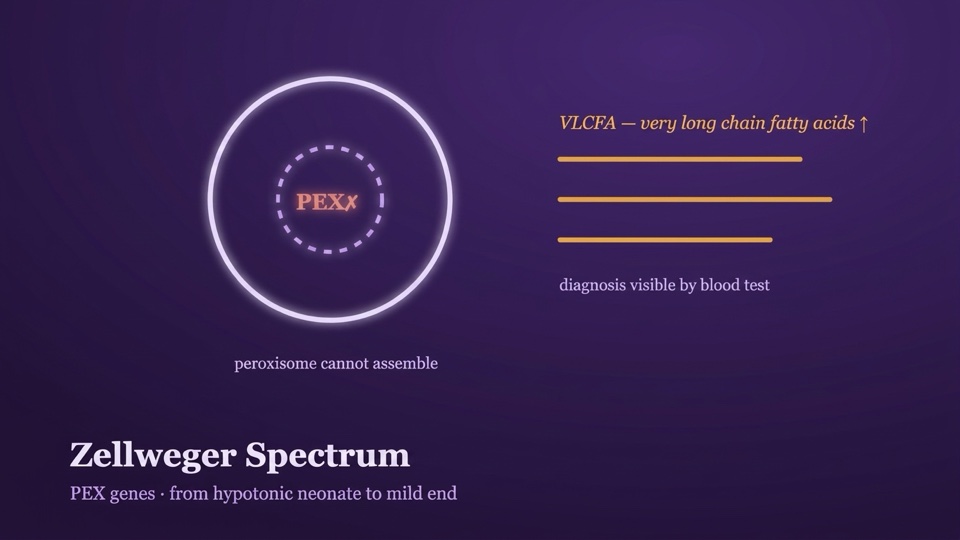
Zellweger spectrum disorders (ZSD) are multisystem diseases caused by failure of peroxisome assembly. They are not a single disease but a spectrum of severity: ranging from a severe presentation in the newborn to a mild form recognised in school age through hearing and vision loss. The key to diagnosis is a simple blood test: VLCFA.
Genetic Cause
Disruption of both copies of one of the peroxisome assembly genes (the PEX family; most commonly PEX1) (autosomal recessive). When the peroxisome does not work: very long chain fatty acids and phytanic acid accumulate, and plasmalogens (a building block of myelin) and mature bile acids cannot be produced — the clinical picture is the sum of these four disturbances.
Clinical Spectrum
Severe (neonatal) end
- Marked hypotonia, poor feeding, early seizures; wide fontanelle-high forehead; enlarged liver, prolonged jaundice, bleeding tendency
- Migration disturbance (polymicrogyria) may be seen on MRI; cataract-retinal involvement
Moderate-mild end (infancy-childhood)
- The triad of hearing loss + retinal degeneration (beginning with night blindness) + developmental delay — often confused with "Usher-like" presentations
- Liver dysfunction, fat malabsorption problems, growth delay; dental enamel defects
- Adrenal insufficiency may develop over time — ACTH/cortisol should be requested during follow-up
- Flares of progressive white matter involvement may be seen in some patients
Diagnosis
- First step: plasma VLCFA (↑) — supportive: plasmalogen (↓), phytanic/pristanic acid, bile acid intermediates
- Definitive diagnosis: PEX gene panel; genetic testing is essential to distinguish single-gene (sometimes single-enzyme) disorders
- VLCFA should be requested through two separate routes — the "hypotonic newborn with liver involvement and seizures" and the "child with developmental delay and hearing-vision loss"
Treatment and Follow-up
- Nutrition: Adequate energy; fat-soluble vitamin A-D-E-K supplementation with level monitoring; monitoring of vitamin K and coagulation
- Liver: Function tests; mature bile acid (cholic acid) treatment may be used in selected cases to reduce liver involvement
- Senses: Early hearing aid/cochlear implant; low-vision rehabilitation and cataract surgery for vision
- Adrenal: Annual screening; hydrocortisone and stress-dose education in case of insufficiency
- Standard seizure treatment; physiotherapy and developmental support; avoiding excessive sources of phytanic acid (large amounts of ruminant animal fat) may be recommended
Prognosis — An Honest Framework
- In the severe form, survival is usually limited to the first year; the goal is comfort and supporting the family
- Children with the moderate form often reach school age to adolescence: some individuals walk and communicate with gestures/words; hearing-vision loss is progressive and the educational plan should be arranged accordingly
- At the mild end, reaching adulthood with partial independence is possible
- Sibling recurrence risk is 25%; prenatal diagnosis options should be discussed with the family
Research Horizon
- Chaperone/read-through strategies targeting the common PEX1 mutation and gene therapy approaches are at the preclinical stage
- Intraocular approaches aimed at slowing retinal degeneration are under investigation
Daily Life
- Hearing and vision loss may progress together: learn tactile/sign communication options early
- During illness, use of an adrenal alert card (if available) and awareness of vitamin K-related bleeding
- Early and frequent dental check-ups against tooth decay
- ZSD family foundations are valuable for sharing experience in managing sensory loss