
Overview
Ataxia-Telangiectasia (A-T) results from loss of the DNA-repair gene ATM, and combines progressive balance impairment, immune weakness, cancer predisposition and radiation sensitivity. Early diagnosis has three concrete benefits: protection from unnecessary radiation, infection-cancer follow-up, and protection of the family (especially the carrier mother).
Genetic Cause
ATM (autosomal recessive) is the alarm bell for DNA breaks; in its absence, cells cannot repair damage. Cerebellar cells are the most sensitive tissue (the cause of the ataxia), and lymphocytes form the second front (immune deficiency + lymphoma risk).
Clinical Course
Early clues (1-3 years)
- Unsteady gait noticed as soon as the child starts walking; often mistaken at first for "ataxic cerebral palsy". The key differentiating point: CP does not progress, A-T progresses
- Oculomotor apraxia: gaze cannot jump to the target, the head jerks forward — a finding that takes seconds to elicit on examination but is highly valuable
Pre-school to school age
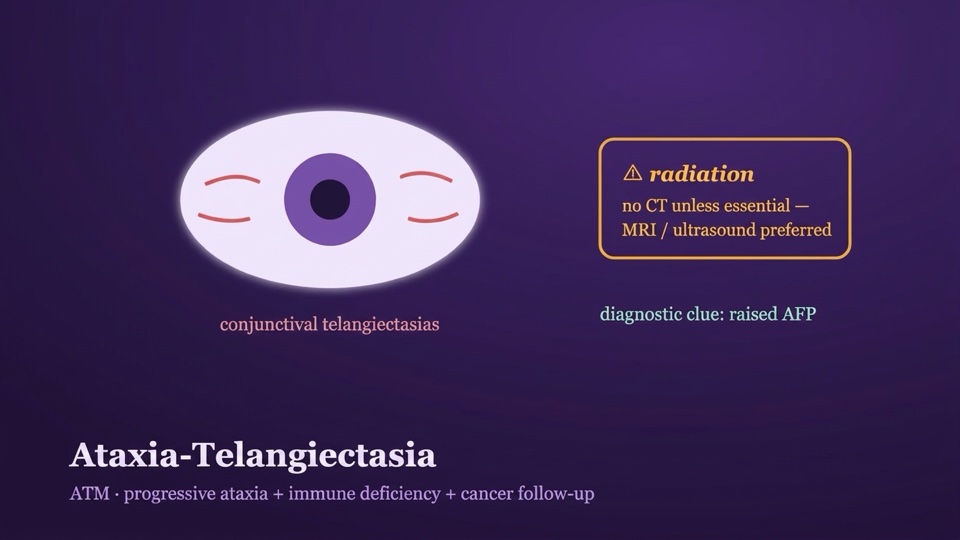
- Telangiectasias (on the sclerae, ear pinnae) typically appear at 4-6 years of age — years after the ataxia; their absence in the early period never excludes the diagnosis
- Deterioration of speech (dysarthria), worsening handwriting, involuntary movements (chorea-dystonia); intelligence is largely preserved
- Frequent sinopulmonary infections; swallowing difficulty and silent aspiration are added over time
Diagnosis
- The most practical clue: elevated alpha-fetoprotein (AFP) (reliable after age 2) — should be requested in every child with progressive ataxia
- Supporting findings: low IgA/IgG subclasses, lymphopenia; definitive diagnosis is made by ATM gene analysis
- At the time of diagnosis a rule is set: "Ask first: is this scan/CT necessary?" — MRI and ultrasound are preferred for imaging; any unavoidable X-rays should use the lowest possible dose
Follow-up and Treatment
The immune-lung front
- Immunological assessment at the outset (immunoglobulins, lymphocyte subsets, vaccine responses); immunoglobulin support for recurrent/severe infections
- Vaccinations are planned in collaboration with immunology; an annual flu vaccine is recommended for the whole family
- Swallowing assessment should be done regularly; when aspiration findings appear, the feeding strategy changes (texture modification, gastrostomy if needed) — swallowing safety is half of lung health
Cancer awareness
- Lymphoma-leukaemia risk is increased: unexplained fever, night sweats, swollen glands, pallor, bone pain → seek early medical attention
- If treatment is needed, protocols are adapted for A-T (marked sensitivity to radiotherapy and certain drugs) — the oncology team must be informed of the diagnosis
Neurological support
- Physiotherapy-balance work, speech therapy, a keyboard instead of handwriting; when the time for a wheelchair comes, it should be presented not as "defeat" but as energy management
- Low-dose steroids have been shown to temporarily ease ataxia; long-term use is limited by adverse effects — used in selected cases, at the physician's discretion
New development — approved drug: levacetylleucine (Aqneursa®)
On 18 September 2026 the US Food and Drug Administration (FDA) approved levacetylleucine (Aqneursa®) for the treatment of ataxia in individuals with A-T — the first drug approved for ataxia in A-T.
- What it is: An oral, modified amino acid (N-acetyl-L-leucine). The same drug has been approved since 2024 for the neurological manifestations of Niemann-Pick type C; its mechanism of action has not yet been fully elucidated.
- Who it is for: Children and adults weighing 15 kg and above, for ataxia due to A-T.
- Evidence: In a double-blind, placebo-controlled, crossover phase 3 study (IB1001-303) of 73 people aged 4-50 years, a significant improvement of about 1.9 points on the SARA ataxia severity scale versus placebo was shown.
- Honest limits: The drug targets the ataxia symptom — it has not been shown to change the disease's immune deficiency, lung, or cancer-risk components; the other columns of the follow-up programme continue unchanged. The approval is based on a single pivotal study; long-term data are still accumulating.
- Access in Türkiye: The approval applies to the US; licensing and access status in Türkiye will become clear over time — you can discuss this with your physician at a follow-up visit. The final decision belongs to the physician assessing the patient.
Family protection
- Breast cancer risk is increased in carrier mothers: screening (weighted towards MRI rather than mammography, starting at an early age) should be personalised; carrier testing is recommended for female relatives
Prognosis — An Honest Framework
- The neurological picture progresses slowly: most children move to a wheelchair around puberty; the mind remains clear — educational goals should not be lowered
- The main life-limiting factors are lung disease and cancer; with modern support, the number of individuals reaching adulthood is increasing
- In "mild/variant A-T" forms (residual ATM activity), the course is noticeably slower — the genetic report should also be read with this in mind
Research Horizon
- Trials of personalised ASOs for specific splice mutations are among the pioneering examples of the emerging era of "single-patient drugs" in rare diseases
- Neuroprotection and antioxidant strategies, along with drug trials targeting ataxia, are ongoing
Daily Life
- On the cover of the file: "A-T — radiation sensitivity; consult the physician before CT/X-ray"
- Arrangements at school that reduce the writing burden (keyboard, oral exams), rest breaks for fatigue
- Adherence to texture recommendations for feeding; early assessment for meals accompanied by coughing
- A-T family associations are connected to global networks for physiotherapy and equipment experience
Downloadable Documents: Emergency Response Plan + Routine Follow-up Calendar (PDF)
Two documents have been prepared for children with A-T by Nörogender, under the guidance of Prof. Dr. Burak Tatlı. The Emergency Response Plan (3 pages) carries four critical warnings: radiation sensitivity (a card stating "CT/X-ray only if unavoidable — consult the physician first"), the irradiated blood product rule, a note on immune deficiency and live vaccines, and a low-threshold full blood count+smear (malignancy awareness); with a note that AFP is already elevated in this disease. The Routine Follow-up Calendar (2 pages) is a record chart with an age-by-age table covering the four axes of immunology-lung-swallowing-malignancy, diabetes screening in adolescence, and counselling on breast screening for the carrier mother. For the current state of treatment candidates, see: Genetic Treatments — A-T treatment pipeline.
📄 Emergency Response Plan (PDF, 3 pages) — in Turkish 📅 Routine Follow-up Calendar (PDF, 2 pages) — in Turkish
Fill in the documents together with your physician; keep a copy at home and at school.